



Nursing student beats cerebral palsy, earns top Taiwan honor
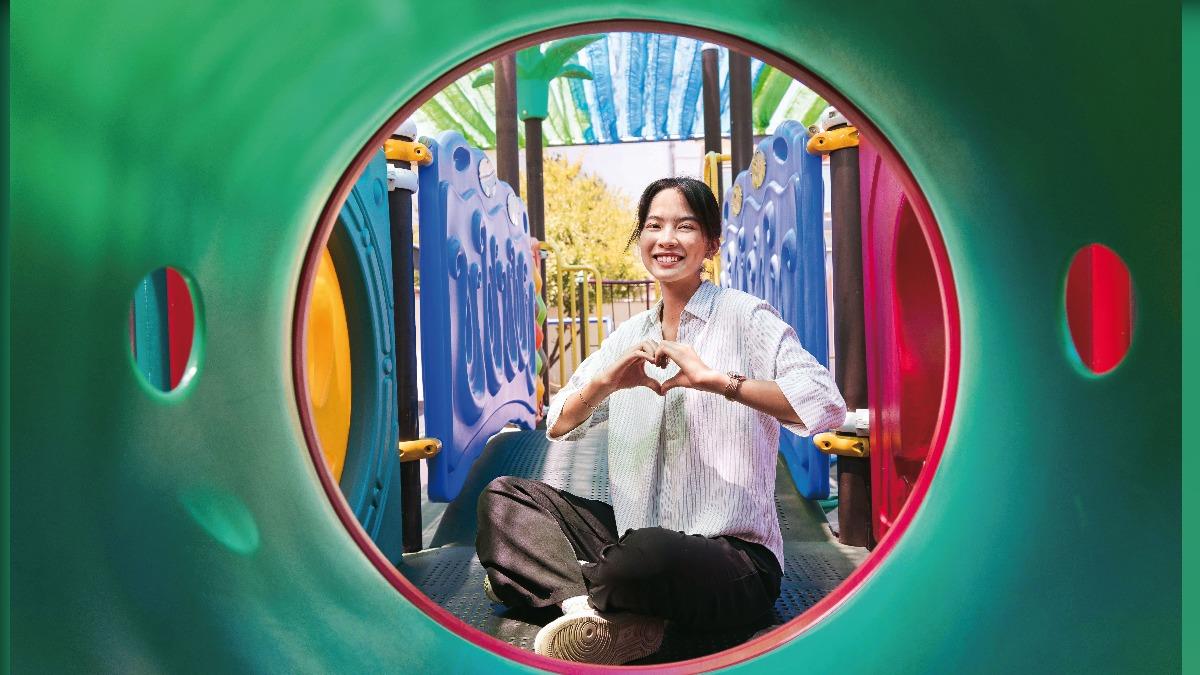
When you meet this 22-year-old from western Taiwan, who seems like any other young woman her age, it's hard to imagine that she was diagnosed with cerebral palsy at birth. Surrounded by her family's unconditional love, she spent seven years in physical therapy. Now, having overcome her condition, she wants to be a light for others.
TAIPEI (Business Today/TVBS News) — In mid-August, after days of summer rain, Miaoli (苗栗) at last welcomed clear blue skies. Taking advantage of the fine weather, 40 seniors, all in their 60s and 70s, filed into an elderly recreational center in the small town of Yuanli (苑裡), prepared to listen to a special health education lecture.
The young woman on stage had her hair pinned up and wore a formal white shirt, though her face still retained its youthful innocence. Under the watchful eyes of 40 seniors, she confidently addressed them in both Mandarin and Taiwanese, showing no sign of nervousness during her nearly two-hour presentation. With practiced ease, she demonstrated to the elderly audience how to properly use wheelchairs and measure blood pressure, displaying remarkable warmth and approachability.
This lecture was organized by the Yuanli Township Office (苑裡鎮), inviting young people to return and give back to their hometown. At just 22 years old, Lai Hsin-yi (賴欣儀) is Taiwan's national representative in the "Health and Social Care" (健康照護) vocational skill category. She has won a silver medal at the Asia Skills Competition (亞洲技能競賽) and a gold medal at WorldSkills Australia (澳洲世界技能大賽). This July, she received the Presidential Education Award (總統教育獎) from President Lai Ching-te (賴清德), making her truly the "Pride of Yuanli."
In the audience, one particularly conspicuous listener kept snapping photos with his phone. "I'm not sneaking pictures — she asked me to photograph her!" said Lai Lai-Deng (賴來燈), her father who had come especially to support his daughter. Despite his momentary protest, he couldn't hide the smile playing at the corners of his mouth.
No one understands better than Lai's father how challenging the journey from Yuanli township to the world stage has been for his daughter. It's even harder for others to imagine that this poised and dexterous young woman before them once suffered from cerebral palsy as a child and held a disability certificate. Twenty-two years ago, when Lai was born, she weighed only 1,600 grams. Besides her low birth weight, there were no other physical abnormalities. But three months later, an illness suddenly appeared at their doorstep.
Early Intervention Overcomes Cerebral Palsy, Becomes College Basketball Player
Lai Lai-Deng (賴來燈) recalled taking his daughter to a health center for vaccinations and routine checkups. An attentive nurse gave little Hsin-Yi toys for a grip test and noticed that "her right hand could hold normally, but her left hand would grip and then release." The perceptive nurse immediately sensed something was wrong and suggested the parents take her to a major hospital for examination, where she was eventually diagnosed with moderate cerebral palsy.
Since cerebral palsy is a motor function disorder that occurs before an infant's brain fully develops, without early detection and treatment, it can lead to lifelong physical disability. Therefore, when his daughter was diagnosed at three months, Lai Lai-Deng didn't view it as a stroke of bad luck, but instead took a positive outlook: "We're lucky it was detected, how fortunate!" Doctors told the couple that with proper rehabilitation, there was a chance to mitigate the symptoms of cerebral palsy. This knowledge allowed the Lai family to maintain an optimistic attitude as they faced this medical challenge.
However, the Lai family was not well-off. Lai Lai-deng worked at a paper factory, and Lai Hsin-yi's mother, who came from Vietnam, also needed to work to supplement the family income, making it difficult for her to provide full-time care. As their daughter grew day by day, it was like racing against time.
To seize the golden period for treatment, Lai Lai-Deng gritted his teeth, often sacrificing rest time, requesting leave, and adjusting shifts to free up three days a week. He personally took his daughter back and forth between Yuanli and Dajia (大甲), Taichung, embarking on a long journey of physical therapy.
Due to the effects of cerebral palsy, Lai developed more slowly than other children during her early years. While most infants start crawling at seven or eight months, she didn't learn until after her first birthday. Because of poor balance when walking, she often fell and cried loudly. Until age four, she still needed to practice on balance beams and treadmills to train her body coordination.
After being diagnosed at three months old, Lai spent a full seven years traveling between home and clinics for repeated therapy. From her earliest memories, "I spent almost all my time on treadmills and balance beams," Lai recalled.
Although early intervention can significantly improve cerebral palsy symptoms, cases like Lai's, where recovery is so complete that others cannot tell, and she could even join the basketball team during school years, are extremely rare in doctors' eyes.
In fact, the energetic Lai Hsin-yi once didn't believe she had ever suffered from moderate cerebral palsy, thinking her father was "making up stories." Only when her family showed her the disability certificate did she slowly recall those gradually forgotten experiences.
Through seven years of illness, her parents' companionship and support were her strongest backing. Looking back, if on that day at the health center they had happened to miss that attentive nurse, Lai Hsin-yi's life afterward might have been completely different.
"What would I be like now without her?" In eighth grade, while contemplating her future plans, Lai Hsin-yi suddenly remembered that unnamed benefactor. Grateful for the help she received, she wanted to help others too, so she resolved to make nursing her future career, brightening the lives of more people.
Understanding their daughter's motivation, Lai Hsin-yi's family always gave unconditional support. Though the Lai family was a traditional rural household in Miaoli, and the couple worked busy shifts day and night with no time to oversee their daughter's studies, they still scraped together money for tutoring, allowing Lai Hsin-yi to learn English, which she loved, and providing a free educational environment. When she chose to pursue nursing, there was no family revolution, only her parents' reluctance to see their daughter leave home for studies elsewhere
Dedicating Herself to Skills Competitions, Aspiring to Be a Nurse Caring for Patients
During her studies at Mackay Junior College of Nursing (馬偕護專), Lai Hsin-yi had a smooth journey. If she had followed the established path, she could have easily become a professional nurse after graduation; however, her ambitions extended far beyond that.
In her fourth year at nursing college, she discovered the "vocational skills competition" stage, particularly the nursing-related "Health and Social Care category" (健康照護職類), which tested the ability to communicate with patients entirely in English. With her longtime interest in English, her eyes instantly lit up. "I thought it was a free opportunity to practice English, so I chose to train," Lai Hsin-yi joked.
Dedicating herself to skills competitions required more time and energy, as well as family resources. "At that time, mom just encouraged me to go ahead and try, saying, 'Mom will work hard.'" When speaking of her parents' silent support as her strongest backing, Lai Hsin-yi unconsciously beamed with smiles.
The "Health and Social Care category" in vocational competitions emphasizes nurses' interaction with patients and on-the-spot responses. Lai Hsin-yi explained that the competition process resembles nursing work procedures: starting with self-introduction to patients, verifying names, changing medications, understanding conditions, etc. Judges observe whether standard operating procedures are followed and note any deficiencies for scoring.
The difference is that clinical nurses typically don't spend as much time with a single patient. In the 45-minute competition, besides communicating entirely in English, empathy for patients is key. Lai Hsin-yi has been good at English since childhood and, having been a cerebral palsy patient receiving long-term treatment, could better empathize with patients' interaction methods, becoming her competitive advantage. Her unique personal experience and English proficiency helped her successfully qualify as a national representative in 2023. Next, she faced the more challenging test of international competitions.
Su Mei-Chen (蘇美禎), associate professor and deputy director of the nursing department at Taipei University of Nursing and Health Sciences (台北護理健康大學), frankly stated that during national team training, many competitors burn the candle at both ends and tend to neglect their regular schoolwork. However, after qualifying for the national team, Lai Hsin-yi never neglected her studies despite undergoing over 2,000 hours of training over two years. "She always courageously shares on stage, with stable presence and appropriate responses, making a deep impression," Su said.
Communicating with patients is the most important ability in nursing work. Lai Hsin-yi gave examples: in skills competitions, besides watching for abnormal signs in patients, competitors must simulate how to comfort and explain situations when patients refuse treatment. For her, the most difficult part is on-the-spot adaptation, as competitions include designed emergencies where nurses must thoroughly assess problems, requiring comprehensive internal and external medicine nursing skills.
After becoming a national representative, Lai Hsin-yi practiced more than 10 hours daily on average. Her hard work paid off as she won medals at both the 2023 Asia Skills Competition and the 2024 WorldSkills Australia competition. Just when her nursing journey seemed to be sailing smoothly, setbacks immediately confronted her.
Learning from International Competition Failure, Turning Weaknesses into Growth
Last September, she competed in the WorldSkills Competition (國際技能競賽) held in Lyon, France, the world's largest competition known as the Olympics of vocational skills. Before departure, she was confident and expected by others to win a medal, but she returned empty-handed from this highest stage.
"Many things I should have noticed, but didn't..." Lai Hsin-yi recalled with frustration. At that time, she couldn't adjust her nervous emotions. In one segment, she should have removed a carpet for the patient to prevent falls, but lost points because she ran out of time, ultimately missing out on a medal.
When the competition ended, she, who had always been optimistic and cheerful, discovered how much she cared, crying all the way back to Taiwan. "Everyone worked hard for a whole year, and we achieved nothing..." Even one or two months after the competition ended, she couldn't move past it, filled with frustration and unwillingness. "What did this experience bring me?" Lai Hsin-yi repeatedly pondered this question during those months.
At the end of last year, while applying for the Presidential Education Award, she began self-reflection, remembering what her teachers had told her: "Grades cannot represent all your efforts; what you gain in the process is truly useful." So, she stopped fixating on "the carpet that wasn't properly put away" and began a more holistic reflection: "What did I learn? What are my shortcomings?" She discovered a bad habit of talking in circles without getting to the point, which made her determined not to forget her inadequacies on the competition field but to bring them back and correct them.
Despite stumbling in international competition, the undefeatable Lai Hsin-yi hasn't stopped moving forward. In the coming year, she plans to complete her university studies, work for two years to save money, study abroad for a master's degree, and return to nursing work to care for more patients. Listening to his daughter discuss studying abroad plans, Lai Lai-Deng pretended to be stern, saying, "Plan it yourself, just don't use my money." Lai Hsin-yi immediately responded playfully, "Dad, save a bit more for retirement and let me use it to study abroad." The father and daughter bantered, laughing together.
The pain she endured as a child and the tears she shed at international competitions as an adult have all become nourishment for Lai Hsin-yi's dreams. No matter how big the world stage becomes, she knows that her small but warm home in Yuanli township will always keep its doors open for her. During her university studies, Lai Hsin-yi, like many classmates, focused on advancing her nursing profession. The difference is that her personal experience with illness allows her to empathize more with patients.
Returning to Yuanli township in Miaoli County, Lai Hsin-yi used her nursing expertise to introduce assistive device usage to seniors, giving back to her hometown. Starting from Yuanli township, Lai Hsin-yi walked through a childhood of stumbling steps due to cerebral palsy, moved north for education, and finally stepped onto the world stage. Her family has always been her greatest pillar of support.
>>> Profile: Lai Hsin-yi
Born: 2003
Education:
Taipei University of Nursing and Health Sciences (currently enrolled)
Mackay Junior College of Nursing
Achievements:
2025 Presidential Education Award
2024 WorldSkills Australia Gold Medal
2023 Asia Skills Competition Silver Medal
>>> For More Reading:
This article is excerpted from the No. 1500 issue of Business Today (今周刊). Click here for the Chinese-language version of this story: 從罹患腦麻早療康復 到參與國際賽事奪牌 賴欣儀改寫身障命運 把人生走成希望的見證
>>> More Coverage:
01 | 黃仁勳親簽《今周刊》!輝達56家台灣戰隊供應鏈「與兆元宴名單吻合」…他感謝:沒有台灣,就沒有今天