



Cheng returns from Xi meeting to divided Taiwan reception
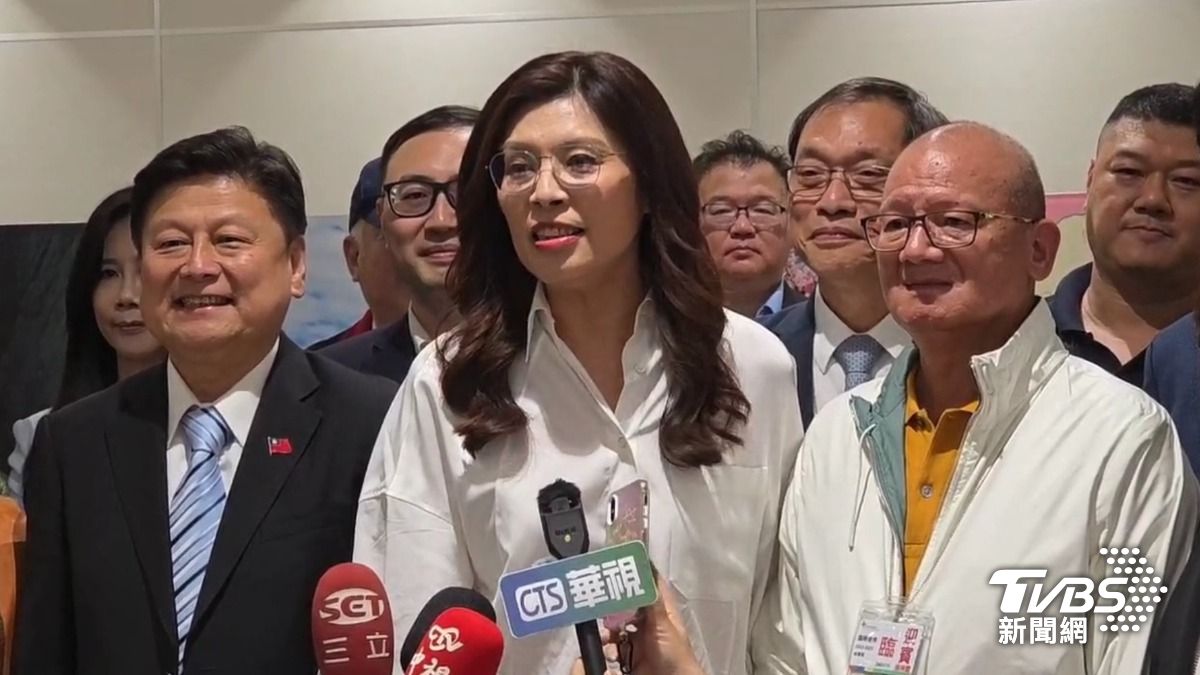
TAIPEI (TVBS News) — KMT Chairwoman Cheng Li-wun (鄭麗文) landed in Taiwan on Sunday (April 12) to a widening divide between ruling and opposition parties over Beijing's 10 new cross-strait measures. Implementation requires cooperation, but the two sides offered starkly different interpretations: The KMT called them "gifts"; the ruling Democratic Progressive Party (DPP, 民進黨) dismissed them as "united front tools" while Cheng was still in the air.
"We have taken a successful first step, but there are still 99 more steps to go," Cheng told reporters at the airport, announcing that she had instructed KMT Vice Chairman Chang Jung-kung (張榮恭) to form a working group to coordinate implementation with Beijing.
Cheng's delegation arrived at Taoyuan International Airport on Air China flight CA189 at 5:05 p.m. The arrival concluded her "Peace Visit" (和平之旅), which culminated Friday in a meeting with CCP General Secretary Xi Jinping (習近平) — the highest-level KMT-CCP contact since then-President Ma Ying-jeou (馬英九) met Xi in Singapore in 2015.
The Taiwan Affairs Office (TAO, 國務院臺灣事務辦公室) under the State Council of the People's Republic of China (PRC) announced the measures at 10 a.m. Sunday. They include promoting resumption of individual tourism from Shanghai and Fujian Province, normalizing cross-strait direct flights, and advancing infrastructure connections between Fujian and Taiwan's outlying islands of Kinmen (金門) and Matsu (馬祖). Other proposals would allow Taiwan television content on mainland platforms and facilitate agricultural imports.
Chang, who has long managed the party's mainland relations, described the measures as a "gift" from Beijing delivered through Cheng. The measures "demonstrate goodwill and sincerity," Chang said, calling the announcement "an immediate and constructive implementation" of the framework established at the Cheng-Xi meeting (鄭習會).
Cheng echoed that framing, telling supporters that Taiwan's youth, farmers, fishermen, and tourism operators would "directly benefit" from the policies. "Our greatest wish is to improve people's lives and let everyone boldly pursue and realize their dreams," she said.
The Presidential Office rejected the KMT's framing. Spokesperson Karen Kuo (郭雅慧) said cross-strait exchanges "should not become bargaining chips for a specific party's political maneuvering or transactions." If Beijing genuinely intends to advance these measures, it "should negotiate with our government's competent authorities through existing communication channels," she said.
Kuo warned that Beijing has long "weaponized" cross-strait exchanges, with policies that "open and close unpredictably" and have caused "incalculable harm" to Taiwan's industries and farmers over the years. She questioned whether Beijing would again use cross-strait affairs as a tool of "economic coercion."
The DPP government had already signaled its opposition. Shen Yu-chung (沈有忠), deputy minister of the Mainland Affairs Council (MAC, 陸委會), Taiwan's cabinet-level agency handling cross-strait affairs, said Saturday the policies "are united front tools that the CCP can deploy or retract at any time."
Executive Yuan (行政院) spokesperson Michelle Lee (李慧芝) said Friday that Beijing was attempting to put Taiwan within a "one China framework" to achieve "the substantive goal of annexing Taiwan." The 23 million people of Taiwan "firmly oppose" any effort to "eliminate the Republic of China," she stated.
DPP caucus chief executive Chuang Jui-hsiung (莊瑞雄) said Sunday the measures are "not simple civilian exchanges." Taiwan's farmers and fishermen "need a stable, predictable market environment, not policy switches that open today and close tomorrow," he warned. Chuang also noted that military activities around the Taiwan Strait "have not decreased" — an approach of "releasing economic incentives on one hand while maintaining military pressure on the other" that he said does not reduce regional tensions.
Several measures require Taiwan government's cooperation to take effect. Scholars told local media that proposals such as normalizing direct flights and resuming individual tourism "clearly require prior consultation with Taiwan, or may become empty talk."
Hung Yao-nan (洪耀南), deputy director of the Tamkang University Center for China Studies (淡江大學中國大陸研究中心), characterized the measures as "soft integration" and "political bypass." He told the Central News Agency (CNA) they represent Beijing's strategy "to bypass sovereignty dialogue and reshape governance structures."
The American Institute in Taiwan (AIT, 美國在台協會), which represents U.S. interests in Taiwan, weighed in Friday. AIT said "meaningful cross-strait exchanges should focus on Beijing leadership and Taiwan's elected government" engaging in dialogue "without preconditions" and "with participation from all parties in Taiwan."
Cheng told reporters after her closed-door meeting with Xi that she reiterated the "1992 Consensus" — a 1992 understanding that both sides of the Taiwan Strait belong to "one China," though interpretations differ sharply. The DPP maintains the consensus equals "one country, two systems," which it rejects. Cheng said Xi told her that unless one's "heart is dark" or one is "deliberately playing dumb," one should know the true content — though no transcript was available to verify the exchange.
The pattern suggests what comes next. When Beijing announced similar measures after former KMT Chairman Lien Chan's (連戰) 2005 visit — tourism, tariff exemptions, giant pandas — implementation took years and required Taiwan's ruling party to change. The DPP held the presidency then and lost it in 2008. The current measures may face the same timeline: announced in 2026, perhaps realized only if Taiwan's voters bridge the divide between the island's parties. ◼