



Taiwan warns of power grid disruptions from solar storm
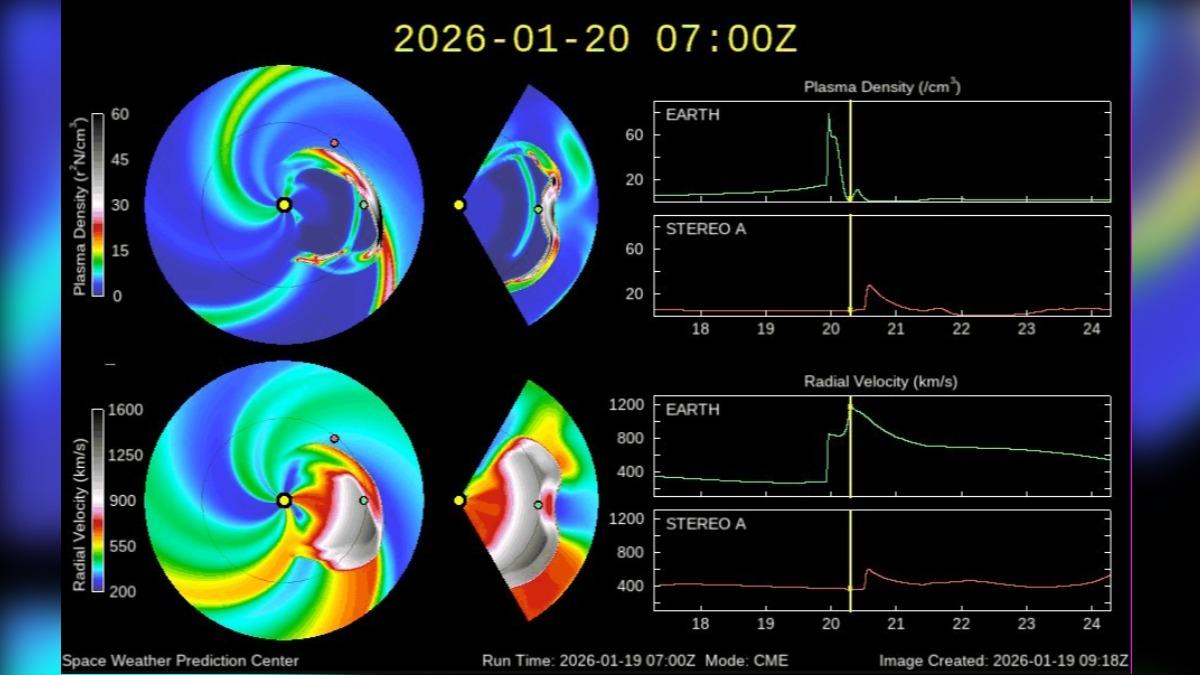
TAIPEI (TVBS News) — Taiwan's Central Weather Administration Space Weather Operational Office (中央氣象署太空天氣作業辦公室) issued a severe (G5) geomagnetic storm warning on Tuesday (Jan. 20) at 9 a.m., predicting potential impacts lasting up to 36 hours. The warning, the highest level on the geomagnetic storm scale, follows a significant increase in Earth's magnetic field disturbance index. Authorities urge vigilance and preparedness for potential disruptions to power grids, communications, and satellite systems.
Active Region 4341 (AR4341) on the sun's surface unleashed an X1.9-class long-duration solar flare on Monday (Jan. 19), accompanied by a coronal mass ejection (CME), an ejection of plasma mass from the sun. The event passed through near-Earth space at 2 a.m. on Tuesday (Jan. 20), leading to a marked increase in solar wind speed and density in interplanetary space. The U.S. National Oceanic and Atmospheric Administration (NOAA) analyzed data and forecast the disturbances may briefly reach severe geomagnetic storm level (Kp=9, G5).
The NOAA analyzed data from the WSA-Enlil model, a solar wind prediction system, and forecast a significant increase in geomagnetic disturbances, according to Taiwan's weather office. The disturbances may briefly reach the severe geomagnetic storm level (Kp=9, G5), the highest classification on the geomagnetic storm scale. Auroral activities could also be visible in mid-latitude regions at a geomagnetic latitude of 40 degrees during this period.
Taiwan's weather office anticipates several potential disruptions during this period, including abnormal increases in line currents and unusable high-frequency radio communications that could affect critical infrastructure. The office also warned of increased satellite positioning errors and anomalies in low-frequency radio communications affecting navigation and telecommunications. Surface charge accumulation may cause anomalies in spacecraft operations, affecting attitude control, data transmission, and positioning systems.
The forecast warned of large-scale issues with voltage control and protection systems, potentially leading to partial power grid outages or brief blackouts. Transformers face a risk of damage from the geomagnetic disturbances, according to the weather office. Authorities urge vigilance and preparedness for potential impacts as these conditions unfold over the next 36 hours. ◼