



Taiwanese team doubles proton conductivity in breakthrough
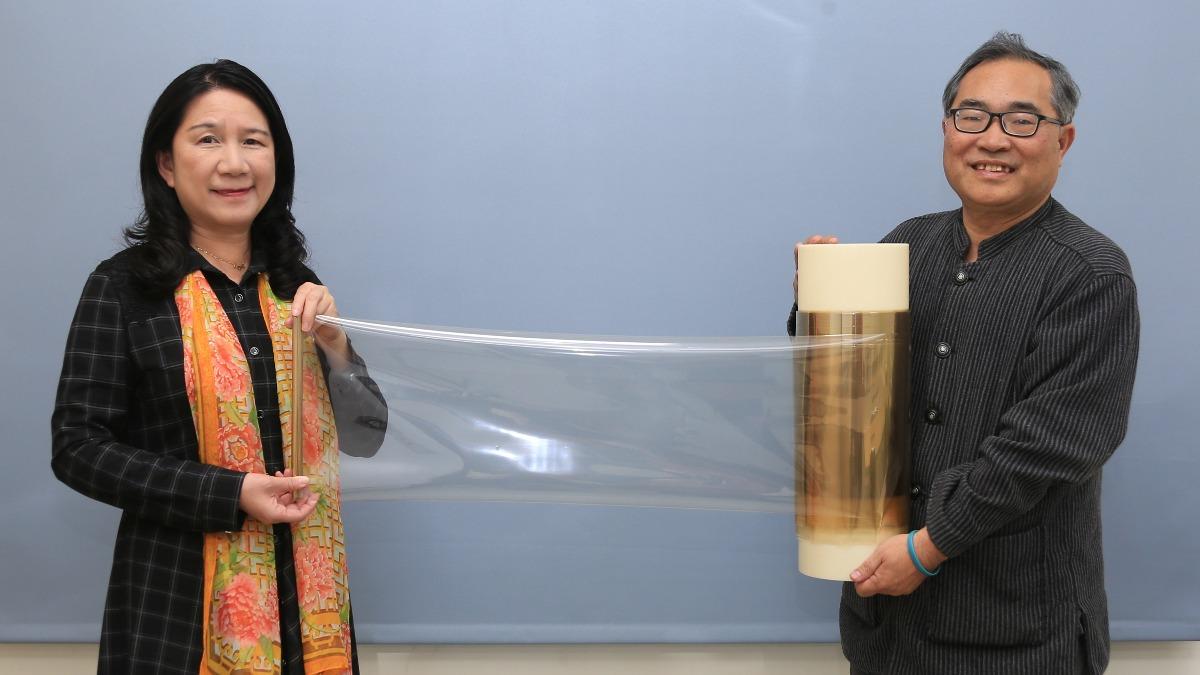
TAIPEI (TVBS News) — A team from National Sun Yat-sen University (國立中山大學) led by Huang Wen-yao (黃文堯) and Chang Mei-shui (張美濙) announced a breakthrough in proton exchange membrane technology on Monday (Feb. 2). Their innovation promises to more than double proton conductivity, paving the way for advancements in the hydrogen energy industry and net-zero transition. According to a press release, this significant improvement enhances battery energy conversion efficiency and output power, marking a substantial leap forward in membrane technology.
The team developed two new proton exchange membranes, SYS7–H and SYS7-L, which show a 102% and 88% increase in proton conductivity over Nafion 211 made by American chemical giant DuPont, respectively. These new membranes excel in thermal stability, mechanical toughness, dimensional stability, and moisture absorption behavior compared to traditional materials. They offer a cost-effective production process without generating toxic substances, making them an environmentally friendly option for widespread application.
Huang emphasized the broad application potential of proton exchange membranes, noting their necessity in almost all chemical battery modules. He said that the superior conductivity and stability of these membranes can drive the development of hydrogen-powered vehicles and buses, highlighting their transformative potential in the transportation sector. The Taiwanese government has actively pursued hydrogen energy policies, establishing hydrogen refueling stations in Kaohsiung's Nanzih District (楠梓) and Tainan's Valley Tree Park (樹谷) by the end of last year.
In the semiconductor industry, proton exchange membrane technology can effectively recover and purify residual hydrogen from exhaust gases. This purified hydrogen can be reused in fuel or battery systems, achieving multiple benefits, including power generation, heating, and carbon reduction. The new membranes also hold promise for vanadium redox flow batteries, which are widely paired with solar systems in Northern Europe. Taiwan could potentially combine this technology with wind and renewable energy sources in the future to develop stable, large-scale energy storage systems.
The industry has shown considerable interest in these two new proton exchange membranes. The research team has already initiated academic-industry collaboration with Shin Yuan Technology (欣緣科技) and is pursuing patent layouts. They aim to achieve large-scale commercial production by next year, signaling a promising future for Taiwan's role in the global energy landscape.