



How Taiwan’s DDK Group weathered the pandemic boom, crash
Twenty-five years ago, this bicycle saddle manufacturer shifted its production center to Vietnam, only to face a series of challenges: anti-dumping measures, riots and a pandemic. Fortunately, the chairman acted decisively to clear inventory, and after three years of adjustments, operations are steadily returning to normal.
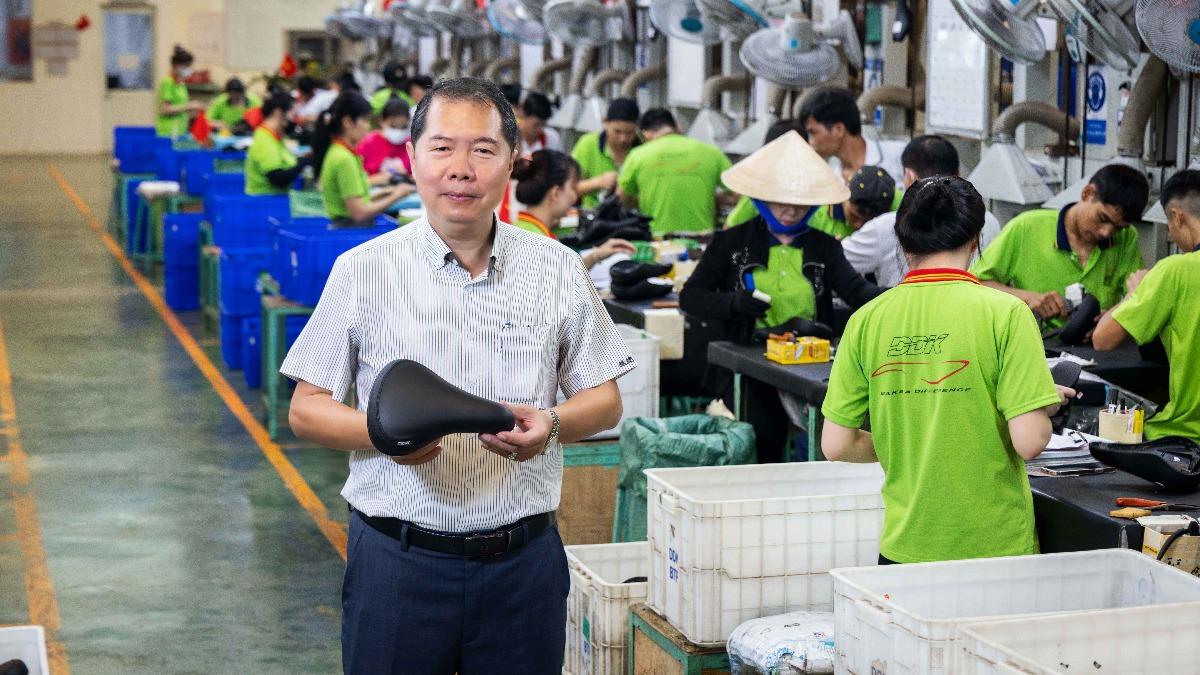
TAIPEI (Business Today/TVBS News) — Inside DDK Group's (鋒明興業) factory in Vietnam's Dai Dang Industrial Park (大登工業區), well-trained workers focus intently on their tasks. A single bicycle saddle undergoes a meticulous six-day process — from cutting and printing to foaming and leather weaving — passing through 17 different "checkpoints" before emerging as a finished product.
"Each saddle is hand-colored by masters who repeatedly blend the colors evenly. The leather weaving is entirely done by hand, and it takes a technician half a year to truly master the skill," said DDK Chairman Wen-jui Tsai (蔡文瑞) as he guided the Business Today (今周刊) reporting team through the sprawling 200,000-ping factory complex. "We develop and create samples every day without interruption," he added, his voice filled with pride.
DDK Group sells its bicycle saddles under its own brand, DDK, to 80 countries or regions worldwide. The company not only dominates the ASEAN market but has also secured a position among the world's top five bicycle saddle manufacturers. At its peak, DDK captured 10 percent of the global market with an annual production exceeding 14 million units and accumulated more than 30,000 product items, covering electric bikes, high-end bicycles and stunt bikes.
DDK Group, established 55 years ago, originally built its foundation in Taiwan before expanding southward to Vietnam in 2000. Unexpectedly, challenges began to emerge one after another.
The first challenge came in 2005, when the European Union (歐盟) imposed anti-dumping duties on Vietnamese bicycles. Orders for millions of bicycles from Vietnam to Europe instantly vanished, affecting DDK Group as part of the supply chain. Fortunately, Tsai carved out a lifeline by securing the Asian agency rights for Europe's second-largest saddle manufacturer, opening new business opportunities.
Then in 2014, the May 13 Anti-Chinese Riots (五一三排華暴動) devastated Taiwanese businesses, with DDK's factory reduced to ashes overnight and production completely halted. Despite this, shipments couldn't stop. Tsai decisively rented alternative factory space, quickly transferred production lines and managed to keep operations running even during the most chaotic period.
Pandemic Order Boom Turns to Bust, Revenue Drops to 30%
The biggest challenge was yet to come. "We survived anti-dumping measures, endured riots, and then faced the COVID-19 pandemic," Tsai said, the pressure and frustration from that period still visible on his face."Actually, when the pandemic first broke out, business was unprecedentedly good!" Tsai recalled.
As the global pandemic intensified in 2020, people concerned about infection risks in crowds increasingly chose bicycles for transportation, causing sales to explode. Importers and agents pressured the factory for shipments daily. At that time, "whoever had inventory made money," and bicycles were in such frantic demand that the Dai Dang factory's order backlog exceeded 500 days.
To handle the surge in orders, Tsai accelerated hiring and expanded equipment. "We were pushed to the limit every day," he said. The Dai Dang factory's annual production was about 7 million saddles, accounting for nearly 90 percent of DDK Group's global capacity. After the pandemic outbreak, capacity doubled, making it the world's largest single production facility at the time.
As customer orders became increasingly frantic, Tsai began to sense something was wrong. He realized that while 2021 production capacity was already at full load, orders for 2022 continued to rise to 16 million units. His instinct told him, "When the market starts to lose control, a collapse will follow."
He made an immediate decision, ordering the sales team to "stop accepting orders from new clients and cancel existing ones when possible," while controlling quantities for existing customers based on historical order proportions. Once the order was given, sales staff faced immense pressure, with some being berated by customers to the point of tears. But Tsai insisted, "If we don't hit the brakes, we'll face an even uglier death later."
The market reversed faster than expected, suddenly freezing in June that year. Despite calling for a halt, the factory was still overwhelmed with inventory. Tsai even built additional walkways between factory buildings to store goods. Corridors on both sides of production lines were also filled with products, with inventory peaking at over 1 million units.
With orders frozen and inventory piling up, the most obvious impact was a sharp drop in revenue. When orders froze in the second half of 2022, revenue plummeted to just one-third the following year. "Many businesses struggled during the pandemic, but he grew stronger with each setback and quickly found a way to survive," said Chen Ying-Ming (陳英明), chairman of the Pingyang Taiwanese Business Association (平陽台商會), of Tsai.
For the next three years, DDK Group faced a difficult "inventory clearance battle." Tsai launched a three-pronged approach, actively negotiating with customers and striving to clear the mountain of accumulated stock. First, "sell cheaply what can be sold cheaply!" As long as it didn't violate trademark rights, he suggested customers quickly clear inventory at low prices. Second, for items that couldn't be discounted, he sought domestic sales in Vietnam. Finally, "if there's no other way, we have to destroy them."
Recovery in Sight, Firm Diversifies
Thanks to this three-pronged strategy, DDK Group's inventory for the first 11 months of this year has decreased by more than 50 percent compared to the end of 2022. With strict control of new orders, the inventory turnover rate improved from a congested three-month peak to two months, outperforming the industry average of three months. Operations are gradually returning to normal.
More encouragingly, revenue has begun to rebound. Revenue for 2025 is expected to reach about US$15 million (about NT$470 million), approaching pre-pandemic levels, with next year's revenue projected at US$18.27 million (about NT$570 million). At this point, Tsai relaxed his tense mood and said with relief, "We now see light at the end of the tunnel. Next year we'll return to normal pre-pandemic volumes of about 6-7 million units."
However, the broader environment remains challenging. A bicycle industry executive cautioned that while European market inventory is gradually being absorbed, uncertainty remains high in DDK Group's other key market, the United States, requiring continued vigilance.
Tsai increasingly appreciates not putting all his eggs in one basket. This year, he diversified risk through reinvestment, with visible results from expanding into real estate development in Vietnam. His main development project, the Taiwan Industrial Development Park (台灣產業發展園區), has attracted dozens of Taiwanese businesses, including listed companies like AMPACS Corporation (安普新) and Yung Shin Pharma (永信製藥). The project is estimated to generate several million dollars in annual rental income, marking a successful first step in diversification. ◼ (At time of reporting, US$1 equals approximately NT$31.59)
>>> For More Reading:
This article is excerpted from the No. 1513 issue of Business Today (今周刊). Click here for the Chinese-language version of this story: 直擊鋒明越南廠疫後自救!庫存清成、營收返常軌...自行車坐墊東協霸主,3招斷尾重生術
>>> More Coverage:
01 | 2025外銷訂單衝破7400億美元、年增26%!AI催生出連11月正成長,今年表現呢?經部給答案