


AI Chip Testing Demand Transforms KYEC
For most of its 38-year history, King Yuan Electronics Co. (KYEC, 2449.TW) operated in the background of the semiconductor industry by testing chips after fabrication, a necessary but unglamorous step. The AI era has changed that calculus entirely. As the world's largest pure-play testing company, KYEC now validates the most advanced accelerators ever built, and surging demand has transformed its testing floors from routine checkpoints into one of the AI supply chain's defining bottlenecks.
KYEC posted record first-quarter 2026 revenue of NT$10.19 billion (approx. US$315 million), surpassing the NT$10 billion mark for the first time and setting a new quarterly high. The result was up 2.26% quarter on quarter and 39.3% year on year.
March revenue reached nearly NT$3.6 billion (US$113 million), up 11.57% from February and 36.06% from March 2025, setting a new single-month record. January revenue had reached NT$3.37 billion (US$106 million), up 41.3% year on year, and February followed with NT$3.22 billion (US$101 million), up 41.0%. The consistent pace of growth through the seasonally weaker first quarter reflects the sustained pull from Nvidia AI chip builds and a broadening customer base across custom ASIC programs.
Full-year 2025 revenue reached approximately US$1.1 billion, propelled mainly by AI and high-performance computing orders, with monthly figures accelerating sharply in the second half as advanced chip volumes ramped. The company is optimistic that growth momentum will continue throughout 2026.
KYEC ranks third among Taiwan-headquartered OSAT firms by revenue and second globally among pure-play testers. As AI chips push power consumption from roughly 3 kilowatts to as high as 8 kilowatts, testing cycles are lengthening and becoming more demanding, effectively turning testing capacity into its own bottleneck.
KYEC has raised its full-year 2026 capital expenditure plan from the initially approved NT$39.4 billion (US$1.25 billion) to NT$50 billion (US$1.57 billion), an increase of more than 26%. This is the largest investment program in the company's history, targeting cutting-edge testers for CoWoS packages, custom ASICs, and next-generation memory. The step-change in investment signals management's conviction that AI testing demand is structural rather than cyclical.
KYEC is executing a dual-axis expansion strategy across Taiwan and Singapore. In Taiwan, Zhunan, Toufen, and Tongluo in Miaoli County serve as key operational hubs for advanced testing. Internationally, KYEC is building its first overseas manufacturing base in Singapore, establishing testing capacity outside Taiwan for the first time in response to customer pressure for supply chain diversification.
Founded in 1987 in Hsinchu Science Park, KYEC has spent 38 years refining a focused set of testing capabilities. Unlike many peers that expanded into packaging, KYEC chose to remain a pure-play testing specialist. That discipline now pays dividends as AI chip complexity explodes.
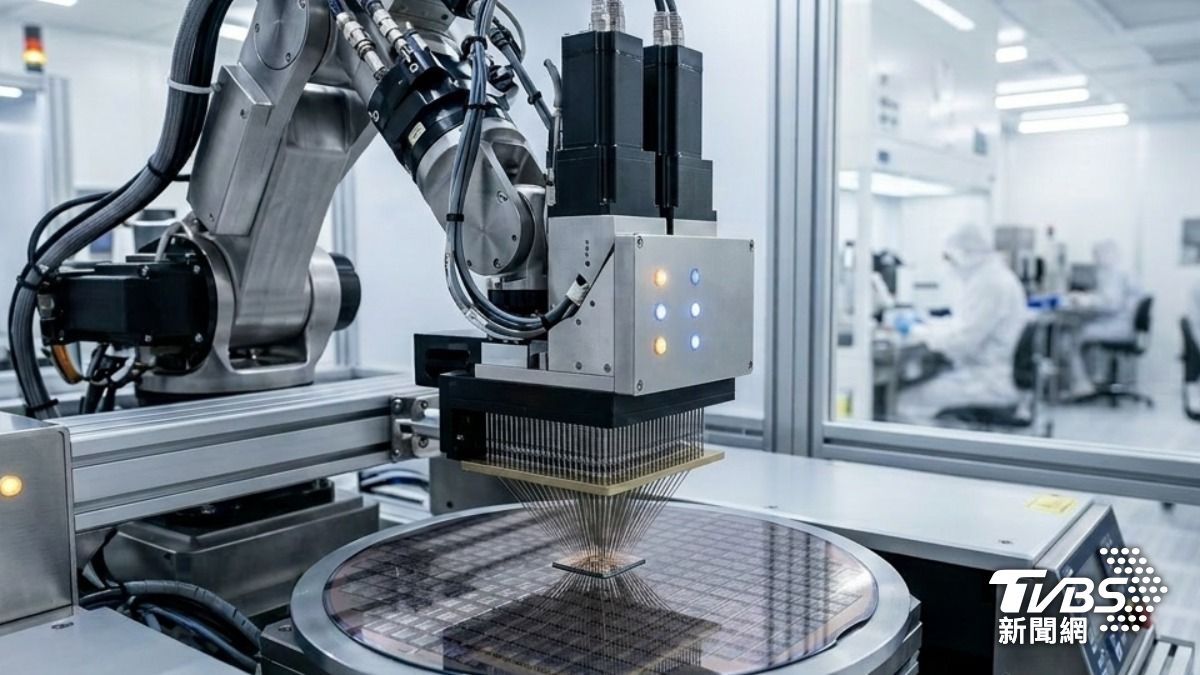
Modern AI processors integrate tens of billions of transistors, high-bandwidth memory stacks, and advanced packaging. KYEC validates them through wafer probing to catch defects early, final testing for specification compliance, burn-in under elevated heat and voltage to expose infant failures, and system-level testing that simulates real-world integration. The company has invested heavily in solutions for chiplets, 2.5D and 3D packaging, and heterogeneous integration.
The company's R&D initiatives are targeting next-generation memory validation, CoWoS package testing, and custom ASIC testing for the major hyperscalers. As Nvidia's platforms progress from Blackwell to Rubin, each generation demands more sophisticated testing at higher power levels. KYEC expects AI-related testing to account for two-thirds of total revenue by 2027, 40% higher than in 2024. With continued growth across its three main wafer testing, final testing, and system-level testing segments, the company sees a clear path toward AI becoming its dominant revenue driver.
KYEC's trajectory for the rest of 2026 is shaped by several converging forces. Nvidia Rubin volumes will begin ramping in the second half, adding a new generation of chips that require more intensive testing. Custom ASIC programs from AWS, Google, Meta, and Microsoft are scaling rapidly, broadening KYEC's customer base beyond Nvidia. The industry's shift toward advanced packaging formats like CoWoS and fan-out adds layers of validation complexity that favor KYEC's decades of specialized expertise.
Despite the impact of rising memory prices and supply shortages that may lead to downward revisions in mobile phone chip demand, KYEC expects that as new cleanrooms and equipment investments come online across Taiwan, full-year 2026 operations are likely to maintain growth momentum and achieve new records.
For most of its history, KYEC's work of validating chips that others designed and fabricated took place in the background. The AI era has rewritten that hierarchy. With record capex committed, expansion underway in Miaoli and Singapore, and AI testing demand that shows no sign of peaking, KYEC has moved from the periphery of the semiconductor conversation to a position where the pace of the entire AI buildout depends, in part, on how fast it can add capacity.