


Competing visions collide over Taiwan’s security strategy
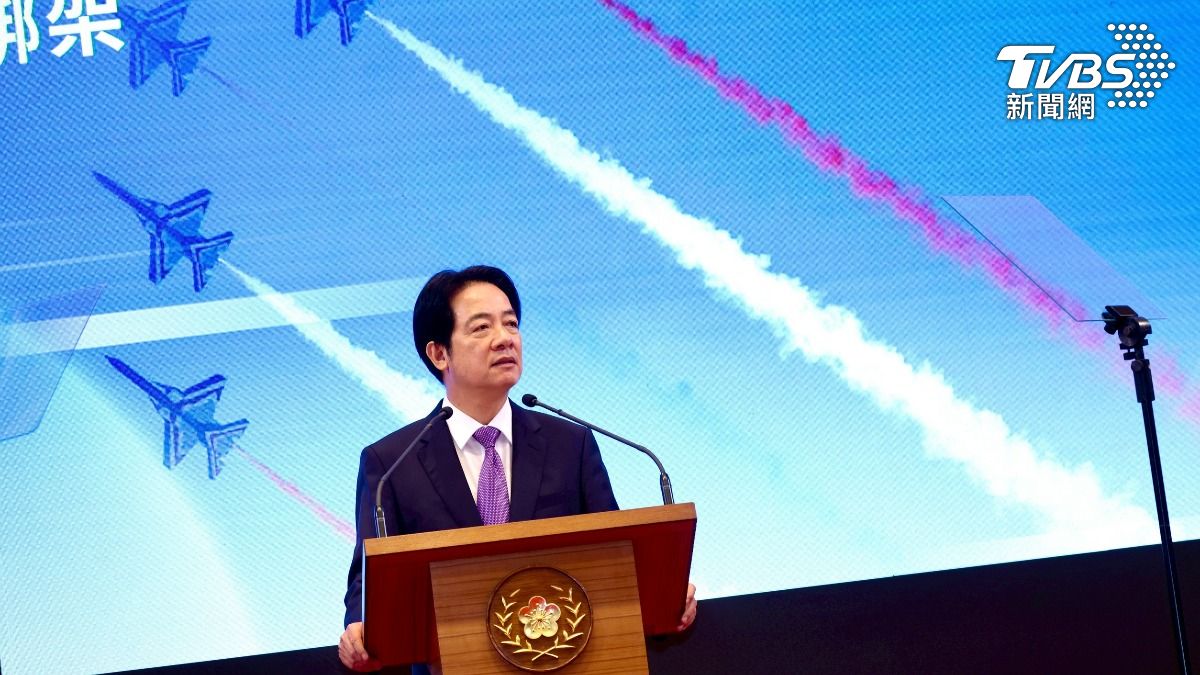
TAIPEI (TVBS News) — Two competing visions of Taiwan's security collided Wednesday (May 20) as President Lai Ching-te (賴清德) rejected opposition calls for dialogue based on the 1992 Consensus (九二共識), pledging instead to maintain the island's status quo through military strength and refusal to accept Beijing's unification framework. The clash — playing out as the opposition-controlled legislature slashed his special defense bill by 38 percent — raises a fundamental question: Can Taiwan simultaneously refuse Beijing's political framework and maintain cross-strait stability?
The Kuomintang (國民黨), Taiwan's main opposition party, accused Lai of distorting its "two legs of national security" (國家安全兩隻腳) proposal, which pairs robust self-defense with sustained cross-strait dialogue and exchanges.
Lai's anniversary speech framed Taiwan's democratic elections as evidence of sovereignty. "Taiwan is willing to engage in healthy and orderly exchanges with China on the basis of equality and dignity, but firmly rejects united front tactics that package unification as peace," he told a Presidential Office gathering attended by Vice President Hsiao Bi-khim (蕭美琴) and Presidential Office Secretary-General Pan Men-an (潘孟安).
Maintaining peace requires strength rather than concessions, Lai emphasized, directly rejecting the KMT's argument that dialogue itself serves as a security tool. "We cherish peace, but will not abandon freedom; we are willing to engage in dialogue, but will not accept being diminished; we pursue stability, but will not sacrifice sovereignty and our democratic way of life," he said.
The defiant stance came one day after the Legislative Yuan (立法院), Taiwan's parliament, rejected an impeachment motion against Lai, and followed the opposition-controlled legislature's decision to slash the administration's proposed eight-year special defense budget from NT$1.25 trillion (around US$39.5 billion) to NT$780 billion (around US$24.6 billion) and exclude commercial arms purchases such as drones.
1992 Consensus: Foundation or Sovereignty Trap?
The KMT accused Lai of "maliciously distorting" party chair Cheng Li-wun's (鄭麗文) security framework, arguing Taiwan cannot stand on military strength alone — dialogue must complement defense to prevent miscalculation. The opposition defended the 1992 Consensus, which it interprets as acknowledging "one China" while disagreeing on its meaning, as enabling the 1993 and 1998 Koo-Wang talks (辜汪會談) and the 2015 Ma-Xi summit in Singapore.
"The 1992 Consensus is the anchor for enabling cross-strait dialogue, reducing hostility, and avoiding war within the framework of the Republic of China Constitution," the party said. Critics contend Beijing now defines the Consensus as requiring acceptance of PRC sovereignty, effectively negating the ROC's existence.
Beijing suspended official contact after President Tsai Ing-wen (蔡英文) took office in 2016—a suspension continuing under Lai despite neither administration formally renouncing the framework. China's Taiwan Affairs Office (國台辦) responded that nothing Lai says can prevent "the historical inevitability that the motherland will be reunified and must be reunified."
Hung Pu-chao (洪浦釗), associate executive director of Tunghai University's Mainland China Research Center (東海大學陸研中心), told Liberty Times (自由時報) that accepting the Consensus under Beijing's current interpretation would effectively endorse PRC sovereignty over Taiwan, undermining the ROC's sovereign status.
Trump's Warnings Complicate Both Positions
Lai maintained that U.S. support validates his refusal to accept Beijing's framework, noting President Trump and Secretary of State Marco Rubio have repeatedly stated American policy toward Taiwan remains unchanged.
However, Trump told Fox News following his Beijing summit with Xi that he opposed Taiwan declaring independence. "I'm not looking to have somebody go independent," Trump said, adding he wanted both sides to "cool down" and wasn't looking to "have somebody say, 'Let's go independent because the United States is backing us.'" Aboard Air Force One, Trump said he made "no commitment either way" about defending the island.
The KMT seized on Trump's remarks as proof Lai's U.S.-reliant strategy is collapsing, stating his attempt to "rely on the U.S. to pursue independence has been exposed by President Trump."
Responding to the NT$470 billion cut, Lai announced plans to circumvent the legislature through special legislation, supplementary budgets, and increased annual appropriations to proceed with commercial purchases, international cooperation, and defense industry autonomy.
The urgency is acute: the first payment for the HIMARS multiple rocket system—around NT$800 million (around US$25.3 million)—is due May 31, creating an immediate test of whether Lai can secure funding despite legislative opposition. Lai urged the Legislative Yuan to approve the Executive Yuan's NT$290 billion (around US$9.2 billion) military procurement budget, which includes the HIMARS payment, before the deadline.
Between the impeachment vote Tuesday and the HIMARS deadline twelve days later lies the gap between Lai's vision of security through strength and the opposition's vision of security through dialogue. Trump's warning that he doesn't want to "travel 9,500 miles to fight a war" suggests that gap may be unbridgeable without American military commitment. Taiwan's sovereignty, it turns out, may depend less on which vision is correct than on whether either vision can survive contact with reality. ◼ (At time of reporting, US$1 equals approximately NT$31.68)
>>> Lai Ching-te won the January 2024 presidential election with 40.05% of the vote in a three-way race. The opposition parties hold a combined majority in the Legislative Yuan.