



Agentic Computing Arrives at Computex 2026
Computex has always been a barometer for where the industry thinks the next wave of demand will come from. This year the message was unmistakable: the future belongs to agentic computing. The dominant workload will no longer consist of a human typing a prompt and reading a reply, but software that plans, calls tools, evaluates its own output, and iterates across many steps with little supervision.
Jensen Huang’s keynote captured the shift precisely. A single prompt, he argued, can now trigger a thousand-step journey of reasoning, retrieval, and action. The entire computing stack, from data center to desktop, must be rebuilt to support it. Two flagship announcements defined this vision: the Vera CPU for the data center and the RTX Spark processor for the personal computer. Together, they represent Nvidia’s bid to own both ends of the emerging agentic ecosystem.
At first glance, Vera might seem like a sideshow in a GPU-driven market. That view is now outdated. Agentic workloads place CPU performance back on the critical path. When an AI agent compiles code, queries a database, orchestrates tool calls, or runs reinforcement-learning loops, those steps execute on the CPU and and each one is inherently sequential. A slow CPU starves an expensive GPU fleet.
Vera directly addresses this bottleneck. Built on 88 custom Olympus cores optimized for high single-threaded performance and delivering roughly 1.2 TB/s of memory bandwidth, it reportedly completes agentic and reinforcement-learning workloads about 50% faster than conventional rack-scale CPUs while using half the power. Within the Vera Rubin platform, five purpose-built racks function as a single pod-scale supercomputer.
Crucially, the supply chain is already aligned. Taiwan’s leading ODMs including Foxconn, Quanta, Wistron, Pegatron, and Wiwynn are all building Vera systems. For them, this is the next predictable wave of AI server demand. Hyperscalers already know how to buy and deploy large-scale Nvidia infrastructure, and Vera Rubin is in full production. Adoption should therefore accelerate quickly.
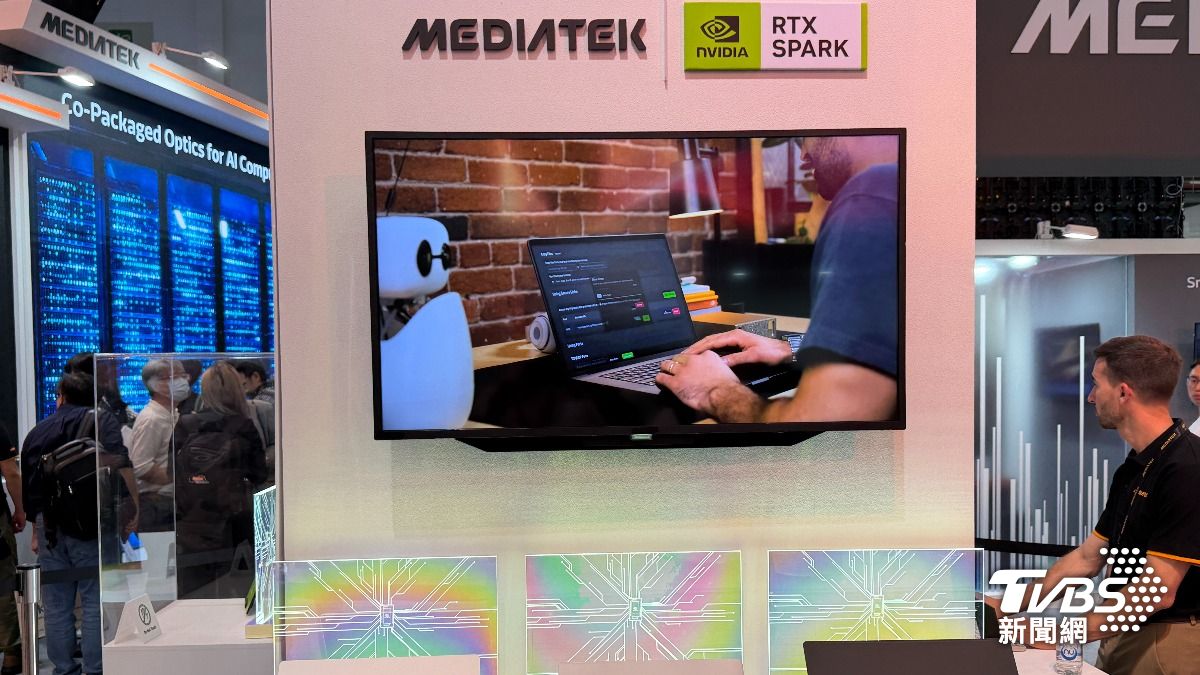
While Vera extends Nvidia’s existing AI infrastructure dominance, the RTX Spark is the more ambitious move aimed at redefining the PC market, which Nvidia has never truly owned. Developed in partnership with MediaTek, the RTX Spark is a Windows-on-Arm SoC that combines up to 20 Arm cores with a powerful Blackwell GPU featuring 6,144 CUDA cores, up to 128 GB of unified memory, and roughly one petaflop of AI performance. The vision is transformative: the PC becomes less a tool you operate and more a teammate you instruct. Local agents can run 120-billion-parameter models with million-token context windows entirely on-device, delivering private, unmetered intelligence.
Vera and the RTX Spark operate on very different timelines. Vera adoption will grow quickly, because it plugs into an existing buying machine. Hyperscalers and the Taiwan supply chain already know how to procure and deploy rack-scale Nvidia systems, the demand signal from agentic inference is immediate, and Vera Rubin entering full production.
The RTX Spark, by contrast, faces a steeper climb. While the hardware is ready, building a robust Windows-on-Arm ecosystem remains challenging. Past attempts have struggled with application compatibility, driver maturity, and emulation overhead. Nvidia is betting that its CUDA/RTX software stack and close Microsoft partnership can finally break that cycle.
The first devices from Dell, HP, Lenovo and Microsoft only ship this fall, followed by ones from Asus and MSI. The agentic use cases that justify the premium are still nascent, and enterprises move slowly on new client architectures. Consumers will not instantly abandon decades of workflows because a keynote told them to. The virtuous cycle of developers writing native agentic Windows applications, users adopting the hardware, and a growing installed base attracting more developers will take years, not quarters, to gain momentum.
Nvidia’s Computex 2026 announcements reveal a disciplined, two-speed strategy. Vera monetizes the agentic transition immediately through infrastructure it already dominates and a Taiwan supply chain primed for volume. The RTX Spark plants a long-term flag in a huge market Nvidia has long coveted but does not yet control. In betting on both, Nvidia is positioning itself not merely as the leader in AI acceleration, but as the architect of the agentic computing era.