



Taiwan city installs smart sensors in public restrooms
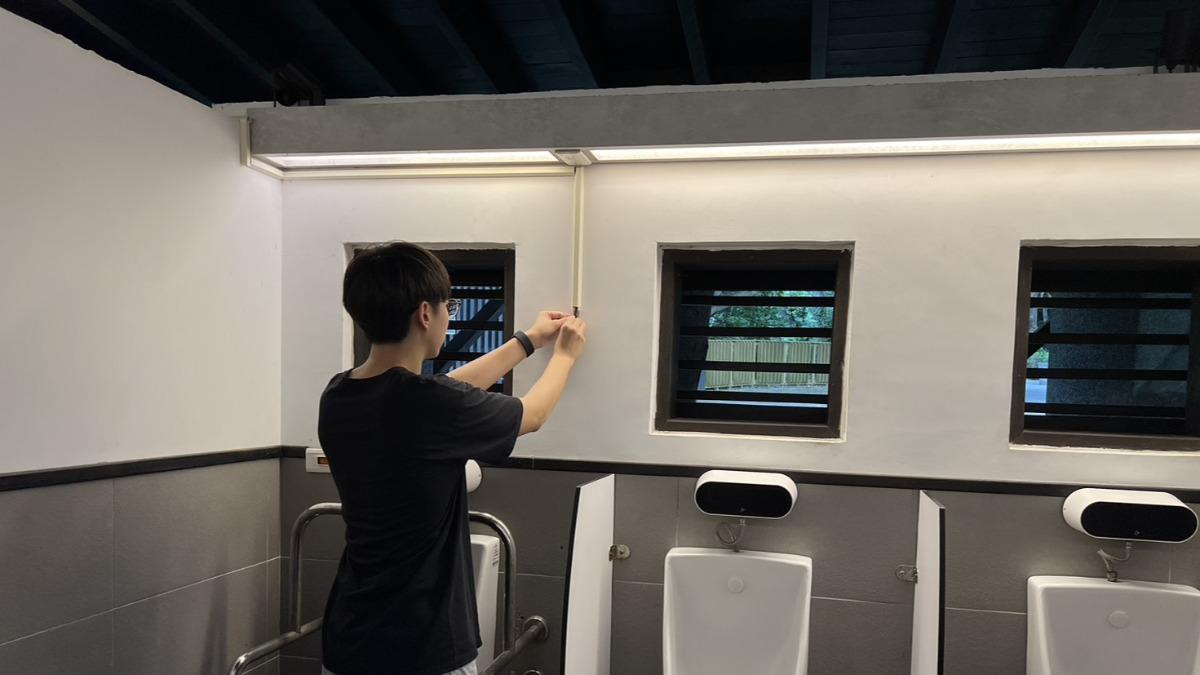
TAIPEI (TVBS News) — The Hsinchu City Government unveiled an innovative public health initiative on Thursday (June 26) that brings high-tech solutions to an often overlooked urban challenge: public restroom maintenance. City officials announced a three-way partnership with National Tsing Hua University (NTHU, 國立清華大學), one of Taiwan's premier research institutions, and the National Center for Instrumentation Research (NCIR, 國家儀器科技研究中心), a specialized government research facility, to deploy advanced environmental monitoring sensors in public restrooms at two popular tourist destinations — Eighteen Peaks Mountain (十八尖山), a local nature preserve, and the historic Hsinchu Confucius Temple (新竹市孔廟).
The newly installed monitoring system employs sophisticated sensors capable of detecting potentially hazardous gases common in restroom environments, including ammonia, hydrogen sulfide, and carbon dioxide, while automatically dispatching alerts to maintenance personnel when levels exceed predetermined thresholds. The technological breakthrough underpinning this system comes from NTHU researchers who developed a specialized semiconductor-based gas sensing chip utilizing two-dimensional materials that offers exceptional durability against corrosive environments, heightened sensitivity to subtle atmospheric changes, and remarkably low energy requirements for continuous operation. Technical experts from the NCIR contributed their expertise by creating the integrated system architecture and implementing the wireless communication protocols necessary for real-time data transmission and alert functionality.
Municipal officials indicated that successful implementation at these initial locations would serve as a pilot program, potentially leading to broader deployment across additional public facilities throughout Hsinchu City. Representatives from the Public Works Department (工務處), the city agency responsible for infrastructure maintenance, highlighted the substantial improvement in response times achieved through the sensor network, explaining that the previous system of scheduled manual inspections often resulted in significant delays between facility problems and their resolution. The smart monitoring approach represents part of Hsinchu's broader smart city initiative, with authorities expressing confidence that the technology will simultaneously improve operational efficiency for maintenance staff while delivering a more pleasant and hygienic experience for residents and visitors using public facilities. ◼