



Here's why Taipei's mayoral race just got interesting
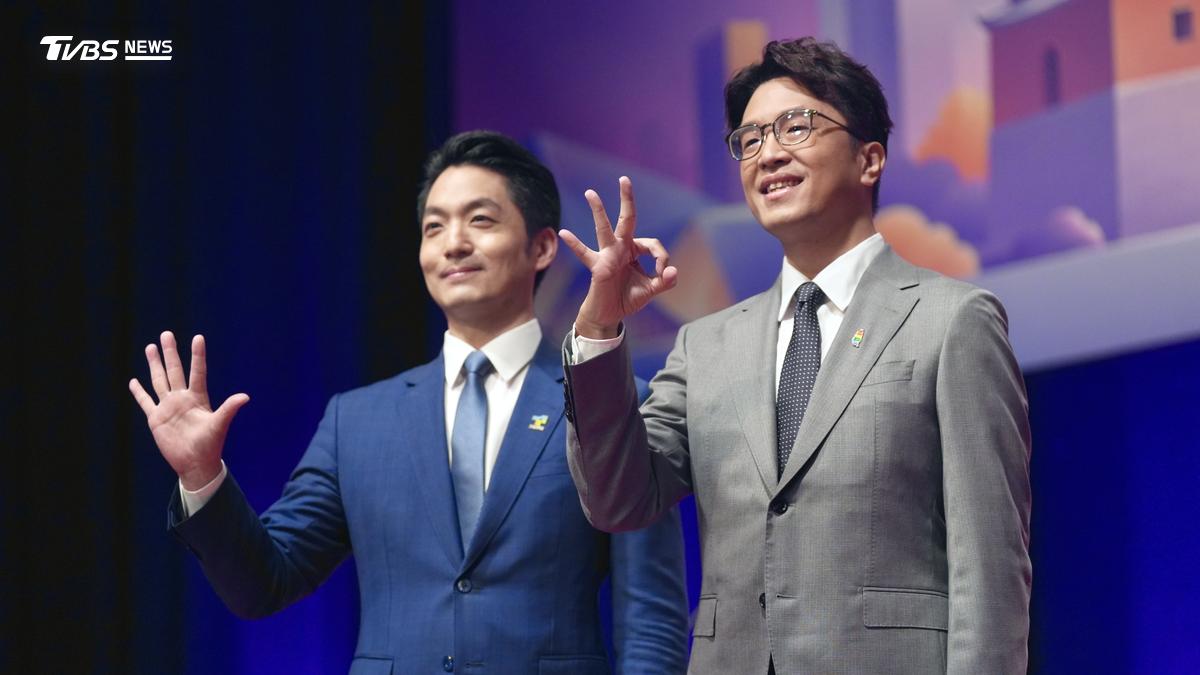
TAIPEI (TVBS News) — Did Saturday's mayoral debate change the race? The answer depends on who watched, according to a new survey. Among the 59 percent of Taipei voters who tuned in, challenger Puma Shen (沈伯洋) leads incumbent Chiang Wan-an (蔣萬安) by 11 points. Among the 41 percent who did not, Chiang leads by 27. The overall margin stands at just 4 points — but that single number obscures a fractured electorate heading into the final 28 days.
A TVBS poll conducted immediately after the two-hour televised exchange shows the Kuomintang (KMT, 國民黨) mayor at 46 percent support and the Democratic Progressive Party (DPP, 民進黨) legislator at 42 percent. The margin has shrunk dramatically from 28 points in late May and 8 points in early October. Here is what the poll found, why the numbers matter, and what each candidate's debate strategy revealed about the final stretch.
What do the numbers show?
The survey of 1,747 Taipei residents — contacted at home on a Saturday afternoon via landline — was conducted between 2 p.m. and 6 p.m., within four hours of the debate's conclusion. With a margin of error of ±2.3 points, the 4-point gap falls just outside the statistical margin, meaning the race is competitive but Chiang retains a narrow advantage.
The viewer/non-viewer divergence suggests the debate itself moved preferences, or that already-engaged voters who lean toward Shen were more likely to watch. Either interpretation poses challenges for both campaigns: Chiang must reach voters who tuned out, while Shen must hope his performance travels beyond the screen.
Throughout the exchange, Shen maintained an earnest, conversational tone. "Since so many questions weren't answered, I'd like to ask Mayor Chiang if there's a chance we can schedule another debate," Shen said in his final cross-examination slot. "If you can't decide now, you can add me on LINE later." Chiang responded only that both teams could "coordinate."
Who do voters think won, and where are the undecided?
On debate performance, 47 percent said Shen performed better, compared to 40 percent for Chiang, according to the TVBS survey. Before the debate, 41 percent expected Shen to outperform while 30 percent expected Chiang to. The gap was even wider among neutral voters — those who do not identify with either major party — where 44 percent rated Shen's performance higher, compared to just 24 percent for Chiang.
Chiang's debate strategy may have contributed to the gap. The mayor repeatedly opened questions with variations of "Legislator Shen, you really don't understand municipal governance," a phrase he deployed throughout cross-examination that some observers criticized as repetitive and dismissive.
Overall, 12 percent of voters remain undecided, but that figure masks significant variation. Among neutral voters, 26 percent remain uncommitted, the largest persuadable bloc in the final four weeks. Among those who have chosen a side, the race is essentially tied: Chiang at 37 percent, Shen at 36 percent.
How are 2022 third-party voters breaking?
Perhaps the most consequential finding involves voters who supported Huang Shan-shan (黃珊珊) in the 2022 election. Of those 2022 Huang voters, 53 percent now support Shen, while 39 percent back Chiang. This finding stands in tension with another data point: among current Taiwan People's Party (TPP, 民眾黨) identifiers, 80 percent support Chiang and only 14 percent support Shen.
The divergence suggests many 2022 Huang voters were protest voters rather than committed TPP partisans. In other words, voters who cast ballots for former Mayor Ko Wen-je's (柯文哲) movement four years ago are not necessarily the same as voters who identify with his party today.
Chiang appeared to target this bloc directly. In his closing statement, he thanked Ko for laying a "solid foundation" and characterized Ko's ongoing corruption charges as "judicial persecution." "Despite the DPP's judicial persecution, he still bravely stands up to offer fair and objective assessments," Chiang said. "I deeply admire him."
What are the poll's limitations, and what happens next?
The survey captured immediate reactions, within four hours of the debate's conclusion, that may not reflect settled preferences. TVBS co-hosted the debate with SET Television (三立電視), a pairing that spans Taiwan's political media spectrum, with TVBS generally seen as leaning pan-blue (KMT-aligned) and SET as leaning pan-green (DPP-aligned).
Both campaigns now face 28 days of intensive campaigning. For Chiang, the challenge is reversing Shen's momentum among the 59 percent who watched — and weighing whether a second debate would help or hurt, given his performance ratings among neutral voters. For Shen, the question is whether his debate performance can reach the 41 percent who did not tune in, and whether he can translate his academic fluency into the image of a decisive executive.
The debate revealed two competing visions of leadership. Chiang cast himself as a builder: "The mayor's greatest responsibility is to build a stage that carries every citizen's dreams," he said. Shen emphasized "accompaniment" (陪伴), a concept he invoked throughout the debate. "I hope no one in this city feels lonely," he said. "No one should be left behind."
Whether Shen's gains hold or fade, whether Chiang's Ko Wen-je gambit wins back third-party voters, whether Shen's LINE invitation yields a second debate: these remain open questions. What the data confirms is that the race once considered comfortable is now genuinely competitive, and the final 28 days will determine which version of the electorate shows up on Nov. 28. ◼
▶ Poll methodology: The TVBS survey contacted 1,906 Taipei residents aged 20 and older via landline random-digit dialing between 2 p.m. and 6 p.m. on Saturday, with 98 interviewers deployed. Of those contacted, 159 refused to participate (8.3 percent refusal rate), yielding 1,747 valid responses. Results were weighted by gender, age, district and education level. The margin of error is plus or minus 2.3 percentage points at a 95 percent confidence level.