


EXCLUSIVE Taiwan not a trade-off with China: AIT Director
TAIPEI (TVBS News) — American Institute in Taiwan (AIT) Director Raymond Greene said in an exclusive TVBS interview on Friday (March 27) that the United States is ready to expand cooperation with Taiwan across energy, defense, and trade. Greene said both sides confront growing geopolitical and supply chain pressures. The AIT serves as the de facto U.S. embassy in Taiwan.
Greene said Washington's policy toward Taiwan has not changed. He backed Taiwan's push to strengthen its self-defense capabilities through a special defense budget and indigenous defense production. Greene said the U.S. remains committed to following through on its reciprocal trade arrangement with Taiwan. The special defense budget is currently under review in the Legislative Yuan, Taiwan's parliament.
Greene pointed to energy security as a rising priority. He said the U.S. is prepared to work with Taiwan on liquefied natural gas (LNG), nuclear energy, and emerging technologies such as small modular reactors. The remarks signal Washington's intent to deepen ties with Taipei across multiple sectors as Taiwan faces pressure on multiple fronts. ◼
Here is the full text of the interview:
Tingting Liu: “Director Greene is a longtime diplomat and an expert on this region, especially on geopolitical issues, so we are very happy to have him with us today to talk about the U.S.-Taiwan relationship. To begin the interview, I want to talk about energy security. The Lai administration has recently appeared to have a shift in its nuclear energy policy. What is your view on such a shift, and how could the U.S. support Taiwan’s future nuclear energy policy?”
AIT Director Raymond Greene: “I think Taiwan, like many countries around the world, is concerned about energy security, given the disruptions we’ve seen in the global supply chain. So we’re very happy to work with Taiwan to meet its energy needs across all sources and all types of energy. Obviously, the U.S. and Taiwan have a long history of energy cooperation, including liquefied natural gas, oil, and other forms of energy. This is one of the topics that we often discuss during some of our bilateral engagements like the Economic Prosperity Partnership Dialogue. But in the nuclear field as well, the U.S. has much to offer. As you know, right now the U.S. nuclear industry is very dynamic, given the huge demand for AI-related energy supplies, so we have a very vibrant energy sector that’s very eager to work with Taiwan, whether it’s on conventional nuclear materials, conventional nuclear technologies, or new technologies such as SMRs, or small modular reactors. Also, we have over 40 years of cooperation between U.S. regulatory and nuclear safety organizations and their Taiwan counterparts. So as Taiwan looks at options in the nuclear field, the U.S. stands ready to be a partner.”
Tingting Liu: “I think the Taiwanese are actually very concerned about nuclear safety when we talk about energy in that sense, so do you think that small modular reactors are going to be the future trend?”
AIT Director Raymond Greene: “Small modular reactors are definitely a future trend, but so are more advanced conventional reactors. Safety is an issue that I think everybody is concerned about. I mean, I was in Japan on March 11, 2011, and so I understand the concerns that exist in all societies about that. But there have been so many advances in terms of technology and in terms of regulatory oversight that we see nuclear as a very safe, very environmentally friendly alternative. And so we stand by to support Taiwan as it seeks to address these issues.”
Tingting Liu: “I want to move on to regional security issues. We know that President Trump is set to visit Beijing between May 14 and May 15, and many expect that Taiwan is going to be one of the topics discussed. But if Chinese President Xi Jinping were to press the U.S. to explicitly oppose Taiwan’s independence, how do you think President Trump would react, and how could that affect U.S. policy toward Taiwan?”
AIT Director Raymond Greene: “Obviously, I don’t comment on hypothetical questions, but the Trump administration has been clear on many occasions that our Taiwan policy, our one-China policy, has not changed. And this has been a policy that has been consistent across administrations since 1979. If you look at our one China Policy, the White House recently pointed out the fact that our one China policy, which is based on the Taiwan Relations Act, the three Joint Communiqués, and the Six Assurances, is actually structured in a way that allows us to seek stable U.S.-China relations without sacrificing strong U.S.-Taiwan relations. And if you look at the U.S.-Taiwan partnership, it’s going from strength to strength. Even just in the last couple of months, you saw we had the agreement on reciprocal trade, which is an enormous historic breakthrough in our economic relationship. We hosted the Economic Prosperity Partnership Dialogue, where we talked about, for example, the Pax Silica initiative and how the U.S. and Taiwan can cooperate in shaping the AI revolution. We had a high-level education dialogue where we not only talked about language learning, like we have in the past, but expanded to include areas like workforce training to support our high-tech industry. So you see the U.S.-Taiwan relationship going deeper and deeper. At the same time, we don’t see that as a trade-off with a stable U.S.-China relationship. In fact, we think these two tracks are mutually reinforcing.”
Tingting Liu: “There are reports that additional U.S. arms sales could be expected in the pipeline. So do we expect any good news later this year?”
AIT Director Raymond Greene: “Well, you know, we have the Taiwan Relations Act, which commits the United States to provide Taiwan the articles and services it needs to fulfill its self-defense capabilities, commensurate with the threat that it faces. And so the U.S. will continue to abide by that policy and continue to support Taiwan’s self-defense needs.”
Tingting Liu: “But earlier this year, there were actually some concerns raised after President Trump, when he was asked about his phone call with Chinese President Xi Jinping and also additional arms sales to Taiwan, where President Trump said that he would be discussing the issue with Xi. So that led to some concerns in Taiwan, wondering what that means, or whether it signals a change to the Six Assurances.”
AIT Director Raymond Greene: “Right. I mean, after that episode you discussed, the White House iss very clear in reiterating that our Taiwan policy remains consistent. And so I would just refer to the White House, because they obviously are the closest to that issue.”
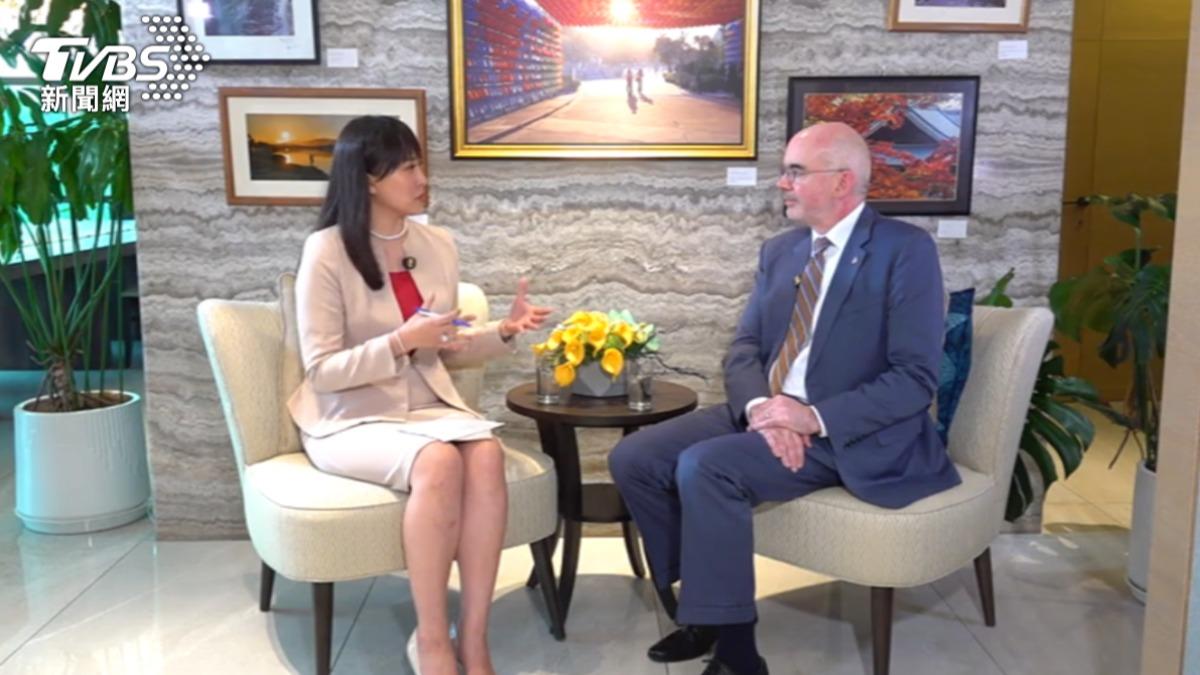
Tingting Liu: “There’s also speculation that President Lai would be doing a foreign trip visiting diplomatic allies, and that also includes transit through the U.S. Do you think that May is a good timing?”
AIT Director Raymond Greene: “We aren’t tracking any requests for any high-level travel from Taiwan. As you know, it has long been U.S. practice for Taiwanese leaders who are traveling to Latin America to transit the United States, and for the U.S. to arrange their transits to ensure the dignity, comfort, safety, and convenience of the traveler. But right now, we don’t have any specific requests.”
Tingting Liu: “KMT Chairperson Cheng Li-wun had expressed hope that she wants to visit Washington, D.C., hopefully in the first half of this year. What message does the U.S. hope to convey to Taiwanese opposition parties?”
AIT Director Raymond Greene: “Yeah, we’ve seen the reports. We don’t have any specific plans that we’ve received from Chairwoman Cheng to visit the United States, but we are very happy to welcome visits by senior Taiwan political leaders. Just the other day, we had a very successful visit by Taichung Mayor Lu Shiow-yen, and we here in Taiwan regularly reach out to party leaders on all sides. Our message is very consistent. Obviously, we talk about the deep respect we have for Taiwan’s democracy, as well as the role that all the political parties play in deepening U.S.-Taiwan relations, whether it’s in the security sphere, economic sphere, or people-to-people ties. Obviously, right now there’s a lot of focus in the United States on the special defense budget and Taiwan’s security. In the U.S. Congress, you know, we have partisan politics as well. But one of the few areas where I think there’s cross-partisan consensus in the United States is on security issues, particularly security in the Taiwan Strait. And I think we see the same commitment here in Taiwan and so we hope to see that same spirit as Taiwan looks at some of these significant security challenges, as well as issues like defense budgets.”
Tingting Liu: “When we talk about the defense budget, let’s talk about numbers. The Legislative Yuan is currently reviewing the special defense budget. This is, of course, a hypothetical question, but if the final approval amount is lower than NT$1.25 trillion, how do you think that would affect Taiwan’s self-defense capabilities?”
AIT Director Raymond Greene: “As you know, President Trump and the Trump administration have asked all of our allies and partners to increase their defense spending to 5% of GDP, and we very much welcome President Lai’s announcement that Taiwan will hit that target by 2030. And on the road to that target, we see the special defense budget as a very, very important first step. Obviously, in addition to the amount of money that’s spent, how Taiwan spends the money is very, very important. And so when we look at this special defense budget that the Ministry of National Defense has proposed, it includes, I think, all of the capabilities we believe the Taiwan military needs to fulfill its role in deterring conflict across the Taiwan Strait, whether it’s integrated air and missile defenses, distributed command and control or communications facilities, anti-missile, anti-ship, or anti-armor capabilities. All of those are reflected in the budget.
But what is also reflected in the budget is investment in Taiwan’s own defense industrial base, especially to produce drones and other uncrewed systems. And we believe this is equally important for several reasons. On one hand, I know many in Taiwan welcome it because of the economic advantages it provides to Taiwan’s industry. But from our perspective, we think it gives Taiwan additional deterrent capabilities, and capabilities that it can acquire actually quite quickly because Taiwan has such a deep industrial manufacturing base. It also enables Taiwan to produce drones, munitions, or other equipment on the island. So in the case, for example, of a blockade or some conflict where they couldn’t be resupplied, it gives Taiwan additional resilience. And so we’re very supportive of the contents of the special budget. We understand it’s in the process of legislative review, but our position is that we hope all the parties will quickly come to a consensus, given the urgency of the threats Taiwan faces.”
Tingting Liu: “If the number did fall short, would it also have implications for U.S. deterrence strategy or deterrence policy in the Indo-Pacific?”
AIT Director Raymond Greene: “I wouldn’t think so much in terms of specific numbers, but rather specific capabilities. As you saw from our national security strategy, we talk about the fact that we are seeking to deter conflict up and down the First Island Chain, and so we’re working with all of our partners in the region, whether it’s Japan, Korea, Taiwan, the Philippines, Australia, or others, to ensure that they’re investing in the right capabilities to help us achieve that deterrent effect. And so we believe the capabilities that Taiwan is seeking to acquire through the special defense budget, and the regular annual budgets will achieve that effect, because that’s good for all of us. And I think nobody or any of our partners wants to be the one party that causes other parties to have to adjust their posture. So I think it’s very important to send not only a deterrent effect, a kind of physical deterrent effect, but also, symbolically, to show Taiwan’s commitment to our joint efforts to preserve peace and stability in the Indo-Pacific region.”
Tingting Liu: “I just want to press a bit further, because in my recent interview with Vice President Bi-khim Hsiao, she actually talked about how the special defense budget is the result of a long time discussion between both U.S. and Taiwan partners to basically work through what is needed for Taiwan’s defense capabilities. I’m just wondering whether you could share more details on that.”
AIT Director Raymond Greene: “It has been the result of a long set of consultations between the U.S. and Taiwan. But I think especially because you’re seeing the changing character of warfare, whether it’s in Ukraine or in the Middle East, the traditional focus on conventional forces is not being replaced, but is being very much influenced by new technologies, especially unmanned and AI-enabled capabilities.
And so we see the special budget including a big focus on these areas that are not only asymmetric but also are basically new technologies that will change the character of the battlefield. And that sort of disruptive change can be very, very effective as we’re looking to deter conflict, because others who are planning, or potentially planning, aggressive actions have to take into account these new risks that they face from these types of technologies.
Given Taiwan’s very advanced technological base, given its deep manufacturing capabilities, we think Taiwan is especially well positioned. In the last couple of weeks, I’ve been traveling around Taiwan, visiting a lot of Taiwan companies. Some of them have been doing this for a long time, like Thunder Tiger. Some of them are very new. For example, I was at I-Mei the other day. It used to make snacks, and now it is making uncrewed systems. But all of these companies have really impressive technologies and a really impressive ability to scale up, if given the right incentive structure. And it’s not just me or my colleagues at AIT, but American companies like Anduril and Shield AI, a lot of these new technology companies in the U.S., are coming to Taiwan because they see Taiwan as a natural partner to build secure supply chains, but also to scale up their own production. We have a lot of great technologies, but I think we really can find a partner in Taiwan as we look to build these into a more sustainable production line. And that, I think, will not only help serve Taiwan’s defense needs, but I think there’s huge potential for us to export it to third countries.
And that’s one of the reasons that in January, we arranged and supported the signing of a memorandum of understanding between AUVSI, which is the leading U.S. drone association, and the Industrial Technology Research Institute, or ITRI, to do certification of drone production under what we call ‘Green UAS,’ which will allow Taiwan companies to be able to be registered and certified as being safe and secure in terms of cybersecurity and in terms of their supply chain, so they can sell directly into the U.S.’ market and eventually into the U.S. Department of War procurement system. And so I think this is an enormous opportunity. Taiwan is the first location outside of the United States that is able to do this sort of certification. And I think that really reflects how much we value Taiwan’s potential as a partner in this field.”
Tingting Liu: “Because the opposition parties in Taiwan would actually say that in regards to U.S. arms sales, most of them don’t have any issue with it, but the primary part is actually what you mentioned earlier, the investment in Taiwanese defense industry. So what you’re trying to say is that in this Taiwanese defense industry portion, the U.S. and Taiwan actually have a lot to work on in that part?”
AIT Director Raymond Greene: “Yeah. I mean, this is a new area for everybody. I think in the United States, we traditionally relied on a small number of what we call defense prime companies. But more and more, given the pace of technological change, we’re looking to a lot of startups, many from Silicon Valley, a lot of companies that are quite small and quite new to the defense sector. And so it’s a learning process for all of us. I think for Taiwan as well. You have companies that have, for maybe decades, been doing work in the commercial sector, all of a sudden finding the opportunities there. And it requires a different procurement system. It requires a different mentality. It requires a lot more speed. And so I understand why there would be concerns, just as in the United States, as we look at how do you match the government procurement system, how do you match the legislative oversight process to this new style of procurement. It can be a challenging problem set, but it’s not an unachievable problem set. I think as the legislature reviews the budget and debates these sorts of factors; they should be able to come to a conclusion that supports Taiwan’s defense needs, supports Taiwan’s industry requirements, and also supports the oversight that every legislature in the world fulfills.”
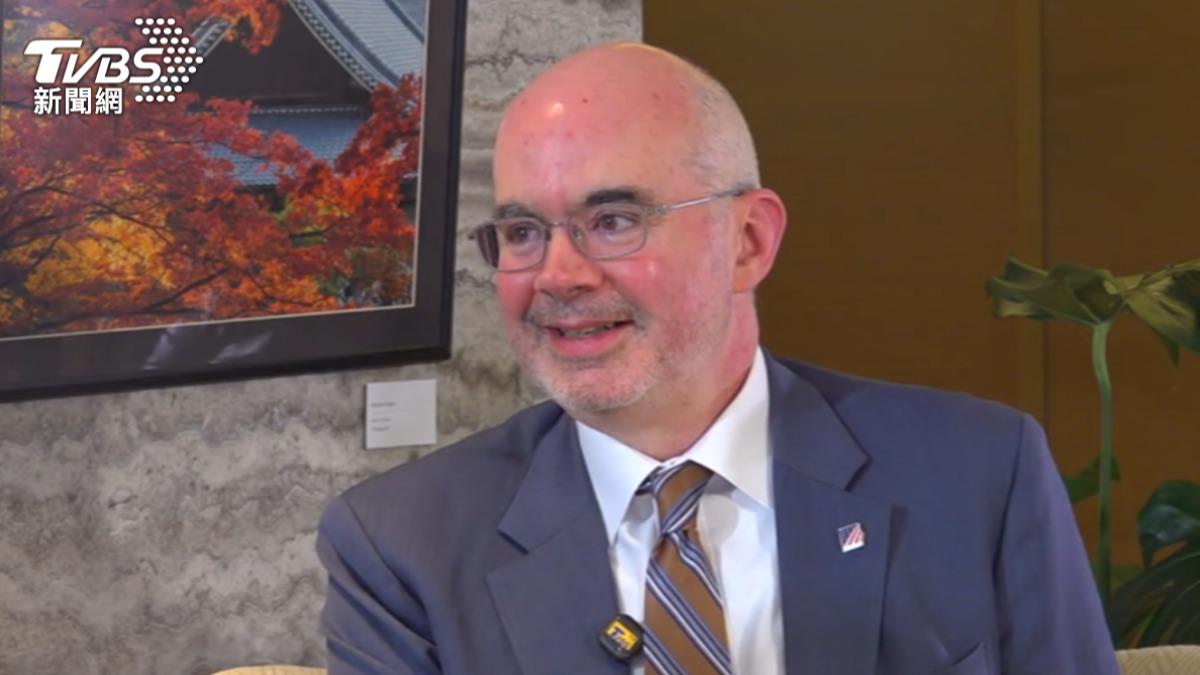
Tingting Liu: “I want to move on to economic security. In your latest speech at Xie Nian Fan, you talked about how we have welcomed a new golden age between U.S. and Taiwan economic relations. I just want to ask and probe you further: after the U.S. Supreme Court ruling, many in Taiwan began asking whether it could affect the trade deal between the U.S. and Taiwan. So what is your assessment on that?”
AIT Director Raymond Greene: “Yeah, I think our government has been quite clear. U.S. Trade Representative Greer, after the Supreme Court ruling came out, it was very clear that we intend to abide by the agreements we’ve reached with our key trading partners. And obviously Taiwan is our fourth-largest trading partner in the world and one of the most important partners we have. We’re very pleased with the outcome of the ART, the Agreement on Reciprocal Trade. I think Taiwan was as well. I saw that all six major trade associations in Taiwan quickly came out and endorsed the ART, and so our intent is to abide by the ART. I saw Vice Premier Cheng has also reaffirmed that Taiwan has a desire to stick to the negotiated agreement. So right now, what we need to do on the U.S. side is to make revisions to the ART to reflect new legal authorities. Because, as you mentioned, the Supreme Court struck down IEEPA, the International Economic Emergency Policy Act, as the basis for our tariffs. So right now we’re in a temporary period under Section 122 of our Trade Act, which allows the U.S. administration to maintain 10% tariffs on all of our trading partners, but that will expire in July. And so our goal is to replace those authorities with more permanent authorities to allow us to again get back to the terms of the deal. And so I expect in the coming months we’ll be able to achieve that effect.”
Tingting Liu: “Because the timeframe (window) can’t be very long. It has to be done before July, and now it’s already the end of March.”
AIT Director Raymond Greene: “Right, yeah. So I don’t think it’s going to drag on. I think almost by definition, we’ll need to move in the next couple of months toward resolution.”
Tingting Liu: “I’m also curious about regional security. Given the recent U.S.-Iran conflict, which is still ongoing, we have seen countries like South Korea and Japan being pushed to provide necessary assistance to the U.S. in the Middle East region. So what does that mean for U.S. Indo-Pacific strategy? What message does it send?”
AIT Director Raymond Greene: “I would think there are maybe three messages for the Indo-Pacific region coming out of the ongoing conflict in the Middle East.
I think one message is that the U.S. maintains the ability to project overwhelming military power anywhere in the world at very short notice. Just in the last three months, you saw that in South America, and now you see it in Iran. And it requires that we can project that same level of force and overwhelming capabilities in the Indo-Pacific or in Europe.
But I think the second message is that in order for the U.S. to be effective in providing that level of military support, we need our allies and partners to provide a baseline of deterrence, especially by investing in their own capabilities in areas like integrated air and missile defense and drone and counter-drone warfare. Because I think that baseline will then allow the U.S., our ability to project globally to be effective. And we are really the only country in the world that can project power like that anywhere on the planet. I would say Taiwan is working, and our allies in the region are working very well in that direction, given their increased investments not only in acquiring those capabilities but also in building the defense industrial base to support them. And so all of these things, I think, go hand in hand.
I would say the third message is the importance of energy security, because I think the Europeans, after the Ukraine invasion, realized their dependency on unreliable energy sources. And I think right now in Asia, many countries are realizing they also need to diversify their energy supplies because of the risk of disruption.
And so the good news is the United States is the world’s largest energy producer. We’re very eager to deepen our cooperation with Taiwan, with Japan, Korea, and others to provide alternative supplies. And so I think Taiwan CPC’s announcement of a new contract with Cheniere to import Gulf of American LNG is a positive step, and a very well-thought-out step by Taiwan to diversify its sources. I think Taiwan’s work with us to develop the Alaska North Slope LNG field over the longer term is going to be strategically a huge advantage for Taiwan. But also in other areas, building up geothermal, nuclear, and other forms of energy supplies that can be sourced internally is, I think, a very important step to ensure that in the future Taiwan is not going to face similar disruptions.”
Tingting Liu: “So I’m very glad that we made a full circle.”
AIT Director Raymond Greene: “Back to energy policy.”
Tingting Liu: “And the whole security issue. But I’ll end this interview on a lighter note. You have been posted to Taiwan for 20 months, and before that you were also the deputy director in Taiwan. So I’m wondering, is there anywhere in Taiwan you haven’t been to and have plans to visit?”
AIT Director Raymond Greene: “Oh, yeah. I’ve been fortunate to be able to travel to most of Taiwan, especially because I was here during COVID, and so there actually weren’t a lot of other choices, but I took advantage of that to really see the island.
The only place I haven’t been to is Matsu, but I plan to do that. I think we’re looking at June of this year. So that will complete the set of all the cities and counties in Taiwan. But I look forward to resetting and starting to work through all of them again after that.
But yeah, one of the best parts of this job is the ability to get out and travel all around Taiwan, meeting different people and enjoying different cultures. I think I’ve been to Taichung once a month so far this year, and I’m going back again in a few weeks as well. And Kaohsiung, obviously, because we have our office there, and we arrange travel around that district.
Last year I went to Taitung for the balloon festival, but unfortunately the winds were too high, so fingers crossed this year I’ll be able to get up in the balloon. It’s been on my bucket list for many, many years.”
Tingting Liu: “Thank you, Director.”
AIT Director Raymond Greene: “Thanks so much, Tingting.”