



Computex 2026: Taiwan Tech Firms Turn Silicon Into Spectacle
While the silicon vendors captured the keynote headlines, Taiwan’s hardware manufacturers drew the biggest crowds on the Computex show floor. Their expansive booths featured server racks, advanced cooling systems, robots, and complete computing platforms. The attention was well deserved. Taiwan assembled roughly 90 percent of the world’s AI servers in 2025, and total server shipments are forecast to rise nearly 20 percent in 2026, marking the strongest growth in years. Global shipments in the second quarter alone are projected to exceed five million units for the first time. These manufacturers turned Computex into a vast showroom for the physical machines powering the AI boom.
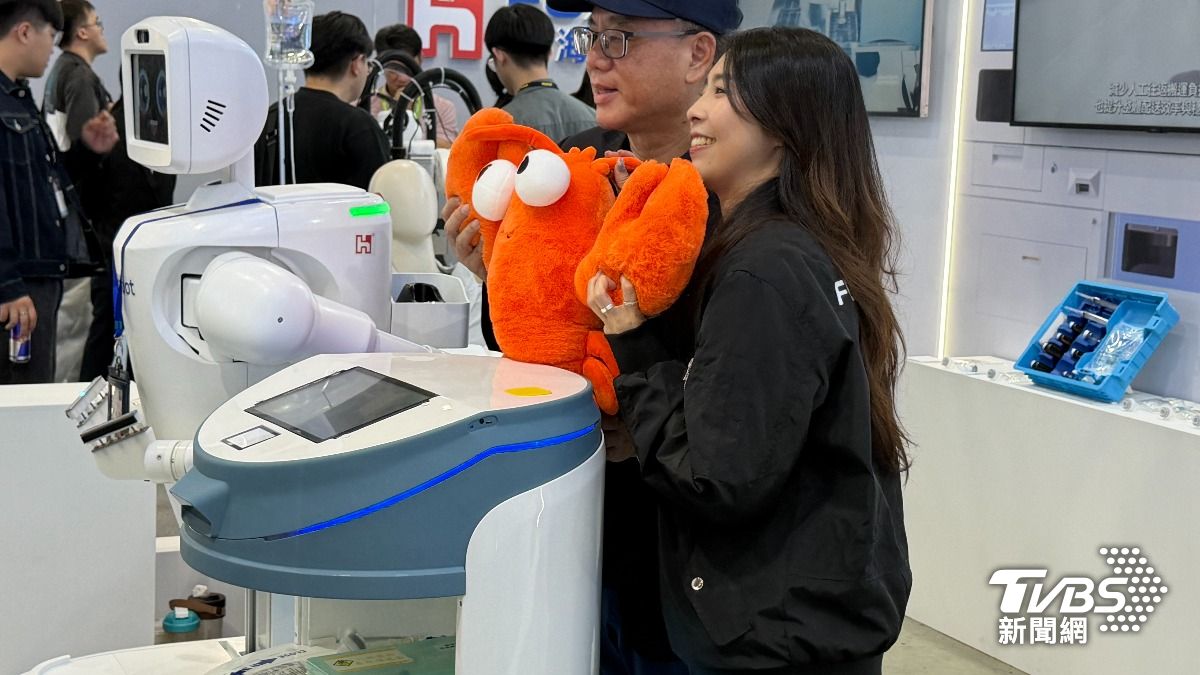
Foxconn had a commanding presence. Its booth featured a fully operational Nvidia Vera Rubin NVL72 rack, the liquid-cooled system that integrates 72 GPUs and 36 CPUs into one unified supercomputer. The booth also showcased HGX Rubin NVL8 and MGX server designs, the Nvidia Groq 3 LPX, and a full wall of in-house components, including liquid-cooling cold plates, manifolds, printed circuit boards, co-packaged optics, and 1.6-terabit optical modules. Foxconn claims more than 40 percent of the global AI server market and produces over 60 percent of the key components in a typical AI rack. Nearby, its robotics zone featured live demonstrations of Nurabot, its nursing robot, and a hand-washing robot developed with Kawasaki and Taichung Veterans General Hospital.
The business momentum matched the spectacle. In May, Foxconn reported record revenue of NT$859.4 billion (US$27.0 billion), a nearly 40 percent increase year over year. During the show, the company signed a strategic partnership with Intel covering AI racks and custom chips. Chairman Young Liu declared that the traditional weak second quarter for Taiwan tech, known as the “five poor, six weak” period, no longer applies.
The same focus on complete AI systems appeared across the major ODMs. Quanta, through its QCT division, centered its booth on Nvidia’s Vera Rubin architecture with fully liquid-cooled racks and agentic AI solutions, alongside Intel and AMD platforms. The company is adding three new plants in California by the end of 2026. Quanta reported first-quarter revenue of NT$809.2 billion (US$25.3 billion), up 67 percent, with chairman Barry Lam noting that order visibility now extends into 2027.
Wiwynn, the cloud specialist spun out of Wistron, attracted engineers with practical innovations including an 800-volt direct-current rack power system developed with Delta and TE Connectivity, a co-packaged-optics scale-up rack, a 96-drive liquid-cooled storage server, and a six-kilowatt double-sided cold plate. All were presented as ready for both Nvidia’s Vera Rubin NVL72 and AMD’s Helios platform. Wiwynn posted first-quarter revenue of NT$276.5 billion (US$8.7 billion), a 62 percent increase. While Foxconn pursues deeper vertical integration, Wiwynn’s parent company Wistron is taking the opposite approach by strengthening partnerships with specialized component suppliers.
Branded manufacturers brought the technology even closer to end users. Asus displayed a range of finished systems, including the Ascent GX10 compact Grace Blackwell machine, a DGX Station based on Nvidia’s GB300, RTX Spark devices, and a new AI healthcare lineup that pairs a handheld DuoScan ultrasound with its VivoWatch. The company has raised its 2026 server growth target to 100 percent year over year.
Gigabyte unveiled GADU, a containerized AI deployment unit that combines high-density compute, direct liquid and immersion cooling, and power distribution, enabling customers to bring new capacity online up to 400 percent faster than traditional builds. Other players such as Compal, Inventec, Pegatron, and Chenbro highlighted specialized offerings ranging from high- and mid-density servers to robot dogs and smart-hospital platforms.
Walking the floor, the same impression formed at stand after stand. The abstract visions sketched by the chip companies during their keynotes stood here as something you could circle on foot: towering Vera Rubin racks, precision-machined cold plates with channels only a fraction of a millimeter wide, and robots navigating real-world tasks. The real spectacle was the engineering, the craft of turning a bare processor into a system capable of handling megawatts of power and the intense heat they generate.That is the discipline Taiwan has spent decades perfecting, and Computex 2026 put it on full display. The chips may define the frontier, but the manufacturers on the show floor are the ones who make it real.