


Analysis: Why transactional anxiety is gripping Taiwan
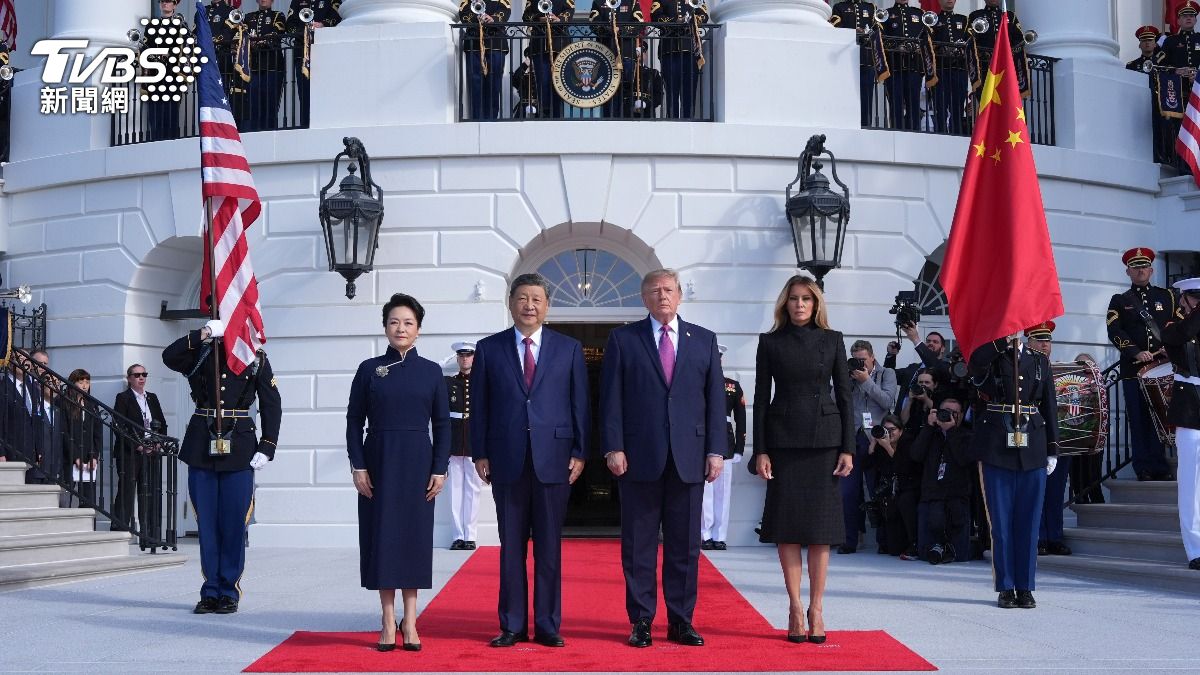
TAIPEI (TVBS News) — Taiwan is suffering from a new kind of diplomatic ailment: transactional anxiety. As U.S. President Donald Trump and Chinese President Xi Jinping (習近平) toasted at a White House state dinner on Thursday (Sept. 24), Taiwan's government could only watch from 12,000 kilometers away — not fearing betrayal, but something worse: being reduced to a bargaining chip.
For Washington, this summit was about managing a rival superpower. For Beijing, it was about projecting strength ahead of next year's Party Congress. But for Taiwan, the stakes are existential. The worry is real that a broader U.S.-China deal could come at its expense, not through dramatic betrayal, but through the slow erosion of commitments.
The evidence is mounting. Trump has described a frozen US$14 billion (around NT$445.9 billion) arms package for Taiwan as "a very good bargaining chip." At the summit, Xi pressed further: according to Xinhua (新華社), he urged Washington to "oppose" Taiwan independence. This marks an escalation from the long-standing formulation of "not supporting" independence.
The distinction matters, according to Jennifer Welch of Bloomberg Economics. While "not supporting" Taiwan independence is passive, "opposing" it implies active countermeasures. Beijing could use this framing to justify pressure on third countries, demanding they limit diplomatic, economic, or military ties with Taipei.
Reuters reported no indication the Trump administration will change its existing formulation. Writing in the Washington Post, Max Boot argued Trump's approach has given China a historic opening. For the first time, Beijing has the opportunity "to influence" whether Washington aids Taiwan, a departure from decades of policy treating Taiwan's defense as principle, not negotiation.
Sun Chenghao (孫成昊), a scholar at Tsinghua University's Institute for International Relations in Beijing, offered a blunt assessment of Trump's calculus. "Trump will keep delaying until the end," Sun told United Daily News (聯合報), "because once the arms are sold, that bargaining chip becomes invalid."
Taiwan's national security officials anticipate continued pressure. The Liberty Times (自由時報), citing officials, reported Beijing aims to delay arms sales "all the way past Christmas," with potential pressure at APEC and the G20. Neither the Ministry of Foreign Affairs nor the Presidential Office has issued a statement on the summit itself. The Mainland Affairs Council's (陸委會) last comment came Monday, four days before the leaders sat down.
The Taiwanese agency responsible for handling cross-strait relations outlined a "three unchangeds" framework: U.S.-China competition, U.S. Taiwan policy, and Taiwan's cross-strait stance will remain unchanged. Critics call this wishful thinking. United Daily News deputy editor Yu Chi-chang (游其昌) characterized the government's posture as "pretending all is well" while diplomatic space shrinks.
The ruling DPP has pushed back. At a press conference on Tuesday, caucus whip Chuang Jui-hsiung (莊瑞雄) reminded Washington that the 1982 August 17 Communiqué requires China to pursue peaceful resolution. He invoked the Six Assurances, which stated Washington did not agree to consult Beijing before selling weapons to Taiwan.
Yet Taiwan is not without leverage. TSMC announced in July an additional US$100 billion (around NT$3.185 trillion) investment in Arizona, reinforcing the semiconductor giant's role as a linchpin of U.S. technology supply chains. The U.S.-Japan-ROK trilateral statement issued on Sept. 21 explicitly "emphasized the importance of maintaining peace and stability across the Taiwan Strait."
In an interview with Voice of America before the summit, State Department spokesperson Jakob Lengacher reaffirmed the U.S. position. "The United States opposes any side changing the status quo," he said. Yet reassurances may not resolve the paradox Taiwan faces: the same logic that makes it vulnerable also gives it leverage. TSMC investments create interdependence. Congressional support remains bipartisan. But none of these safeguards are self-executing.
The summit produced no breakthrough on Taiwan, and perhaps that was the point. For Taipei, the ambiguity is both shield and cage: protection from the worst-case scenario, but confirmation that its fate remains subject to negotiation. As Trump and Xi raised their glasses on Thursday, Taiwan's silence was not passive. It was the sound of a government calculating how long it can afford to wait. ◼ (At time of reporting, US$1 equals approximately NT$31.85)