



Wistron’s AI Pivot Outpaces Taiwan’s Server Giants
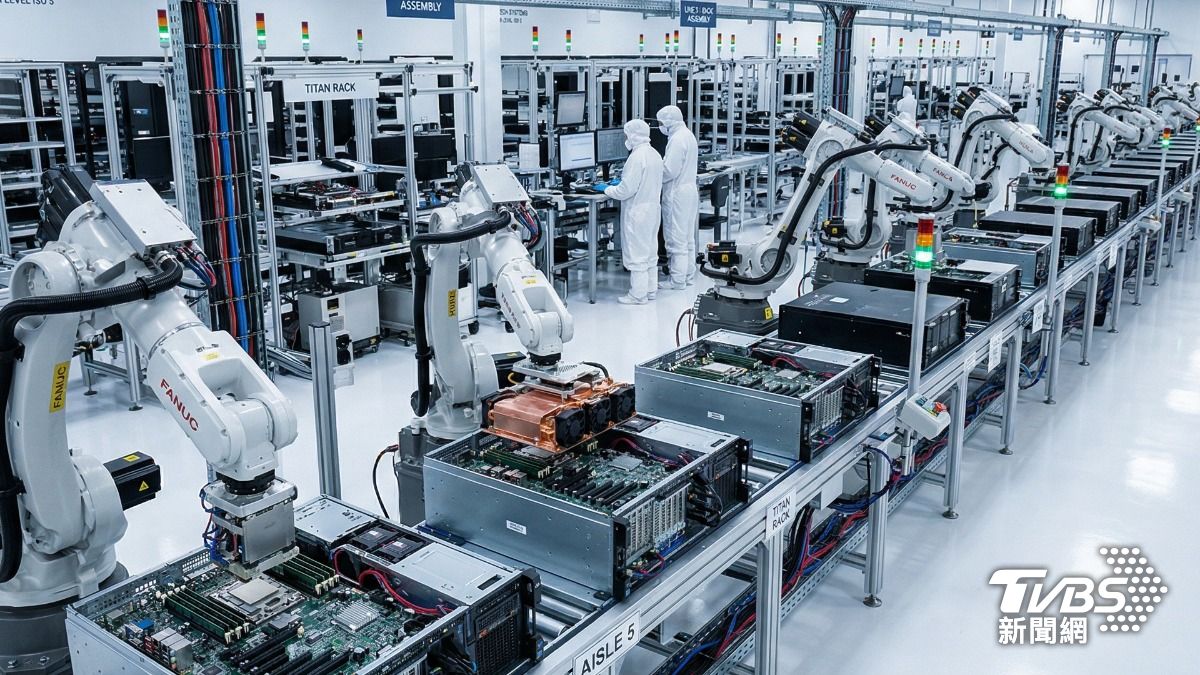
Wistron Corporation was once best known as one of the world’s largest notebook assemblers. Today, it is one of the biggest stories in the AI hardware industry. In the first quarter of 2026, the Taiwan ODM posted the highest revenue growth rate among the island’s five major server makers, cementing a transformation that has reshaped the company from top to bottom.
Wistron reported first-quarter 2026 consolidated revenue of NT$846.3 billion (US$26.5 billion), up an extraordinary 144.3% year-over-year. March alone set a new monthly record at NT$333.0 billion (US$10.4 billion), up 117.7% from a year earlier. February was equally striking, with revenue of NT$284.9 billion (US$8.9 billion), a 177.4% year-over-year jump.
The results cap a remarkable 2025, in which full-year consolidated revenue reached NT$2.19 trillion (US$68.6 billion), roughly doubling from the prior year. Net profit attributable to the parent company came in at NT$27.41 billion (US$858 million), up 57%, with earnings per share of NT$9.04 (US$0.28).
AI servers now account for approximately 70% of Wistron's total revenue, up from a fraction just two years ago. Management has guided for high-double-digit to triple-digit year-over-year growth in AI server shipments in 2026 – a signal that the current pace is expected to hold.
Wistron is making one of the most ambitious manufacturing investments among its Taiwan peers. The company is investing US$761 million in two AI supercomputing facilities in Fort Worth, Texas, that are scheduled to open in the first half of 2026. Wistron eventually plans to hire around 900 employees across the two locations.
The Texas plants will use Nvidia technology to build smart factories for manufacturing AI supercomputers, incorporating digital twin technology and physical AI principles. This makes Wistron not just a producer of AI hardware but a user of it in its own production processes.
Back in Taiwan, the board has approved an investment of up to NT$1.82 billion (US$57 million) to upgrade its Hsinchu facility, and the company's subsidiary Wistron InfoComm Technology (Texas) is investing up to US$32.9 million to expand AI server manufacturing capacity in Mexico.
On the technology front, Wistron is deepening its role as a primary assembler of Nvidia’s next-generation rack systems. The company is already building GB300 Blackwell rack systems and preparing for the upcoming Rubin platform.
Wistron is also benefiting from the rise of custom ASIC servers featuring chips designed by hyperscalers like Amazon as alternatives to Nvidia GPUs. ASIC server production is expected to ramp Q2 2026, adding another revenue stream beyond GPU-based systems.
The notebook segment remains active too. Wistron shipped 2.8 million notebooks in March 2026, a 75% jump month-over-month, though the AI server business now clearly dominates the company's growth profile.
The outlook for the rest of 2026 is bullish. Management expects continued sequential and year-over-year revenue growth in Q2. Order books extend well into 2027, and the constraining factor is no longer demand but supply chain capacity.
Wistron's transformation is one of the most dramatic in Taiwan's technology sector. A company that doubled its revenue in a single year and now derives 70% of sales from AI infrastructure has effectively reinvented itself. For investors and industry observers, the question is how much further this trajectory can run. So far, the answer keeps surprising to the upside.