


Foxconn turns to veteran Lee Kuang-yao for robotics overhaul
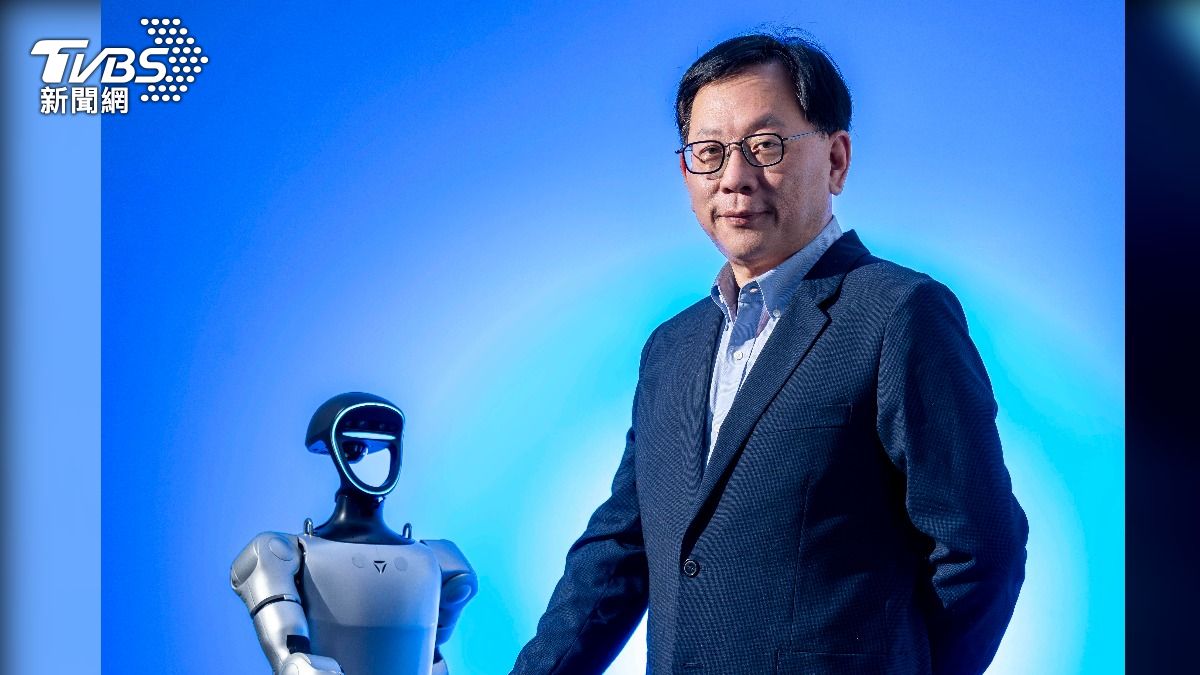
In Foxconn's (鴻海) NT$8 trillion (US$254 billion) empire, robotics is considered the most challenging yet crucial engine in its "3+3" blueprint. When this responsibility fell to Lee Kuang-yao (李光曜), he did more than transform the contract manufacturing mindset — he pledged to triple revenue by 2028.
TAIPEI (Business Today/TVBS News) — Since Foxconn (鴻海) Chairman Young Liu (劉揚偉) took office, he has charted a clear "3+3" strategic course for the company, an industrial aircraft carrier with annual revenues exceeding NT$8 trillion (US$254 billion). The three future industries — electric vehicles, digital health and robotics — are regarded as key engines for the group's transformation and growth.
Also Serves as Pan-International Industrial Chairman; Once Helmed Foxconn Technology
Among these future industries, the robotics business — the most technically challenging sector — is overseen by Lee Kuang-yao, who concurrently serves as head of Foxconn's C Business Group (C事業群) and chairman of its subsidiary Pan-International Industrial (廣宇).
Lee, who studied mechanical engineering formally, has worked on various businesses at Foxconn (鴻海) including desktop computers, tablets and point-of-sale (POS) systems. He has also served clients including one of China's largest technology companies and a major American startup. After the COVID-19 pandemic, he transferred back to Taiwan and became chairman of Foxconn Technology (鴻準), where he oversaw the electric vehicle casing lightweight metal project while concurrently serving as head of Foxconn's electric commercial vehicle business.
In 2023, Lee became chairman of Pan-International Industrial Corp.(廣宇科技), leading the company into AI servers and robot wiring harnesses. Late last year, he was promoted to head of Foxconn's C Business Group (C事業群).
What makes Lee so distinctive that he has held important positions throughout his career? Why did Liu entrust him with the robotics business, which is crucial to Foxconn's competitiveness for the next decade?
In an exclusive interview with Business Today (今周刊), Lee's tone was pragmatic. But when discussing industry positioning, he analyzed technology in detail and clearly explained business strategies, demonstrating a capable and seasoned management style.
Lee explained that C Business Group is Foxconn's oldest business unit and can be considered the origin of the conglomerate's precision manufacturing. However, as the group's scale expanded, core businesses such as precision machining and precision mold-making gradually dispersed after multiple organizational restructurings. His most important goal upon taking over is to restore the unit's golden reputation.
"When I took over, the most important goal I discussed with Chairman Liu (劉揚偉) was to bring back these precision technologies and ensure they can be preserved and advanced," Lee said.
Lee observed that in the era of automation and AI, traditional manufacturing cannot be satisfied with earning "contract manufacturing money" — hard-earned income from assembly work. Instead, they should strive to earn "technology money."
He noted that C Business Group's metal processing precision is extremely high, reaching nanometer-level accuracy. The unit also possesses highly challenging fiber optic connector (MPO) precision manufacturing capabilities. "If you exclude robot software and computing components, C Business Group can supply about 40 to 50 percent of a robot's total cost in mechanical structures and key components," he said.
However, monetizing technology requires a flexible organizational structure. Pan-International Industrial, a publicly listed company with 50 years of history and deep roots in wiring harness and electronics contract manufacturing, became Lee's platform for realizing his vision.
Although Pan-International Industrial has a deep technical foundation, its existing profitability has been under pressure in recent years, creating an urgent need for transformation. As soon as Lee took over, he targeted the robotics business as the transformation objective. "Pan-International Industrial has always excelled at making wiring harnesses, and robot joint motors require a large amount of copper wire winding, which is highly aligned with the company's core technology," he explained.
Beyond technical advantages, Lee identified the complementarity between Pan-International Industrial and C Business Group. Pan-International Industrial, as an independent publicly listed company, has quick response times and a lean structure but finds it difficult to bear massive heavy-asset investments. C Business Group, by contrast, is the epitome of heavy assets.
"Massive production capacity and scale are our advantages when competing as robot component suppliers," Lee said. Through resource sharing between C Business Group's heavy assets and Pan-International Industrial's light assets, both sides can avoid wasteful redundant investments.
Currently, Lee is adopting a group strategy, positioning robotics as C Business Group's second growth engine. He has established an internal project team and is gradually adjusting the organizational structure to develop new product lines.
However, transitioning from an electronics contract manufacturing stronghold to robotics is not easy.
Leading on Specifications While Helping Clients Cut Costs by 80 Percent
Lee stated that in the past, the fatal flaw of Taiwan's contract manufacturers was "not knowing how to define specifications." But the robotics industry is currently in its nascent stage, with no consensus yet on basic interfaces or arm specifications. Therefore, his team is actively discussing specifications with global startups to establish technical barriers to entry.
But why do startups need Foxconn (鴻海)? Lee has pondered this question for a long time. He believes that many startups have innovative concepts but lack experience in translating designs into factory production. Foxconn can intervene at the early stage when customers' concepts are still germinating, helping catch errors and optimize costs. For example, he once helped a startup team lacking mass production experience adjust unreasonable tolerance requirements, reducing production costs by 80 percent.
Lee pointed out that when setting robot specifications, he constantly reflects on fundamental questions. "Why must a robot have five fingers?" he asked. If a robot doesn't play piano, it actually only needs four fingers to meet movement requirements — and can save significant joint control costs. This is specification thinking that starts from first principles.
Lee observed that in the Chinese market alone, there are currently more than 120 humanoid robot startups. Facing such intense competition, his strategy is to create a closed loop. In this ecosystem, Foxconn simultaneously plays three roles: investing shareholder, contract manufacturing supplier, and customer — enabling Foxconn's factory system to procure and integrate the products. Recently, Pan-International Industrial has also been striving to gain full control of core components through investment and acquisitions.
Regarding the future development of C Business Group, Lee has set specific goals: He expects that by 2028, C Business Group's revenue will triple compared to 2026, with gross profit margin rising to above 15 percent.
Whether Foxconn's robotics business can stand alongside industry giants to jointly set robot specifications will determine whether the parent group, with NT$8 trillion (US$254 billion) in revenue, can continue to grow. This bears close watching. ◼ (At time of reporting, US$1 equals approximately NT$31.54)
>>> For More Reading:
This article is excerpted from the No. 1532 issue of Business Today (今周刊). Click here for the Chinese-language version of this story: 鴻海8兆帝國關鍵一役!劉揚偉為何欽點李光曜掌舵機器人?不能只賺代工辛苦錢,立軍令狀「業績2028年成長3倍」
>>> More Coverage:
01 | 魏哲家不去美國,赴屏科半導體專區,賴清德:他要去見誰想得到吧?雨大到鞋濕⋯CC喊不缺水「但缺人才」