



How Taiwan helped Jensen Huang build Nvidia
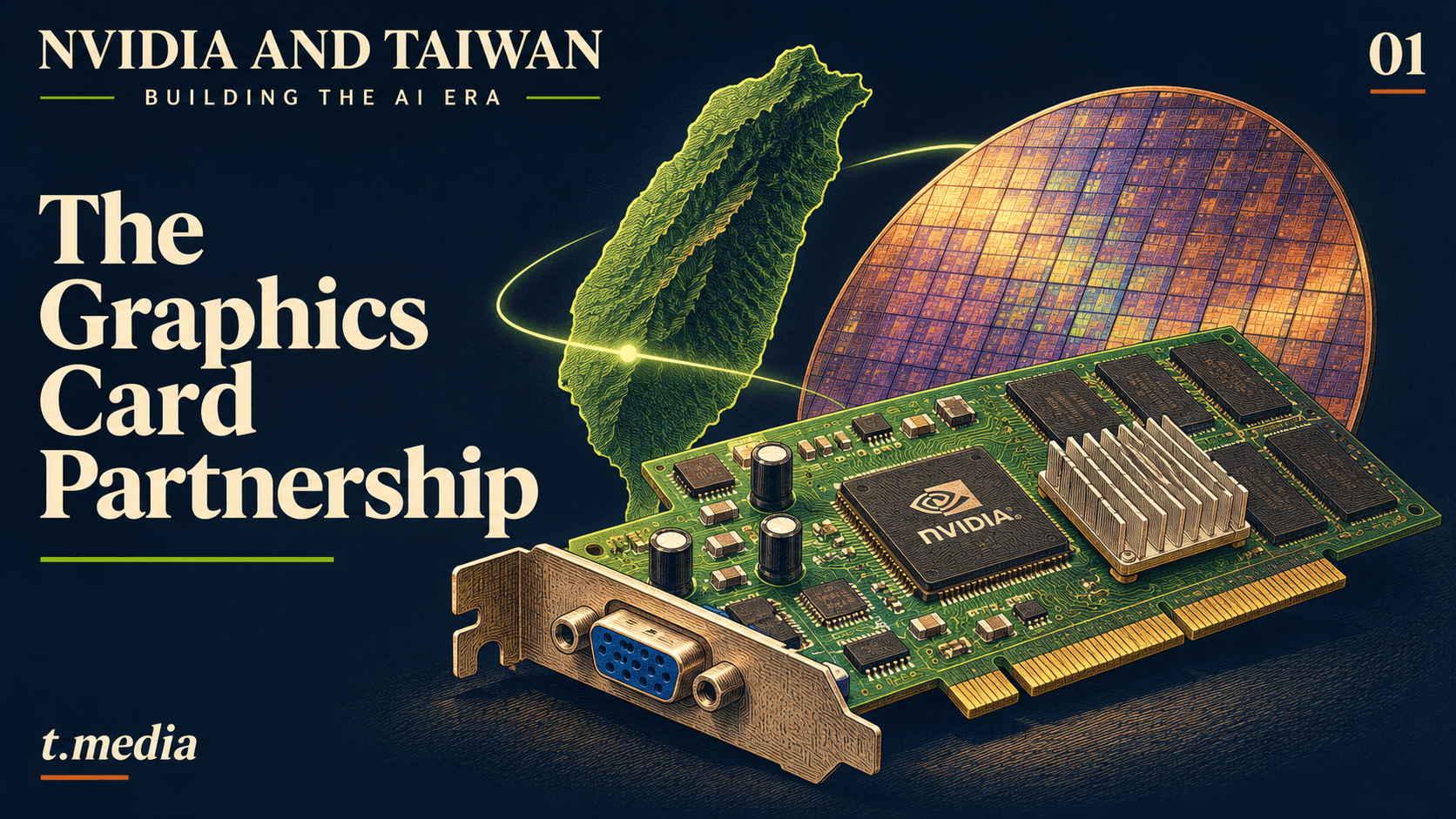
Nvidia has never owned a chip factory. From its earliest years it relied on other companies to produce its processors and to build the graphics cards that carried them into millions of computers. Taiwan supplied both, and the relationships formed in the 1990s later supported Nvidia’s expansion into AI servers.
In those years, a separate graphics card was something a PC maker had to be persuaded to add because it increased cost, consumed electricity, and generated heat. Nvidia had to show that better games and visual performance justified those additions, and Taiwan’s manufacturers turned that argument into products customers could buy.
The RIVA 128 became Nvidia’s first commercial success in 1997, but manufacturing problems at its European supplier, SGS-Thomson, left Huang looking for another chipmaker. His approaches to TSMC’s California sales office went unanswered, so he wrote directly to the company’s founder, Morris Chang. Chang has recalled that the letter made him curious and a little irritated, because he had always told his sales staff never to neglect a small customer. He telephoned Huang himself.
Nvidia then had 50 to 60 employees and annual sales of less than $30 million. Huang nevertheless told him that Nvidia would become one of TSMC’s major customers. The two companies announced their partnership in February 1998, and Chang later wrote that Nvidia ranked among TSMC’s five largest customers from that year.
The arrangement allowed Nvidia to concentrate on chip design and software while drawing on TSMC’s process technology and fabs. Volumes rose quickly. Nvidia had shipped its ten millionth graphics processor by the end of 1999, and in December 2002 the two companies celebrated the 200 millionth.
Taiwan’s PC manufacturers supplied the other essential link. Asus, MSI, Gigabyte, and Leadtek were among the firms that designed circuit boards, sourced memory, added power and cooling, and built finished cards for each generation of Nvidia chips. Huang later credited these early partners with helping build the modern PC gaming market.
The work demanded close coordination. A new chip needed compatible boards, available components, and dependable software drivers on the day it launched, and motherboard makers and PC assemblers had to ensure the cards worked properly in their systems. A supplier that fell behind could lose sales to a competitor and fall behind in the market.
Intel added to the pressure. Its 810 chipset, introduced in 1999 for inexpensive PCs, featured integrated graphics and removed the need for a separate card. To keep selling its chips, Nvidia had to continue offering capabilities that integrated graphics could not match.
Later that year it introduced the GeForce 256, marketed as the first GPU, or graphics processing unit. The chip took over the demanding calculations for positioning and lighting three-dimensional objects from the computer’s CPU, or central processing unit, allowing richer scenes and freeing the processor for other work. Taiwan’s manufacturers built those chips into graphics cards that brought better performance to gamers and PC enthusiasts.
These launches established a pattern of cooperation across chip manufacturing, board design, components, and software. Nvidia and its partners in Taiwan had to bring increasingly complex hardware to market on tight schedules while meeting greater power and cooling demands. By the time Nvidia entered the AI server market, it could draw on decades of manufacturing experience and close cooperation with Taiwan’s suppliers.
This is the first article in “Nvidia and Taiwan: Building the AI Era,” a six-part series exploring the partnership behind the AI boom.