



Tech titans join Taiwan crisis talks on doubling stock stabilization fund
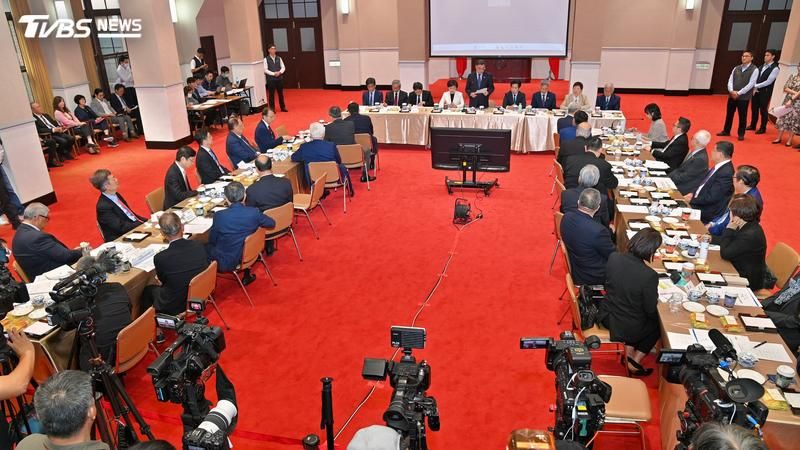
TAIPEI (TVBS News) — Taiwan's premier convened an emergency summit Monday (Nov. 23) with the island's top technology and financial executives. The government pledged to expand the National Stabilization Fund and ease trading restrictions as officials mobilized to contain the worst stock market rout in years.
Premier Cho Jung-tai (卓榮泰) hosted the 90-minute session at the Executive Yuan, Taiwan's cabinet. Attendees included Hon Hai Chairman Young Liu (劉揚偉), Fubon Financial Holdings (富邦金控) Chairman Daniel Tsai (蔡明興), and Cathay Financial Holdings (國泰金控) President Lee Chang-ken (李長庚).
Minister of Finance Chuang Tsui-yun (莊翠雲) said the government would take a "positive and proactive" approach to expanding the fund beyond its current NT$500 billion (around US$15.17 billion) cap. Legislative proposals would double it to NT$1 trillion (around US$30.35 billion). Foreign ownership of Taiwan stocks has risen from 8.44 percent in 2000 to 46.9 percent today, she noted.
"If we expand the scale of the National Stabilization Fund, it can indeed help strengthen the fund's medium- to long-term ability to respond to market volatility," Chuang said. It would also help "maintain stock market stability."
Financial Supervisory Commission (FSC) Chairman Peng Jin-lung (彭金隆) said regulators were reviewing restrictions on "disposition stocks" — shares subject to heightened trading curbs. The FSC planned to announce changes Thursday (Nov. 27).
Young Liu, who also chairs the Taiwan Electrical and Electronic Manufacturers' Association (TEEMA, 電電公會), said Taiwan's AI supply chain accounts for more than 90 percent of global AI server production, with orders booked through 2029. "We believe in Jensen Huang's vision," Liu said, referring to Nvidia's co-founder. "This is a once-in-a-century industrial revolution."
Taiwan Semiconductor Industry Association (TSIA, 臺灣半導體產業協會) Chairman Cliff Hou (侯永清) projected semiconductor production value would reach NT$9.19 trillion (around US$278.91 billion) in 2026, up more than 40 percent from 2025. SEMI Taiwan President Terry Tsao (曹世綸) said demand would outstrip supply "at least through 2028, even 2029."
Taipei Computer Association (TCA) Chairman Jason Chen (陳俊聖), also chief executive of Acer Inc. (宏碁), said exhibitor demand for next year's Computex trade show underscored industry confidence. Booth requests exceeded 5,600 as of mid-October, leaving a shortfall of more than 1,400 booths even after organizers added 600 spaces, he said.
The summit followed a week in which the benchmark TAIEX plunged 7,641 points, or about 17 percent. Monday's session saw the index swing 1,665 points before closing up 778 points at 36,811.89.
Bankers' Association of the Republic of China (銀行公會) Chairman Ray Dawn (董瑞斌) acknowledged funding pressures. "Taiwan is not short of capital," Dawn said. "It's just that there is no longer cheap capital." He said banks had subsidized NT$4.5 billion (around US$136.57 million) in interest costs to support 10,000 small and medium enterprises.
The National Stabilization Fund confirmed it had entered the market Monday, though officials did not disclose the amount. The FSC's third wave of short-selling restrictions took effect the same day. Premier Cho, speaking to reporters Monday morning before the summit, urged unity: "We must work together to face this situation." ◼ (At time of reporting, US$1 equals approximately NT$32.95)