


From Guanghua to Syntrend, Taiwan’s PC industry changes its shopfront
Beneath a flyover in central Taipei, a wall covered in old motherboards offers a fitting introduction to the neighborhood. For half a century, this district has been a place to buy components, assemble computers, and keep aging machines running. Its shops made Taiwan’s electronics industry accessible to anyone prepared to compare specifications and negotiate a price.
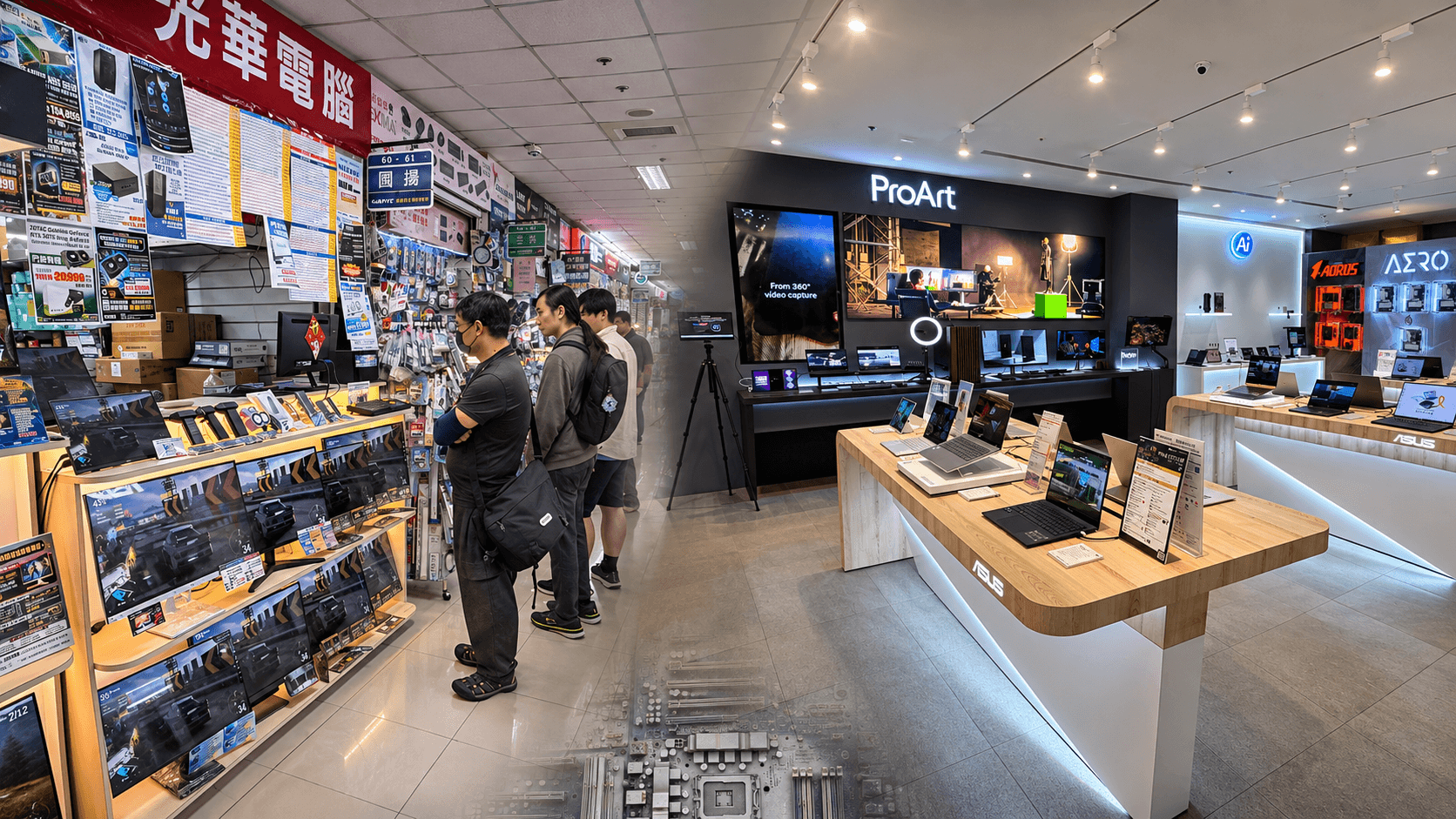
Today, two neighboring buildings reveal how that industry has changed. Guanghua Digital Plaza preserves the crowded, practical world of computer retailing. Syntrend presents technology through carefully arranged displays and dedicated brand stores. The distance between them is short, but their approaches to selling a computer are markedly different.
Guanghua Market began in 1973 beneath the Guanghua Bridge, bringing together second-hand booksellers. Electronics subsequently became an important trade, including used equipment and parts obtained from departing American military personnel. Students from the nearby technical college provided a ready market, and computer hardware and software followed as Taiwan’s PC industry developed.
By the 1990s, the district had become known as Taipei’s Akihabara. Customers could choose a motherboard, processor, power supply, and case, negotiate the total price, and have a computer assembled on the spot. Boards from Asus, Gigabyte, and MSI connected the shops directly to companies that were becoming major international suppliers.
The bridge was demolished in 2006. After a period in temporary premises, traders moved into the present Guanghua Digital Plaza in July 2008.
On its upper floors, much of the old retail culture survives. Narrow aisles pass shops stacked with cables, fans, drives, motherboards, and graphics cards. Printed price lists cover counters. Several competing computer brands share the signs above a single doorway, inviting customers to compare their specifications and prices.
Closed shutters also interrupt the rows. Online shopping has made price comparisons easier, while changes in how people buy and use computers have challenged a business built around assembling and upgrading desktop machines. The specialist knowledge remains valuable, but customers have more ways to obtain both products and advice.
Just opposite, Syntrend organizes the encounter differently. It opened in May 2015 following an investment of approximately NT$3.8 billion (approximately US$116 million) by a Foxconn affiliate. The group had secured a 50-year development and operating concession in 2010, with Jeffrey Gou, eldest son of Foxconn founder Terry Gou, leading the project. More than 60,000 visitors arrived on opening day.
Its Chinese name, 三創, refers to creativity, innovation and entrepreneurship. Inside, individual brands have space to establish their own identities. Open tables and warm lighting encourage visitors to linger. Asus gives its ProArt creator range a dedicated display, including its latest RTX Spark notebook dismantled layer by layer to reveal its engineering. Gigabyte presents its Aero range on a sculpted white counter. MSI, Lenovo, and HP appear alongside DJI, Xiaomi, and Logitech.
Customers can handle the machines, examine their screens, and keyboards, and judge how they might fit into their work. Specifications still matter, but the presentation gives design and experience a larger role in the purchase.
That reflects years of investment by Taiwan’s PC companies in recognizable product families. Asus’s Republic of Gamers, Zenbook, and ProArt address different customers, from gaming enthusiasts to mobile professionals and creative workers. Interbrand valued the Asus brand at US$2.595 billion in 2025, when it topped Taiwan’s global-brand ranking for the twelfth time.
The strategy faces a difficult market. Gartner estimates that worldwide PC shipments fell 22.4% year on year in the third quarter of 2026 as higher component costs pushed up selling prices. Brands must give customers reasons to accept those prices rather than postpone replacing a functioning computer. Better design and a persuasive showroom can help make that case, but the product still has to justify the expense.
Meanwhile, some of the same companies are finding much larger customers outside consumer retail. Asus’s infrastructure business contributed 30% of third-quarter branded revenue, while servers generated most of Gigabyte’s sales. Their expertise in boards, components, and PCs now supports complete AI computing systems.
Guanghua and Syntrend capture two overlapping parts of that development: the market where customers could build a computer component by component, and the showroom where companies explain why their finished products deserve a premium. The next stage is increasingly taking place in data centers, beyond the view of shoppers.
For now, a two-minute walk between the buildings offers a compact history of how Taiwan learned to build computers and how its companies are positioning themselves for the AI era.