


How Taiwan’s suppliers will shape Nvidia’s next AI Systems
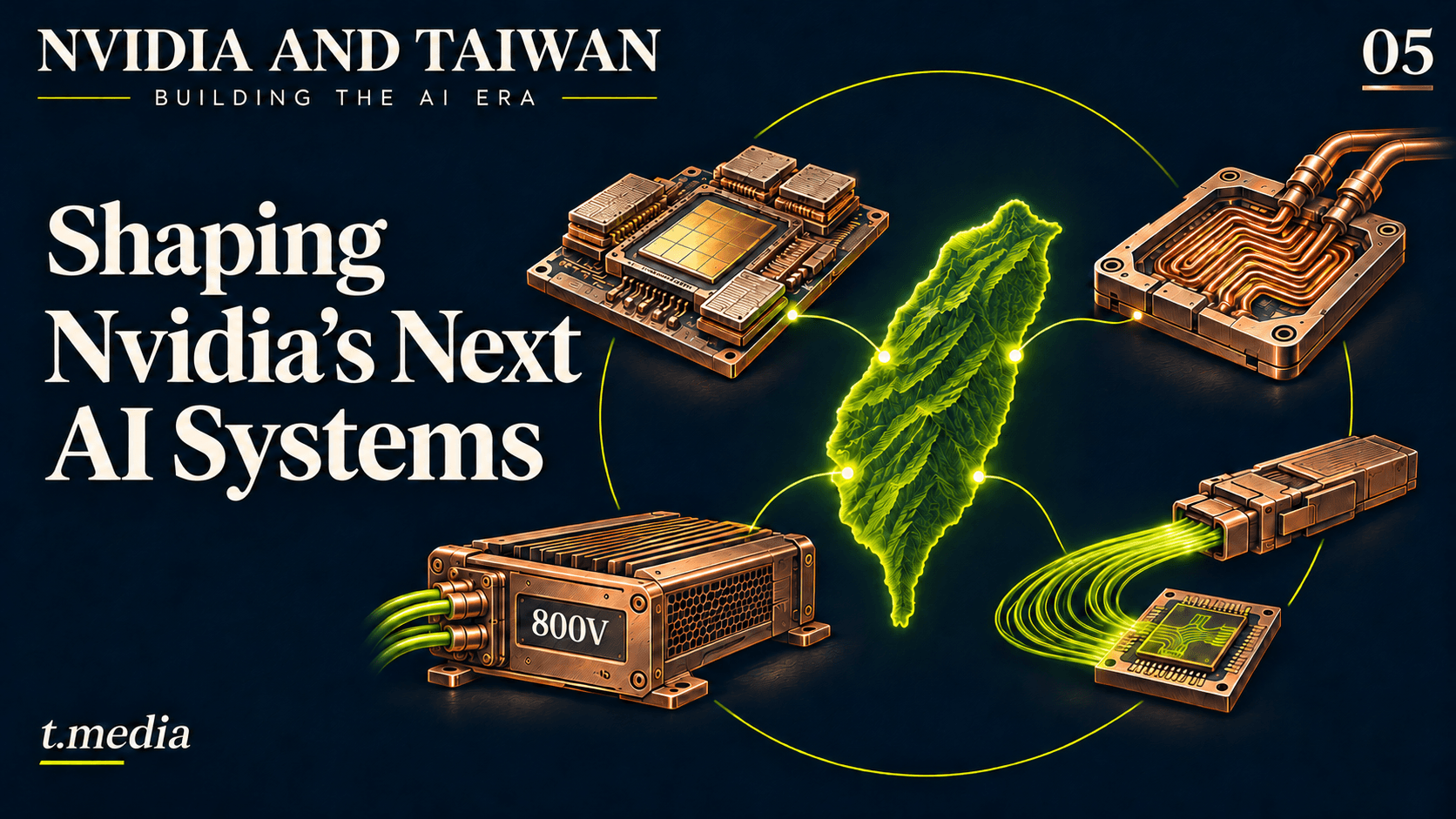
Nvidia reinstated Jensen Huang as chief executive on November 23, restoring the company founder who built its relationships with TSMC, Foxconn, Quanta, and other manufacturers. He returns to a production schedule with little room for delay. Vera Rubin must reach customers in volume while engineers prepare Rubin Ultra for 2027 and Feynman for 2028. Those later generations change how AI systems receive electricity, remove heat, and exchange data. Each change depends on coordinated investment and engineering across Taiwan’s suppliers as AMD and custom AI chips gain ground.
The immediate priority is the Rubin rollout. Nvidia has begun shipping Vera Rubin NVL72 systems, which combine 72 GPUs with 36 CPUs and the networking that allows them to operate together. Scaling those deliveries requires matched supplies of processors, high-bandwidth memory, advanced packaging, substrates, circuit boards, power equipment, and cooling systems. A shortage or qualification failure in one component holds up a complete rack.
Verification is as demanding as output. A rack must run reliably under sustained computing loads, with stable power, adequate coolant flow, and dependable communication between processors. Faults that remain hidden when components are tested separately can emerge once the whole system operates together.
Nvidia is paying for part of the preparation. Its funding for substrate, testing, and packaging capacity gives manufacturers the confidence to invest before orders turn into shipments. Money cannot instantly deliver qualified factories, trained engineers, or acceptable production yields, so Huang must keep expansion schedules aligned with successive product launches.
Rubin Ultra and Feynman raise the difficulty. Nvidia’s planned Kyber rack links larger groups of processors, which increases the demands on connections, power distribution, and maintenance. Suppliers need a manufacturable design early enough to build tooling and capacity, while Nvidia keeps improving performance. A late change forces revisions across several companies at once.
Power delivery is one of the most significant changes. At about 54 volts, rising rack power means higher current, heavier conductors, and greater electrical losses. Moving to 800-volt direct current cuts the current needed to carry the same power, which allows more compact distribution equipment.
The higher voltage requires new converters, connectors, insulation, and protection systems, along with procedures for servicing the equipment safely. Existing data centers also need an upgrade path. Nvidia is developing power racks that connect to a building’s existing electrical supply and distribute 800V to computing equipment, sparing operators an immediate replacement of the facility’s power infrastructure.
Delta has demonstrated a 660-kilowatt 800V power rack with battery backup and a coolant distribution unit capable of transferring up to 2.5 megawatts of heat. Showing the two together reflects how power and cooling are now designed as a pair.
Liquid cooling has to be re-engineered for each generation. Cold plates must remove heat from increasingly concentrated sources, while pumps, pipes, and connectors maintain the required flow without leaks. AVC and Auras must adapt their designs to every new processor and rack configuration. Server manufacturers then have to make those parts work with the equipment at the customer’s facility.
Co-packaged optics, or CPO, places optical engines close to networking chips, which shortens electrical connections and reduces the power required to move data. Nvidia already uses this approach in networking switches. Extending optical links further into its systems requires precise fiber alignment, combined optical and electrical testing, and designs that technicians can service. The production chain includes TSMC for silicon photonics, SPIL for packaging and testing, and Foxconn for switch assembly.
Competitors are assembling complete systems too. AMD’s Helios combines 72 GPUs with its CPUs, networking, and ROCm software. Cloud operators are expanding custom processors tailored to their workloads, supported by Taiwan’s design houses and manufacturers. Nvidia must therefore show that its tightly integrated platforms deliver enough usable computing performance and operating savings to justify their cost and complexity.
Huang helped turn Taiwan’s manufacturing capabilities into Nvidia’s competitive advantage. Keeping it now means coordinating changes in power, cooling, and optics that depend on one another, across three product generations. The next round will go to the company that delivers the most effective working systems on schedule. Taiwan’s manufacturers are building for more than one contender.