



Powering AI’s Heat Wave: Taiwan’s Thermal Sector Breaks Out
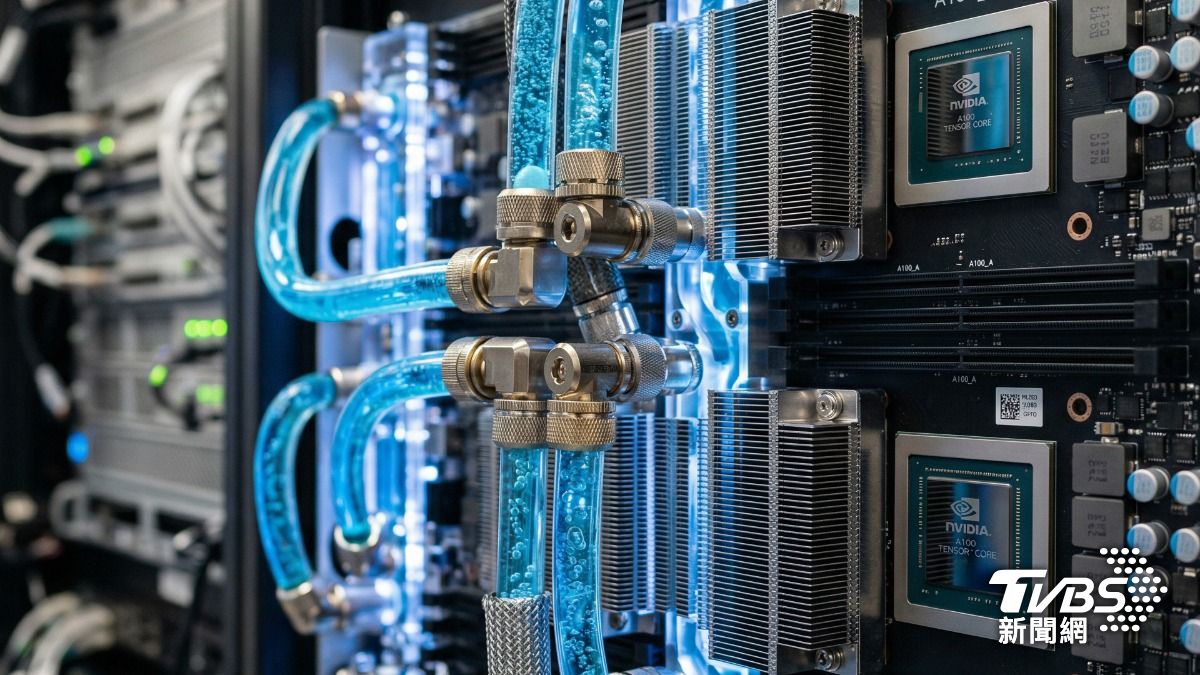
As AI servers grow exponentially more powerful, the infrastructure needed to feed them electricity and keep them from overheating has become one of the technology industry's most critical bottlenecks. In Taiwan, the companies solving these problems are posting some of the fastest growth rates in the entire hardware supply chain, and the momentum heading into Q2 2026 shows no signs of slowing.
A single Nvidia GB200 NVL72 rack, the kind now being deployed by the world's largest cloud providers, draws roughly 120 kilowatts of power. That is six to twenty times more than a traditional server rack from just a few years ago. The next-generation Rubin platform, expected later in 2026, could push individual racks toward 200–250 kilowatts. At these densities, conventional air cooling simply cannot keep up. Direct-to-chip liquid cooling has gone from an optional upgrade to an engineering necessity.
Liquid-cooled AI servers represented roughly 15% of deployments in 2024, reached an estimated 54% in 2025, and are forecast to hit 76% in 2026. Nvidia's upcoming Vera Rubin platform requires liquid cooling from the ground up. Every server manufacturer must have these capabilities or risk being left behind.
On the power side, traditional 48-volt distribution is giving way to 800-volt high-voltage direct current (HVDC) systems, which reduce current by roughly fifteen times, cut resistive losses, and integrate more easily with on-site renewables and battery storage. Industry analysts expect broad 800V adoption by 2027, but the leaders are already shipping.
Delta Electronics is the undisputed heavyweight of this sector. With 2025 revenue of NT$554.9 billion (US$17.9 billion), up 32% year-over-year, and a market capitalization that crossed US$100 billion in early 2026, Delta has evolved from a television power supply maker into what its CEO Ping Cheng calls the "backbone of AI infrastructure." The company's 800V HVDC rack power shelves achieve greater than 98% conversion efficiency, and its liquid-cooled power modules support up to 1.1 megawatts per rack. Delta also manufactures megawatt-class coolant distribution units delivering up to 1,500 kilowatts of cooling capacity. With an estimated 60% share of the AI server power supply market and 2026 capex guidance of roughly NT$40 billion (US$1.3 billion) for expansion in Thailand, the U.S., India, and China, Delta is investing to stay ahead of demand. January–February 2026 revenues rose more than 30% year-over-year.
Asia Vital Components (AVC) has emerged as the volume leader in AI server cooling hardware. The Kaohsiung-based thermal specialist more than doubled its Q1 2026 revenue to NT$49.04 billion (US$1.54 billion), a 110% increase year-over-year. AVC holds an estimated 40–50% share of the cold plate market for Nvidia's GB200 and GB300 systems, supplying the copper microchannel cold plates that sit directly on top of the GPU die. The company is also developing components for Nvidia’s Rubin Ultra platform, which reportedly requires cold plates capable of handling 2.3 kilowatts of thermal load per chip. AVC is expanding capacity in Vietnam and exploring U.S.-based production to stay close to its largest customers.
Auras Technology reported Q1 2026 revenue of NT$8.55 billion (US$269 million), up 94% year-over-year, as the company's product mix tipped decisively from air cooling to liquid cooling. Once known primarily as the world's largest designer of notebook cooling modules, Auras has pivoted aggressively into server thermal components, including cold plates, vapor chambers, heat exchangers, and quick connectors. The company recently earned AMD vapor chamber certification, expanding its addressable market beyond Nvidia-only platforms. Chairman Yu-shen Lin projects 2026 revenue growth of more than 50%, with liquid cooling penetration across the industry surging from 18% in 2025 to 57% in 2026.
Beyond the top three, several companies are scaling rapidly and carving out important positions in the supply chain.
Microloops, a specialist in liquid cooling modules, posted Q1 2026 revenue of NT$854 million (US$27 million), up 50.7% year-over-year. AI cooling now represents roughly 60% of its revenue and is projected to reach 70% by year-end. A major cloud customer is increasing pull-in orders starting in Q2, and management projects full-year 2026 revenue to double. The company has a new Vietnam factory ready for mass production and has expanded its China plant to four times its original capacity.
Kaori Heat Treatment, a brazing and heat exchanger specialist, is pivoting into liquid cooling for data centers. Liquid cooling products already account for more than 20% of revenue and are expected to approach 50% in 2026, with overall revenue growth projected at 80%. CEO Allen Wu has noted that liquid cooling products carry higher profit margins than conventional lines, pushing the company's quarterly gross margin to a record 33%.
International players are also pressing in. ZutaCore, an Israeli firm backed by Wiwynn, is commercializing two-phase direct-to-chip cooling. U.S.-based CoolIT and Boyd are competing for hyperscaler contracts, while Vertiv maintains a strong position in critical power and cooling infrastructure.
The outlook for the power delivery and thermal management sector this year is unambiguously strong. Several forces are converging to accelerate growth.
First, Nvidia’s Rubin platform, with its mandatory liquid cooling requirement, is expected to begin its production ramp around Q3 2026, meaning component qualification and pre-production orders will intensify throughout Q2. Suppliers with proven liquid cooling capabilities will see order books thicken.
Second, rack power densities continue to climb. As Jensen Huang emphasized at GTC 2026, power delivery and liquid cooling must be "co-designed as unified infrastructure." The two transitions are co-dependent: more efficient power delivery reduces waste heat, while denser liquid-cooled racks justify investment in high-voltage distribution. Companies like Delta that offer integrated solutions hold a structural advantage.
Third, geographic diversification is accelerating. Tariff uncertainty is pushing Taiwan thermal and power companies to build capacity in Vietnam, Malaysia, Thailand, and the United States to expand their footprint while opening revenue opportunities closer to end customers.
The global data center cooling market, valued at roughly US$20 billion in 2024, is projected to reach US$50 billion by 2030. For Taiwan's thermal and power specialists, Q2 2026 looks like another quarter of exceptional growth, with the best likely still ahead.