



From Notebooks to Nvidia: Auras’s Liquid Cooling Ascent
For most of its history, Auras Technology was known for cooling laptops. Founded in 1998, the company grew into the world's largest designer of notebook cooling modules, supplying Dell, Quanta, Compal, and Samsung. Today, that business is a sideshow. AI servers drive over 75% of revenue, liquid cooling has overtaken air cooling in the mix, and Auras is posting growth rates that would be the envy of any company in Taiwan's tech sector.
Auras reported first-quarter 2026 revenue of NT$8.55 billion (US$269 million), up 94% year-over-year. March was the standout month at NT$3.33 billion (US$105 million), a 91.7% jump from a year earlier. January had been even more explosive, surging 121.6% year-over-year to NT$3.04 billion (US$97 million).
These results build on a strong 2025, when full-year revenue reached NT$23.3 billion (US$740 million), up 47% - itself a record. But the Q1 2026 growth rate of 94% suggests the company's trajectory is steepening, not flattening.
The most telling number may be the product mix. Liquid cooling now accounts for 55% of Auras' revenue, surpassing air cooling for the first time. Server products represent 76% of total sales, while the legacy PC business has shrunk to just 17%. In the space of a few years, Auras has effectively reinvented itself.
Auras built its reputation on vapor chamber technology: thin, sealed copper plates that spread heat evenly across a surface. These remain a core competency, and the company recently earned AMD vapor chamber certification, expanding its addressable market beyond Nvidia-only platforms into AMD-powered servers.
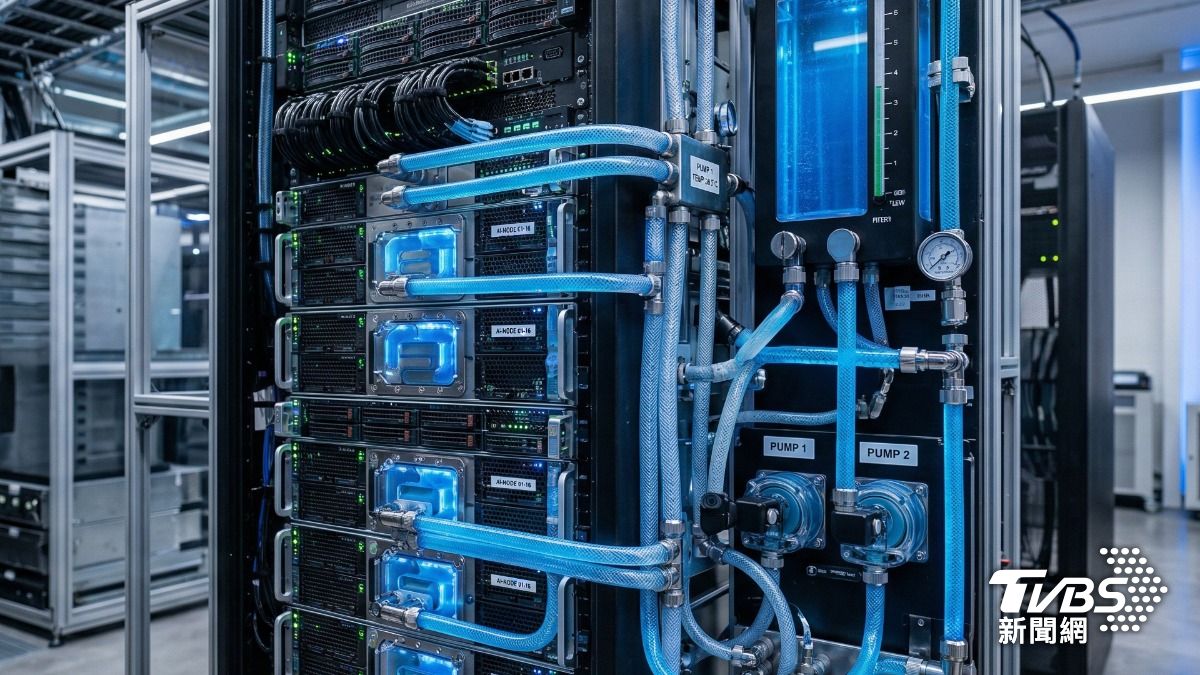
But the bigger growth story is liquid cooling. Auras now manufactures cold plates, liquid-to-liquid heat exchangers, and quick connectors for the cooling loops that circulate liquid coolant directly over GPU chips. The company is also developing 3D vapor chambers for mid-range power applications, a hybrid technology that bridges traditional air cooling and full liquid immersion.
Auras is part of the supplier ecosystem for Nvidia's Vera Rubin platform, which mandates 100% liquid cooling and pushes GPU thermal design power to 1,800–2,300 watts per chip. The company is also reportedly among the key suppliers for AWS's Trainium 3 custom AI chip, which is expected to adopt liquid cooling in the second half of 2026. This dual exposure to both Nvidia GPU platforms and hyperscaler custom ASIC servers gives Auras a diversified order book.
Chairman Yu-shen Lin has projected 2026 revenue growth of more than 50%, a figure that looks conservative given Q1's 94% pace. The company expects liquid cooling revenue to double over the full year, driven by the industry-wide shift from hybrid to fully liquid-cooled server architectures.
Auras is expanding manufacturing capacity to meet this demand. Its proximity to major ODMs like Foxconn, Quanta, and Wistron remains a strategic advantage, enabling rapid prototyping and just-in-time delivery in an industry where thermal requirements change with each chip generation.
The tailwinds are structural. Liquid cooling penetration in AI servers is forecast to jump from 18% in 2025 to 57% in 2026. Nvidia's Vera Rubin platform requires liquid cooling across all deployments. Hyperscaler capital spending shows no signs of easing. And custom ASIC servers from Google, Amazon, Microsoft, and Meta are opening a new wave of thermal management demand.
For Auras, the path from notebook coolers to AI infrastructure has been one of the most successful pivots in Taiwan's technology sector. With liquid cooling now the majority of its business and demand visibility extending into 2027, the company has moved well beyond its origins and the growth runway ahead looks extremely promising.