


Taiwan Surpasses the UK: The Real Story Behind Its Rise
Yesterday Taiwan vaulted past the United Kingdom to become the world's seventh-largest stock market, at roughly US$4.14 trillion in total capitalization against the UK's US$4.09 trillion. The TAIEX is up around 26% year-to-date; the FTSE is up 6%. In April alone, foreign investors poured more than US$10 billion into Taipei.
The reaction in some quarters was predictably dismissive: It’s just TSMC. It’s an AI bubble. Taiwan simply got lucky.
All three claims miss the mark.
TSMC is indeed enormous. Now the world’s seventh-most-valuable company at nearly US$1.9 trillion, it accounts for a heavy share of the Taipei index. But viewing TSMC as a fortunate windfall gets the causation backwards. TSMC is not luck that happened to Taiwan. It is the dividend of fifty years of disciplined, consistent industrial policy.
The foundation was laid in the early 1970s, when technocrats such as K.T. Li recognized that a small island lacking natural resources would have to compete on brains, execution, and long-term vision. The Hsinchu Science Park opened in 1980. Morris Chang was recruited from Texas Instruments in 1985. Through eight presidential terms and countless cabinet reshuffles, Taiwan’s policy direction remained remarkably steady, a rarity in democratic politics anywhere.
The results compounded over decades. Radios gave way to televisions, then personal computers, smartphones, and now AI servers. Each step up the technology ladder was earned by generations of engineers and entrepreneurs who refused to be displaced.
Today, that ecosystem is firing on all cylinders. Southern Taiwan Science Park alone reported record revenue of NT$2.97 trillion (approximately US$94.13 billion) in 2025, a 34.26% increase from the previous year. TSMC’s Fab 25 in Taichung is poised to become the world’s largest 1.4nm production facility, while the company’s projected 2026 capital expenditure exceeds US$55 billion, larger than the annual GDP of many nations.
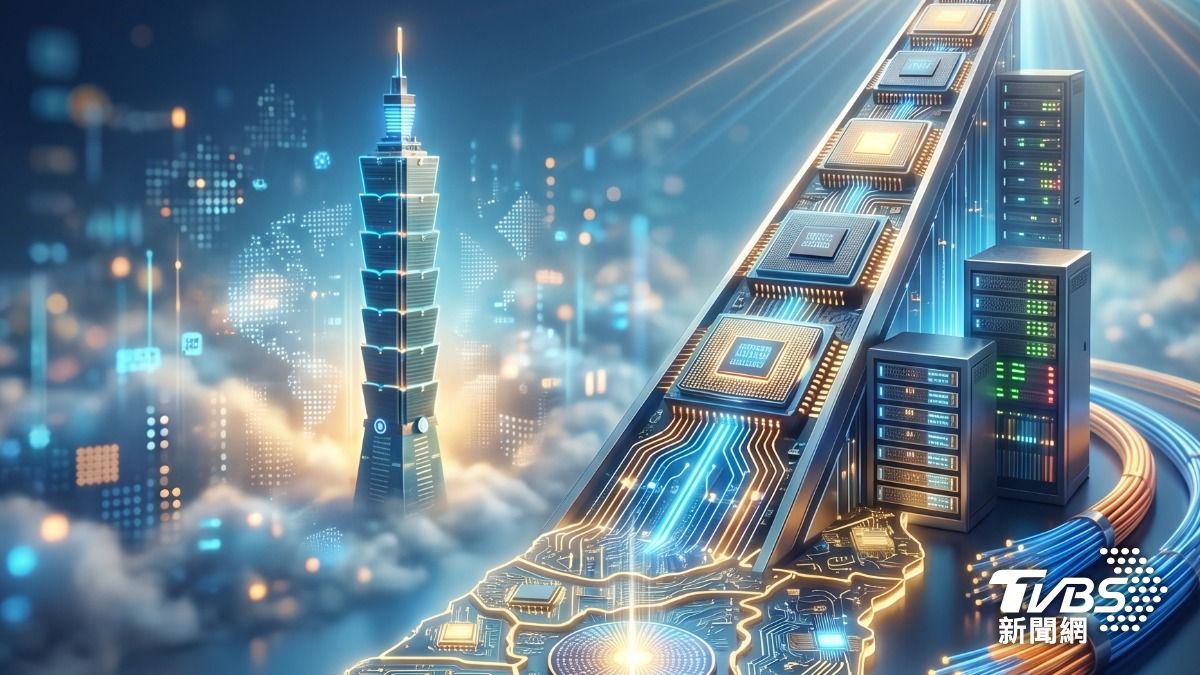
The AI boom did not simply fall into Taiwan’s lap. Taiwan built the runway.
The “it’s only TSMC” argument also overlooks a deeper reality: Taiwan now commands the full AI hardware stack, from silicon wafers to finished server racks. In the first quarter of 2026, Foxconn, Quanta, Wistron, Wiwynn, and Inventec collectively generated over US$133 billion in revenue assembling Nvidia’s GB200 and GB300 servers that power the world’s leading hyperscalers. Delta Electronics, once a maker of TV power supplies, has surpassed US$100 billion in market capitalization by becoming the “grid-to-chip” backbone for high-voltage AI data centers.
Taiwan’s true competitive edge lies in its unmatched industrial density. When Nvidia releases a new chip architecture, Taiwan’s foundries, substrate makers, testing houses, cooling specialists, power suppliers, and ODMs respond as a single, tightly integrated organism. Every link in the supply chain is within a day’s drive of one another.
Even lesser-known players are thriving. AVC and Auras are shipping advanced liquid-cooling systems into server racks that barely existed three years ago. Hiwin and Techman are expanding from motion-control components into humanoid robotics. Chroma ATE, KYEC, and Powertech handle the critical testing and packaging infrastructure for AI chips. Companies such as Lotes, Gudeng, Elite Material, and Unimicron, names still unfamiliar to many Western investors, are quietly contributing to every rack Jensen Huang sells. Printed circuit boards (PCBs) are on track to become Taiwan’s third major industrial pillar, replacing petrochemicals. Each of these firms represents another installment of compound interest earned on policy decisions made before most of today’s executives were born.
The skeptics’ biggest mistake is one of perspective. They look at the soaring charts and see a peak. Taiwan’s companies see a ramp.
AI is rapidly moving beyond the cloud and into automobiles, hospitals, factories, drones, ports, and eventually humanoid robots. Every one of these applications demands precisely what Taiwan has spent half a century mastering: advanced and reliable manufacturing of intelligent hardware at massive scale.
Reaching seventh place is not the ceiling. It is merely a waypoint.
The next decade will belong to the economies capable of building the physical infrastructure of intelligence. On current evidence, that list is very short, and one address stands out: 30078, Hsinchu, Taiwan.