


Taiwan boosts CEE fund by 50M euros during Vystrčil visit
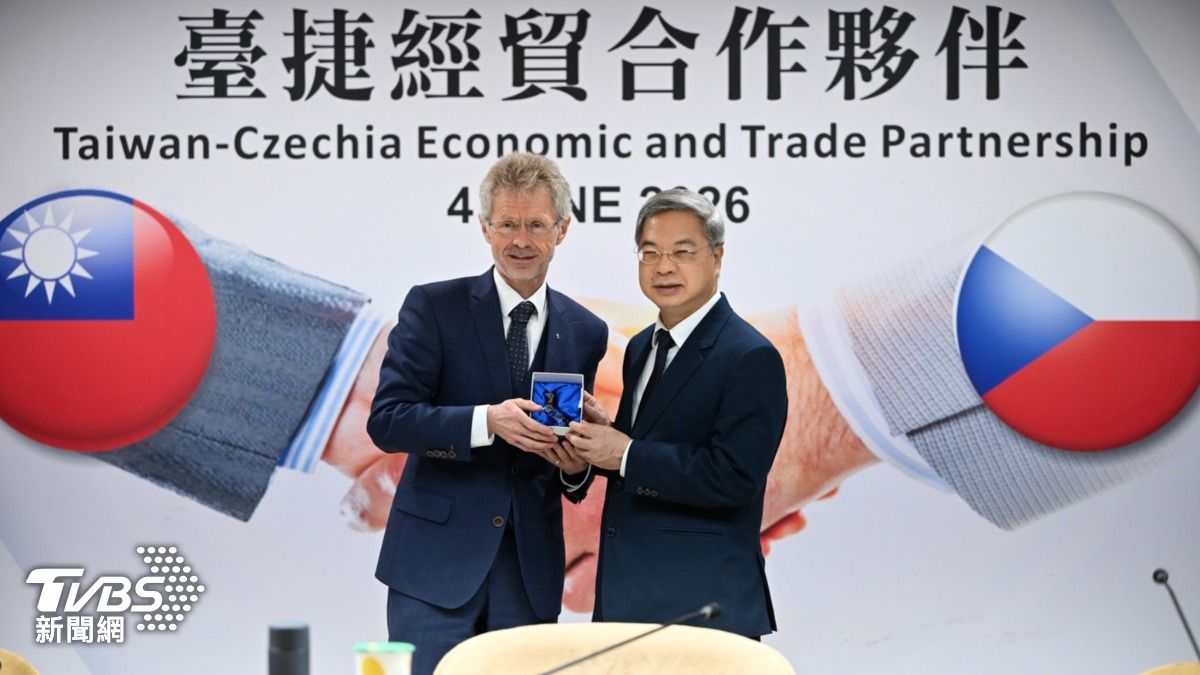
TAIPEI (TVBS News) — Taiwan announced Thursday (June 4) a 50 million euro (approximately NT$1.83 billion) expansion to its Central and Eastern Europe investment fund. The announcement came during a meeting between Economic Affairs Minister Kung Ming-hsin (龔明鑫) and Czech Senate President Miloš Vystrčil. China condemned the visit, and questions persist about whether Taipei's semiconductor diplomacy in the region can achieve meaningful scale.
The new funding, announced by Taiwan's National Development Council (國發會), will support Taiwanese companies investing in Czechia or Czech firms entering Taiwan. It supplements an existing US$200 million (approximately NT$6.3 billion) investment fund and US$1 billion (approximately NT$31.52 billion) credit facility for the CEE region.
Vystrčil, from the opposition center-right ODS party, is leading a business delegation on a visit to Taiwan. President Lai Ching-te (賴清德) awarded him the Order of Propitious Clouds with Special Grand Cordon (特種大綬卿雲勳章) on Tuesday, Taiwan's highest civilian honor.
The Chinese Embassy in Prague issued a statement Sunday condemning the trip, saying it "seriously interferes in China's internal affairs" and "seriously violates the Czech side's one-China commitment." Czech Prime Minister Andrej Babiš, whose ANO party leads a coalition with right-wing and far-right parties, has also criticized the trip. The government did not provide Vystrčil with a state plane, Reuters reported.
Despite the friction, both sides highlighted concrete progress. Minister Kung noted that Taiwan has established a semiconductor research center in Brno, Czechia's second-largest city, with Jmem Tek (振生半導體) participating in advanced chip design. Logistics company i-TRANS Express (愛豐通運) also opened a semiconductor chemical facility in Czechia on May 20 to support supply chains.
Yet the scale of Taiwan's Central European semiconductor push remains modest. TSMC, Taiwan's dominant chipmaker, has committed tens of billions of dollars to fabrication facilities in the United States, Japan and Germany. Czechia has received the largest share of CEE fund projects but no fabrication plants.
Both governments have framed the partnership in ideological terms. During a meeting Wednesday (June 3) with National Science and Technology Council Chair Wu Cheng-wen (吳誠文), Vystrčil emphasized that Taiwan and Czechia are "close partners sharing the values of freedom and democracy" and pledged to "jointly build a resilient international democratic supply chain."
The partnership has relied heavily on personal relationships. Minister Kung recalled that Vystrčil gave him "the best gift of my life" during a 2021 visit to Prague — a T-shirt printed with "I am Taiwanese." The two officials have met four times since Vystrčil's landmark 2020 visit. Kung described it as "the largest delegation in Czech history."
But such personal ties may prove fragile. Vystrčil belongs to the opposition ODS party, while the Czech government under Babiš has distanced itself from the visit. Political transitions could alter the partnership's trajectory.
The visit also touched on areas beyond semiconductors. Vystrčil said the two sides discussed direct aviation links, assistance to Ukraine and nuclear energy cooperation. Eighteen Czech businesses accompanied the delegation and presented during Computex 2026.
Starlux Airlines (星宇航空) will join the Taiwan-Czechia direct flight route on Aug. 1, enabling daily service alongside China Airlines, which launched the route in 2023. Whether such connectivity translates into the "resilient supply chain" both governments tout remains unclear. China's sustained pressure and the partnership's modest investment scale leave that unanswered. ◼ (At time of reporting, US$1 equals approximately NT$31.52; 1 euro equals approximately NT$36.62)