



Lai: China’s ethnic law threatens free speech worldwide
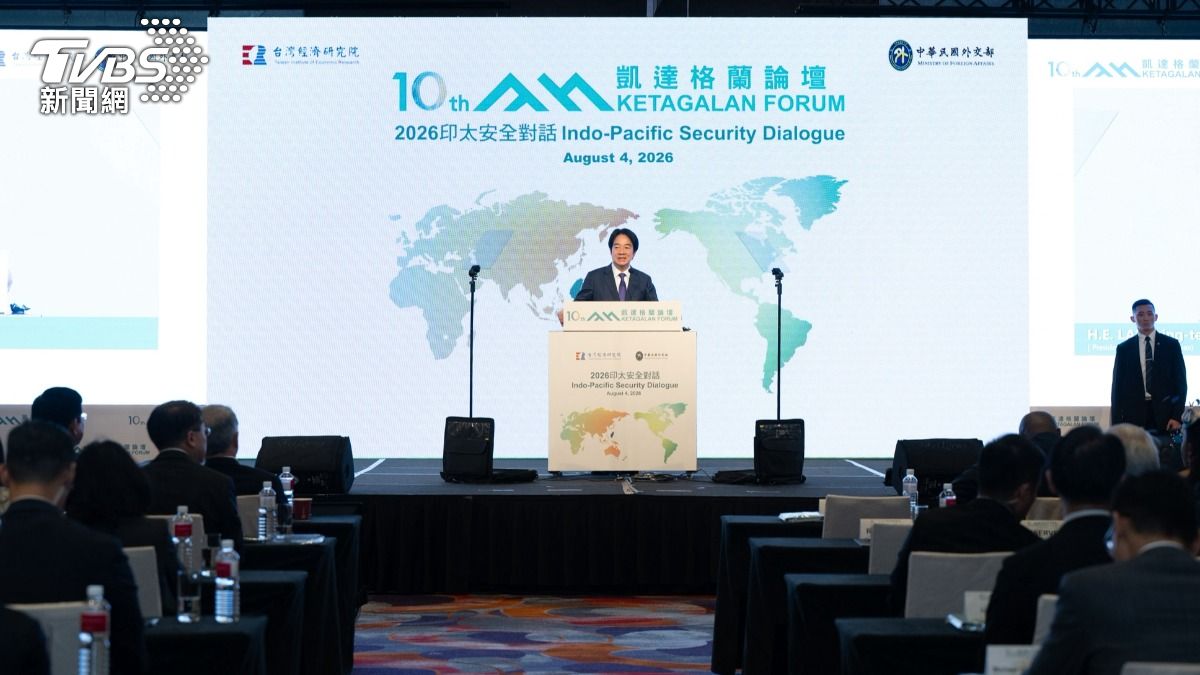
TAIPEI (TVBS News) — President Lai Ching-te (賴清德) on Tuesday (Aug. 4) called on the international community to unite against China's Ethnic Unity and Progress Promotion Law, characterizing the legislation that took effect July 1 as a tool of "transnational repression" that threatens free speech worldwide and warning that "red terror is spreading into every corner of the world."
Speaking at the opening ceremony of the 10th Ketagalan Forum at the Grand Hyatt Taipei, Lai accepted a formal statement from the Inter-Parliamentary Alliance on China condemning the law. The cross-party group of legislators from democratic countries, known as IPAC, presented the document through its executive director, Luke de Pulford.
"I want to emphasize that China's Ethnic Unity Law infringes upon Taiwan's sovereignty and persecutes religions and minority groups," Lai said, his tone firm. "But it goes beyond that. By using forms of transnational repression, it imposes political censorship in all parts of the world, creating a chilling effect."
The president called the law "malicious" and urged the "entire international community" to "staunchly oppose" it. Article 63 of the law states that organizations and individuals outside China who "undermine ethnic unity" or engage in "ethnic separatist activities" shall be held legally responsible — language Taiwan's Foreign Ministry has characterized as enabling "long-arm jurisdiction."
Foreign Minister Lin Chia-lung (林佳龍) opened the forum with a sharp condemnation of the Chinese legislation, formally known as the Law on Promoting Ethnic Unity and Progress (民族團結進步促進法). Lin said the law "provides a legal pretext for authoritarian China to export red terror and engage in international and transnational suppression."
Lin added that "a number of concerning cases have already come to light" since the law took effect, though he did not provide specific examples. Taiwan's Foreign Ministry had warned on July 1 that "individuals worldwide whose words or actions are deemed unacceptable by China may be targeted or prosecuted" under the legislation.
The annual Ketagalan Forum, now in its 10th year, has become Taiwan's flagship platform for security dialogue with democratic allies. This year's edition drew 12 political leaders, lawmakers and experts from nine countries, including former Finnish Prime Minister Sanna Marin, making her first visit to Taiwan, and U.S. House Foreign Affairs Committee Chairman Emeritus Michael McCaul.
Other attendees included Eswatini Prime Minister Russell Dlamini and former Canadian Deputy Prime Minister Chrystia Freeland.
IPAC, which includes parliamentarians from multiple democratic countries focused on China policy, condemned the Ethnic Unity Law immediately after its implementation. Lai thanked IPAC co-chair Gen Nakatani, a former Japanese defense minister, and de Pulford for "reaffirming that position by their participation today."
The president outlined a three-part framework for Taiwan's response: safeguarding democratic values, maintaining regional peace and stability, and fostering global prosperity through technology leadership.
Lai cited recent statements from the G7 and European Parliament reaffirming support for Taiwan Strait stability. He pledged to "continue to upgrade our national defense and build whole-of-society defense and resilience."
Lai vowed that Taiwan "will not accept United Front infiltration or red terror." The law's Article 21 explicitly targets Taiwan, stating that China will "deepen integrated development across the Taiwan Strait" to strengthen Taiwanese people's "sense of belonging to the Chinese nation."
The forum focuses on democratic resilience, responses to "gray zone" incursions, and building what Taiwan calls "non-red supply chains" — production networks that reduce dependence on China.
"Taiwan is a beacon of freedom and democracy," Lai said, his voice rising with conviction. "We are also a cornerstone of peace in the Indo-Pacific. Even in the face of authoritarian threats and emerging global challenges, we will stand firm."
The Ketagalan Forum, named for the indigenous people who originally inhabited the Taipei Basin, was established in 2017. Over nine years, it has hosted 148 international guests from 30 countries, including former U.S. Vice President Dick Cheney, former Japanese Prime Minister Taro Aso and former U.K. Prime Minister Boris Johnson. ◼