



From iPhones to AI Factories and EVs: Foxconn Remakes Itself
Visitors entering the Nangang Exhibition Center for Hon Hai Tech Day on 30 and 31 October were met by a shipping container. Inside was an Nvidia DSX POD, a complete Vera Rubin AI system that Foxconn builds, wires, cools, and tests in its own factory before it leaves for a customer's site. Chairman Young Liu used the event to say Foxconn is "transforming into a technology manufacturing platform service provider." In plain terms, the company that became famous for assembling iPhones is now designing, manufacturing, and in some cases running AI data centers and supplying the core platforms that other brands build electric cars on.
Liu was keen to challenge long-held perceptions of Foxconn, and he backed his case with numbers. The company holds more than 40 percent of the electronics manufacturing services market, and in 2025 it completed 941 new product introductions for its largest customers, about 2.5 a day. More than half of its AI products are now made under ODM or JDM models, meaning Foxconn designs the product itself or co-designs it with the customer rather than building to a finished blueprint.
The AI factory is where Foxconn's ambition goes furthest. Foxconn calls it a token factory: an AI data center treated as a plant whose output is tokens, the units of text that AI models read and generate. A quarter of the record 321 exhibits at the event sat in that zone. Foxconn now covers every stage of the hardware inside such a plant. Components are made in Taiwan and Vietnam, motherboards are manufactured in Hsinchu, servers are integrated in Taoyuan, and full racks and clusters are built in the US and Mexico. With TECO, a Taiwan maker of industrial motors and power equipment, it showed a modular data center to Nvidia's DSX POD design that moves more than 80 percent of the work into the factory and ships computing, cooling, power and fire protection together in a container. Dion Harris, Nvidia’s senior director of AI and HPC hyperscale infrastructure solutions, said modular designs can cut development time from months to weeks and bring forward an AI factory’s first token. Delivering 100 megawatts of capacity in eight weeks, he said, would put billions of dollars of equipment to work sooner. Foxconn also rents out computing through Visionbay.ai, its wholly owned AI cloud subsidiary, whose 5-megawatt HGX B300 cluster in Taiwan went into commercial service in July. A government or company can buy an AI factory from Foxconn or pay to use one.
The same thinking runs through its vehicle business. Under its contract design and manufacturing service, or CDMS, Foxconn supplies the parts of a car that are hardest and costliest to develop, including the battery, electric drive unit, chassis, electrical architecture and operating system, and the customer designs and brands the body on top. Jun Seki, Foxconn's chief strategy officer for electric vehicles, said the aim is to create many models from few platforms, so clients can launch faster with less investment. The Model A+ SUV, the Model K light truck, and the Model K+ small SUV extend that range. Foxconn's agreement to buy half of Mitsubishi Electric Mobility for ¥115 billion (about US$730 million), due to close in October 2027, adds drive units, driver monitoring, and autonomous-driving technology.
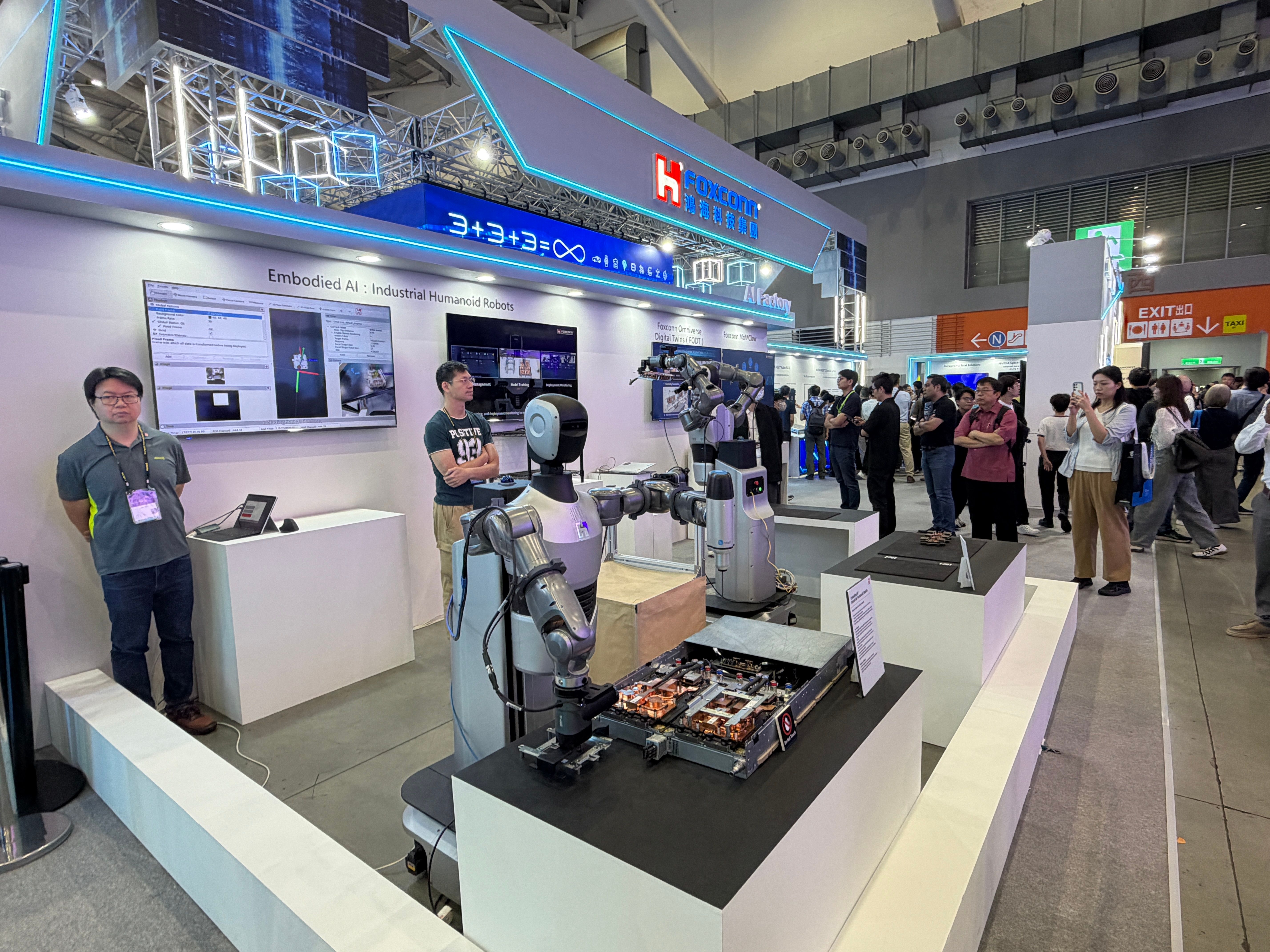
The third theme is Foxconn's own manufacturing. The group is applying automation and AI to its most demanding processes to boost efficiency and quality. A cableless compute tray co-developed with a customer for Nvidia's Vera Rubin platform allows fully automated assembly, cutting the time per tray from more than two hours to 20 minutes. Foxconn's fiber-alignment lines have turned co-packaged optics from a laboratory process into a production step, and the event's precision manufacturing zone displayed machining and mold-making equipment Foxconn built itself. Its FoxBrain AI model, trained on Foxconn's production know-how, is part of the same effort. Li Kuang-yao, general manager of the C Business Group, said robots could handle most factory work within three to five years.
No other electronics manufacturer has the scale to make all three bets at once. In AI infrastructure, Foxconn is moving from manufacturing servers to building and running the token factories that house them. In vehicles, it engineers the platforms on which other companies can design and brand their cars. In its plants, it is automating its most sophisticated processes with its own AI. Together they describe a company that intends to set the standard for how AI factories and electric vehicles are built, and to produce them at a scale no rival can match.