



How gaming paid for Nvidia's long bet on AI computing
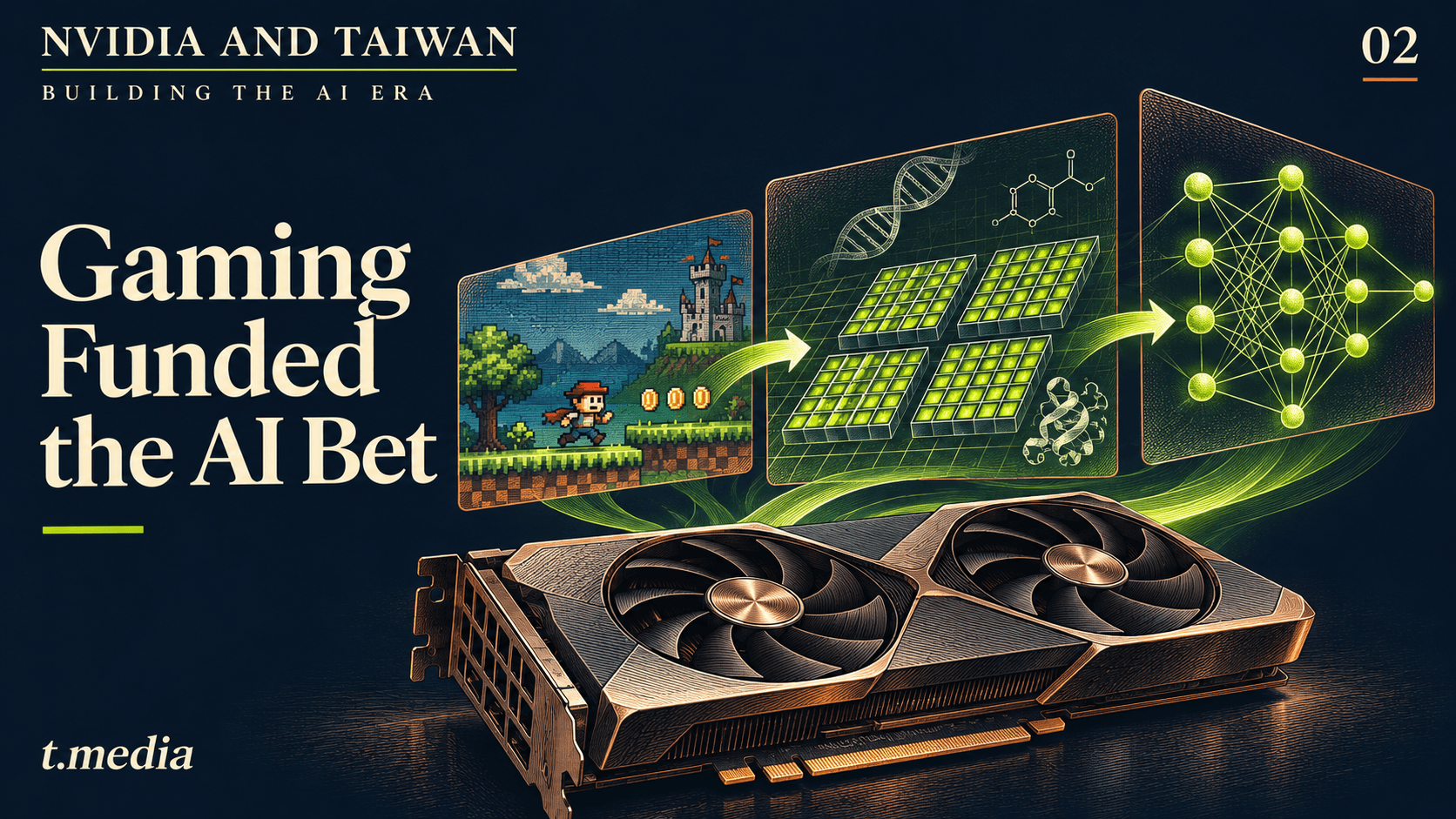
In 2012, researchers at the University of Toronto showed how much computing power had become available in hardware designed for PC gamers. Alex Krizhevsky, Ilya Sutskever, and Geoffrey Hinton trained a neural network on two Nvidia GTX 580 graphics processors and entered it in the ImageNet image-recognition competition. Their entry, later known as AlexNet, missed the right answer on 15.3% of images, against 26.2% for the runner-up. The result helped accelerate investment in deep learning and gave Nvidia a commercial opening for hardware and software it had spent years developing, paid for by a graphics business closely tied to Taiwan.
Scientists had recognized the potential of graphics processors well before AlexNet. GPUs render a scene by applying similar calculations to large amounts of visual data in parallel, and the same capability could speed up scientific work. To use it, however, programs had to disguise their numbers as textures or colors.
Nvidia began removing that obstacle with the GeForce 8800 in November 2006. Its G80 architecture replaced separate processing units for different graphics tasks with a unified pool of programmable processors. Nvidia also announced CUDA, whose first public toolkit followed in 2007. CUDA extended the C programming language so that developers could assign suitable calculations to the GPU while the CPU coordinated the application.
To assure developers that their work would not be stranded, Nvidia built compilers, debugging tools, documentation, and mathematical libraries, and ensured applications would run on later GPUs without extensive rewriting. It also had to deliver processors powerful enough to justify the effort, which placed heavy demands on TSMC. Made on TSMC's 90-nanometer process, the G80 contained about 681 million transistors and was unusually large for its time, and larger chips suffer more manufacturing defects, raising the cost of each working processor.
The market was small. Games and professional graphics paid Nvidia's bills, and CUDA's first serious users were researchers. Oil and gas companies used it for seismic analysis, and others for medical imaging, molecular simulation, weather models, and financial calculations. Nvidia introduced Tesla products for these customers in 2007 and added features for them that did little for games, including double-precision arithmetic in 2008 and protection against memory errors in a later generation.
By April 2010 Jensen Huang could report about 60,000 active CUDA developers and more than 300 universities teaching it. Those figures measured a community, and paying customers were far fewer. Many business applications had little parallel work to speed up, and developers could choose open standards or AMD and Intel hardware rather than depend on one supplier.
Gaming carried it. Each generation of GeForce chips reached buyers on cards from Asus, MSI, Gigabyte, and other Taiwan companies. Those sales financed the chips and the software, and every card sold put a programmable parallel computer into a home or laboratory, which is how two of them came to be training a neural network in Toronto.
AlexNet strengthened the case for neural networks, but it did not create a market overnight. Nvidia's data center revenue rose only 7% in fiscal 2016, to US$339 million. The company added neural-network software libraries, worked with the authors of the main programming frameworks, and in 2016 introduced a complete AI computer, the DGX-1. Data center revenue reached US$1.93 billion in fiscal 2018, but gaming still brought in US$5.5 billion, nearly three times as much.
Taiwan's companies made the gaming products that supplied the revenue and scale on which Nvidia's computing ambitions depended. TSMC manufactured processors that grew larger with every generation, while card makers supplied the engineering, manufacturing, and distribution needed to sell them in volume. As Nvidia's data center business grew, Taiwan's role would deepen again, particularly in the advanced packaging that connects processors with high-bandwidth memory.
This is the second article in “Nvidia and Taiwan: Building the AI Era,” a six-part series exploring the partnership behind the AI boom. You can read the first article here.