



AI chips fuel growth in Taiwan’s precision testing connections
Taiwan’s suppliers of precision chip testing connections are reporting sharply higher sales as AI processors demand more electrical contacts, faster signals, and tighter temperature control. MPI, WinWay, and Chunghwa Precision Test posted strong third-quarter profit growth, while Hermes achieved record revenue. Their expansion reflects the growing difficulty and importance of catching defective chips before they enter expensive packages and computing systems.
These companies supply the connections between semiconductors and testing machines. Probe cards make temporary contact with chips while they remain on a wafer. Test sockets connect packaged chips to testing equipment, and specialized circuit boards carry signals and power between the tester and the device. A poor connection can make a functioning chip appear defective or hide a genuine fault.
AI raises the engineering requirements. More contacts must fit within closely spaced layouts, higher currents generate heat, and faster signals are harder to transmit without distortion. Advanced packaging also raises the cost of a missed defect, because combining faulty silicon with other processors and high-bandwidth memory wastes valuable components and additional manufacturing work.
MPI, known in Taiwan as Wang Silicon, is one of the main beneficiaries. Third-quarter revenue rose about 73% from a year earlier to NT$5.90 billion (approximately US$180 million), and net profit increased about 114% to NT$1.88 billion (US$57 million). The company reported that probe card production was operating at full capacity.
Its cantilever and vertical probe cards address finer spacing, higher contact counts, and greater current delivery, using MEMS, or microelectromechanical systems, to produce tiny, precisely controlled structures.
MPI is expanding capacity and plans to begin its own circuit boards in the second half of 2027. It is also working with customers on testing for co-packaged optics, or CPO, which places optical components close to chips. In a November 16 update, management projected revenue growth of at least 50% in 2027, citing increased orders for cloud customers’ next-generation AI processors.
WinWay’s strength lies in test sockets and temperature-control systems, alongside a developing wafer-testing business. Third-quarter revenue rose 152.6% year on year to NT$4.56 billion (US$139 million). Net profit reached NT$1.03 billion (US$31 million) and gross margin recovered to about 41%.
Its liquid-cooled testing solution pairs sockets with temperature-control equipment, removing heat so that processors can be tested under specified conditions as their power consumption rises. This extends WinWay’s role from supplying a connection to managing more of the test environment.
WinWay is investing approximately NT$3.5 billion (US$107 million) in a new facility in Kaohsiung’s Renwu district, scheduled for completion at the end of 2027 and production in 2028. The facility will support wafer, final, and system-level testing requirements.
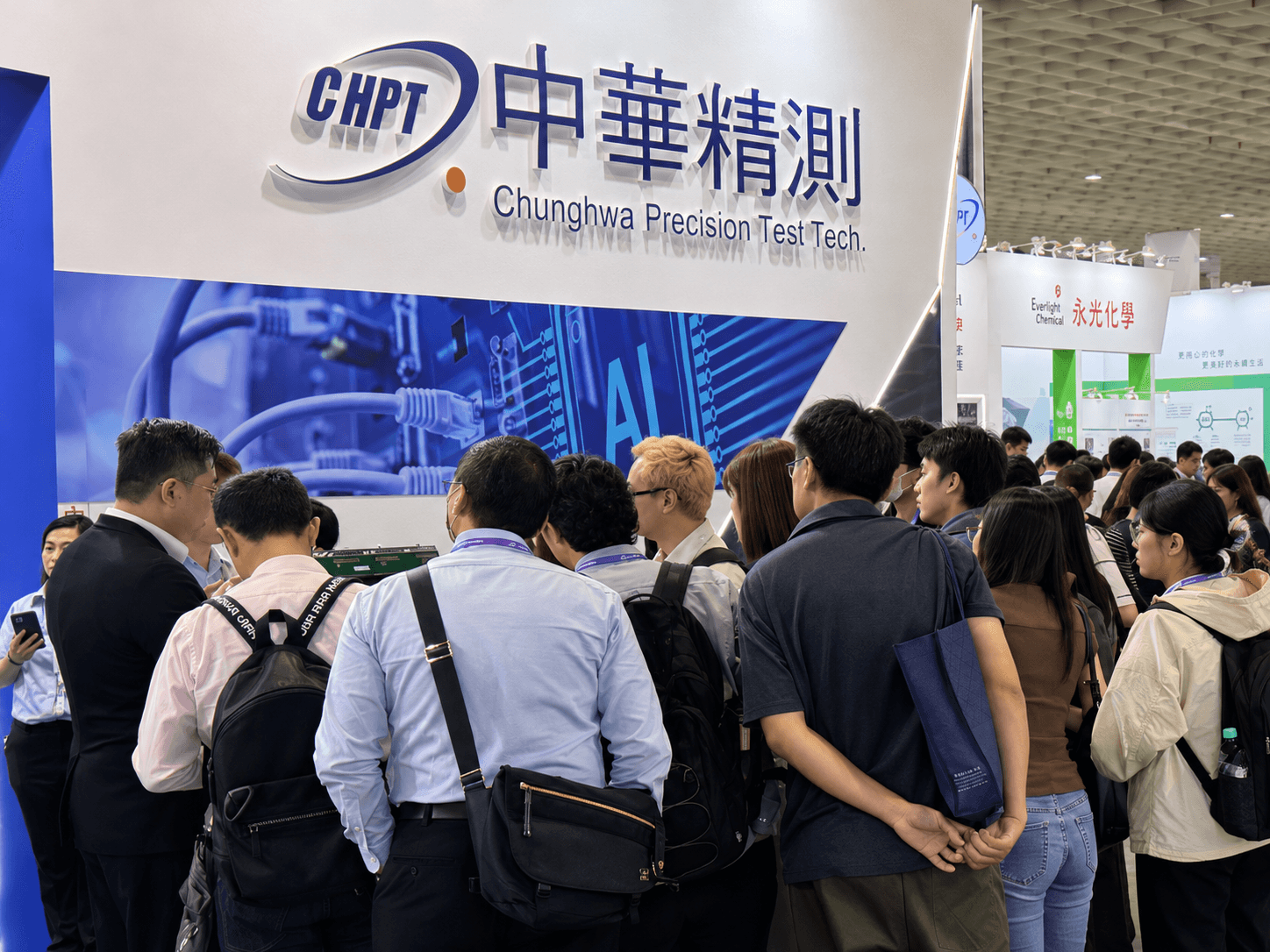
Chunghwa Precision Test, or CHPT, offers a broad range of test boards and probe-card solutions. Third-quarter revenue increased 53.4% to NT$1.905 billion (US$58 million). Net profit doubled to NT$551 million (US$16.8 million) and gross margin reached 57.3%.
Its products cover wafer probe cards, load boards for chip testing, high-power burn-in boards, and system-level test boards, allowing CHPT to serve customers through multiple testing stages. Development priorities include next-generation probe cards and boards for custom AI processors.
Hermes Testing Solutions is expanding from equipment sales and engineering services into more proprietary products. Third-quarter revenue rose 154.2% to NT$1.50 billion (US$46 million). It nevertheless reported a net loss of NT$286 million (US$8.7 million) after recognizing a one-time, noncash employee share-subscription expense of approximately NT$1.12 billion associated with its listing preparations.
Its planned research and manufacturing facilities will support MEMS and thin-film probe cards, silicon-photonics testing equipment, laser probe-cleaning systems, and advanced packaging machinery. Optical testing means assessing light transmission as well as electrical performance. The investment takes Hermes beyond precision contacts into the equipment needed to manufacture and test new chip structures.
These companies benefit from both rising chip volumes and more demanding tests. Their advantage depends on working with customers early enough to match new contact layouts, power requirements, and package designs. As GPUs, custom AI processors, and optical connections evolve, each new generation creates further demand for suppliers capable of turning those requirements into accurate, durable testing interfaces.
US$ conversions use an illustrative exchange rate of NT$32.8 per US$1.