


LEOTEK brings 'Physical AI' infrastructure to UN climate talks
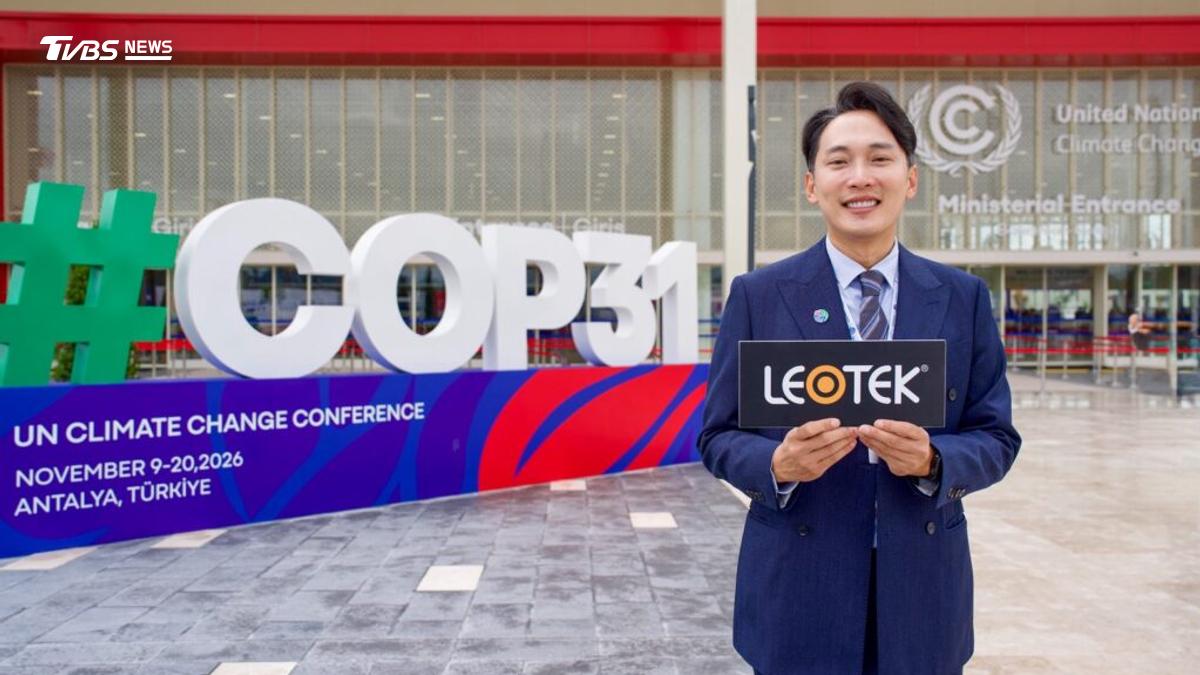
TAIPEI (TVBS News) — A Taiwanese delegation led by smart traffic and energy firm LEOTEK (光林智能) is showcasing AI-powered infrastructure systems at the United Nations climate summit in Türkiye this week. The company is pitching technology that transforms ordinary street intersections into data-gathering "giant computers" as a concrete bridge between climate pledges and real-world action.
LEOTEK, a subsidiary of Lite-On Technology (光寶科技), joined the Taiwan Institute for Sustainable Energy (TAISE, 台灣永續能源研究基金會) delegation to COP31 in Antalya, presenting its "Physical AI" systems, digital twin simulations, and energy management platforms to help cities improve road safety and energy resilience.
"COP31's greatest mission is to transform past commitment targets into implementable results," Eugene Chien (簡又新), chairman of TAISE and a former Taiwan foreign minister, said.
International carbon regulations are reshaping emissions tracking. Under the European Union's Carbon Border Adjustment Mechanism (CBAM), businesses must now report emissions at the product level — a shift demanding more granular data collection across supply chains.
Torrent Chin (金海濤), LEOTEK's president and chief sustainability officer, described the technology.
"Through Physical AI, we can turn an intersection into a giant computer," Chin said, his voice rising with enthusiasm. "Every intersection will have a Physical AI robot that can monitor and collect data."
LEOTEK has tested an emergency vehicle priority system near Hualien Tzu Chi Hospital (花蓮慈濟醫院), giving ambulances and fire trucks green-light priority at intersections. In the United States, the company has validated its technology at Curiosity Lab in Peachtree Corners, Georgia. Its LEOLink platform has been deployed in 49 pilot projects across 19 U.S. states, according to company data.
The technology also supports predictive maintenance. "We can use AI to do real-time diagnosis," Chin said. "We know whether equipment is operating normally or not, and if not, what the problem might be."
LEOTEK is also expanding into urban energy systems. Its RenAI platform integrates data from road equipment, electric vehicle charging stations, and energy storage systems to help cities manage peak electricity demand.
Salmon Sim, chief operating officer of Singapore-based sustainability technology firm Cedars Digital, said regulations like CBAM have fundamentally changed how companies must track emissions — shifting from company-level reporting to product-level accounting. This requires far more granular data collection, increasing costs and time.
"But rather than think of it as a cost, when we collect this data, the whole supply chain can decarbonise together and that becomes a competitive advantage for the whole supply chain," Sim said, his tone shifting from pragmatic to persuasive.
"The government should provide a very good environment," Chien added. "That means the government should have good holistic planning, together with all the financial support."
During COP31, Chin also participated in a forum organized by Taiwan's Ministry of Environment (環境部). Details of any agreements resulting from the summit were not immediately available. ◼