


Taiwan’s PC brands find new growth in AI computing
Taiwan’s PC brands are finding customers with much larger computing budgets than the gamers and PC enthusiasts they grew up serving. Asus and Gigabyte are supplying AI servers and complete computing racks, turning their experience in motherboards, graphics cards, power, and cooling into fast-growing infrastructure businesses. MSI is pursuing a different opportunity, developing compact AI systems and workstations for companies that want to run models locally.
Gigabyte has changed the most. Third-quarter 2026 revenue reached NT$154.71 billion (approximately US$4.72 billion), up 94.4% from a year earlier, with earnings per share of NT$12.80. Servers generated more than NT$310 billion (approximately US$9.45 billion) in the first nine months, accounting for most of the group’s sales.
Its server business includes Nvidia HGX systems and GB300 NVL72 racks, with customers preparing to move to Vera Rubin. Demand increasingly comes from specialist AI cloud operators as well as larger infrastructure buyers. These customers need suppliers that can integrate processors, networking, and cooling into systems ready for deployment, which takes Gigabyte’s work well beyond designing individual boards and systems.
Asus has reorganized around the same opportunity. Its Infrastructure Solutions Business Group contributed 30% of third-quarter branded revenue, which rose 36% year on year to NT$258.79 billion (US$7.89 billion). Net profit increased 105% to NT$21.63 billion (US$659 million). The infrastructure group’s sales include general-purpose servers and related products as well as AI servers.
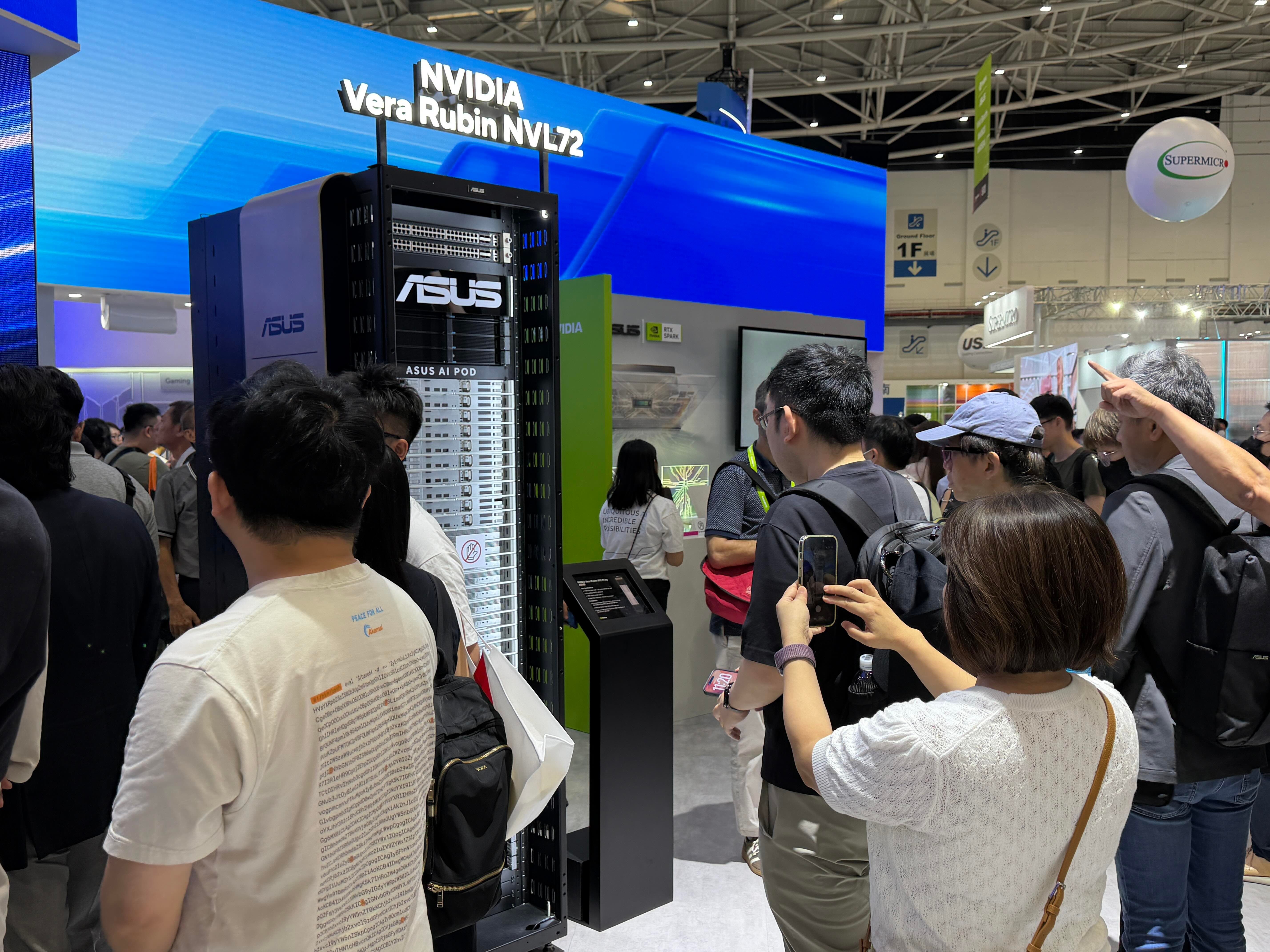
The company is also moving beyond supplying server hardware to helping customers build the infrastructure around it. Its Vera Rubin offering combines liquid-cooled servers with power and cooling equipment developed by partners including Vertiv and Schneider Electric. That broadens its role from delivering systems to coordinating the equipment required to operate them.
MSI’s approach is more closely tied to its desktop and workstation business. President Jeans Huang says the company is leaving large cloud server projects for later and is targeting private AI deployments, where businesses run models near their employees and data. Its AI Connect initiative combines hardware with software partners’ applications, and its products range from compact EdgeXpert AI computers to larger XpertStation workstations.
MSI’s third-quarter revenue was NT$56.95 billion (US$1.74 billion), with earnings per share of NT$4.78. Non-PC products account for more than 10% of sales, and management is targeting annual growth of at least 50% in that business over the next three to five years.
The three companies are selling to different parts of an expanding AI market. Gigabyte and Asus already earn substantial revenue from data center investment, while MSI is betting that private AI will reach a much broader range of businesses. What they share is a starting point. Skills built over decades of designing boards, graphics cards, systems for PC buyers are now being sold to organizations deploying AI, whether they need a single workstation or full rack. For all three, the next phase of growth will be decided less by how many PCs they ship than by how much computing capacity they can deliver.
US$ conversions use an illustrative exchange rate of NT$32.8 per US$1.