



Taiwan’s server and power equipment suppliers prepare for the 800V shift
AI data centers need better ways to deliver electricity to increasingly powerful processors and server racks. As computing capacity grows, the cables, busbars and power converters inside each rack take up more space and copper, while electrical losses add to operating costs.
Many current AI racks distribute electricity internally at about 54V direct current (DC). This approach becomes harder to scale as power requirements rise. Delivering more electricity at the same voltage requires higher current, which increases the demands on conductors, connections, and cooling. Power needs are already rising quickly. Vera Rubin NVL72 racks combine 72 graphics processors (GPUs) and 36 central processors (CPUs) and are estimated to need about 225 kilowatts, compared with around 150 kilowatts for GB300 systems, a 50% increase.
Nvidia is developing an 800V architecture for future AI racks requiring one megawatt or more. The company estimates that distributing one megawatt at 54V could require up to 200 kilograms of copper busbars, the metal conductors carrying electricity through a rack. Power equipment also occupies space that could otherwise hold computing hardware. At the same power level, moving from 54V to 800V cuts the required current by roughly fifteen times, allowing more compact conductors and lower resistive losses. Converters near the computing hardware then step the voltage down to the much lower levels individual chips use.
Nvidia is working with Taiwan partners across server manufacturing, power conversion, battery backup and electrical connections. Foxconn has announced direct collaboration with Nvidia to implement 800V DC infrastructure, including plans to introduce it at its Kaohsiung computing center. Its server subsidiary Ingrasys brings experience integrating computing racks and cooling equipment. At Computex 2026, Wiwynn showcased an 800V power system developed with Delta and TE Connectivity. The exhibit combined a power rack, a liquid-cooled busbar, and a distribution board that converts 800V to 50V for high-density AI servers.
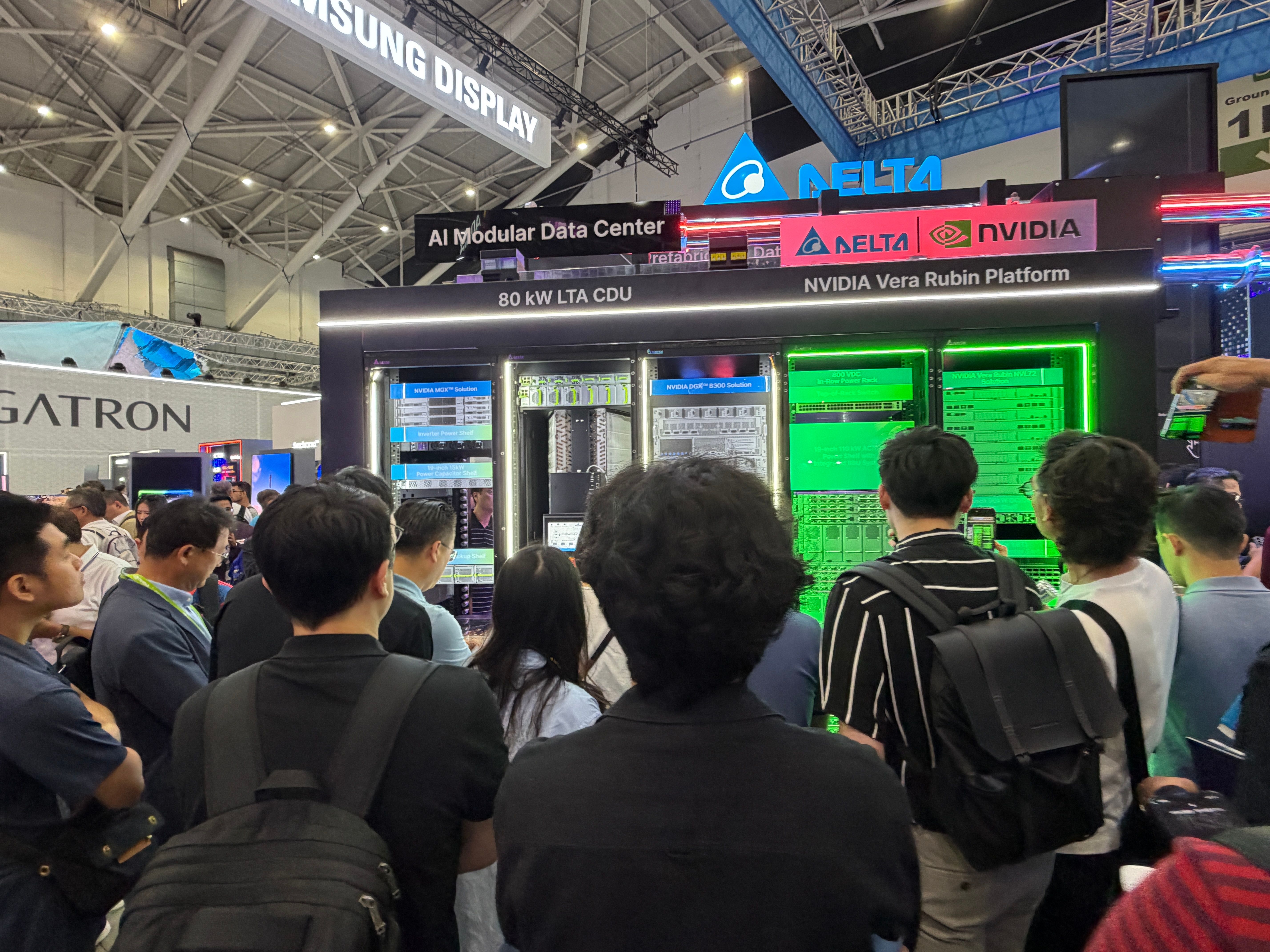
For Taiwan's power manufacturers, the transition broadens the market from individual server power supplies to equipment serving entire racks and rows. A power shelf groups several power-supply modules into a rack-mounted assembly. Larger power cabinets combine these assemblies with controls, protection and backup systems. Delta has presented a 660-kilowatt 800V power rack paired with battery backup capable of delivering 480 kilowatts. Its portfolio also includes a 90-kilowatt shelf that steps 800V down to 54V for equipment still built for the lower voltage.
Battery backup also helps with a problem specific to AI. Electricity demand can change rapidly as processors move between tasks, and batteries and capacitors can buffer these swings over different timescales, steadying the power supplied to computing equipment and reducing abrupt changes seen by the facility.
Lite-On is developing products across several stages of the same chain, including 800V power shelves with battery backup, DC-to-DC conversion modules, intermediate converters, and voltage regulators supplying the GPU. The company is also combining power equipment with liquid cooling, since higher electricity use means more heat to remove. Lite-On expects 800V power-rack shipments in early 2027 following customer qualification. AcBel subsidiary OmniOn Power has announced a 1.2-megawatt 800V sidecar power rack with battery backup, alongside DC-to-DC power shelves. Positioned beside computing racks, a sidecar moves bulky power equipment into a separate cabinet.
The transition also requires changes to the components connecting power cabinets, racks, and circuit boards. BizLink and its Interplex business supply 800V and 400V DC power connections, liquid-cooled products, and designs for power racks and computing racks. Higher voltage places additional demands on insulation, connector design, and safe servicing. At the chip level, Nvidia lists Taiwan's Richtek among its 800V partners. Richtek's power-management chips help control the conversion and delivery of electricity.
Moving to 800V requires coordinated changes across the electrical system of a data center. Connectors, insulation, grounding. and circuit protection must handle higher-voltage DC. Operators need equipment that can isolate faults quickly, along with suitable maintenance procedures, and trained staff. Existing data centers also need a practical upgrade path. Nvidia's roadmap includes a hybrid arrangement that connects to a building's existing alternating-current (AC) supply and delivers 800V DC within a server row, so operators can adopt higher-voltage distribution while keeping parts of their existing electrical systems.
Adoption will proceed across successive generations of AI accelerators. Nvidia's current Vera Rubin NVL72 documentation still specifies 54V distribution inside the rack. 800V adoption is expected to increase with Rubin Ultra from the second half of 2027, followed by wider deployment in 2028. Before then, Taiwan's suppliers must get their products qualified by customers, make sure their equipment works with Nvidia's design, and build enough manufacturing capacity to support the shift.