



Taiwan’s Healthcare Expo to bring technology into clinical practice
Taiwan’s technology companies have spent decades supplying the computers used in hospitals and clinics. They are now developing systems that help interpret scans, screen for disease, and organize care. Healthcare+ Expo Taiwan, opening December 3 at Taipei’s Nangang Exhibition Center, will show how that shift is bringing electronics manufacturers into closer collaboration with doctors and nurses.
The exhibition runs through December 6 and marks its tenth edition with a focus on integrated disease management solutions. Organized by the Institute for Biotechnology and Medicine Industry and the Research Center for Biotechnology and Medicine Policy, with government partners, it brings together more than 50 healthcare systems alongside technology suppliers, researchers, and investors. Hospitals take part as developers and potential customers, which gives the event a clinical focus that a conventional equipment show lacks.
Taiwan’s healthcare system provides a strong foundation. National Health Insurance, introduced in 1995, replaced a patchwork of occupational insurance schemes and extended coverage to virtually the entire population. Together with major teaching hospitals and medical universities, it created an extensive network of clinical expertise and experience treating patients across specialties.
For medical device developers, those hospitals provide partners who can identify practical problems, help design studies, and evaluate products in everyday care. Taiwan’s electronics industry adds expertise in sensors, imaging, computing, and precision manufacturing. Combining the two shortens the distance between a clinical requirement and a working device.
Government policy is reinforcing those connections. The Healthy Taiwan Cultivation Plan allocates NT$48.9 billion (about US$1.49 billion) from 2025 to 2029 to improve working conditions, train personnel, introduce smart healthcare, and strengthen services. Its technology priorities include clinical AI, more efficient workflows and secure medical data sharing. The program ties innovation spending to pressures hospitals already face, including staff workloads and growing care needs.
This year’s featured technology participants include Microsoft, Quanta, Acer Medical, Asus, Compal, and Wistron Medical. Quanta’s offerings span smart-hospital systems, healthcare AI platforms, and connected care, while Microsoft brings cloud, data, and workflow technologies. Visitors can expect medical displays, portable ultrasound, imaging equipment, and surgical technologies, alongside software for diagnosis and hospital administration.
Acer Medical shows how PC expertise can develop into clinical products. Its VeriSee software analyzes retinal photographs to assist screening for eye disease, and its portfolio also includes portable X-ray equipment. Intel has worked with the company on running AI inference locally, which brings screening to the point of care.
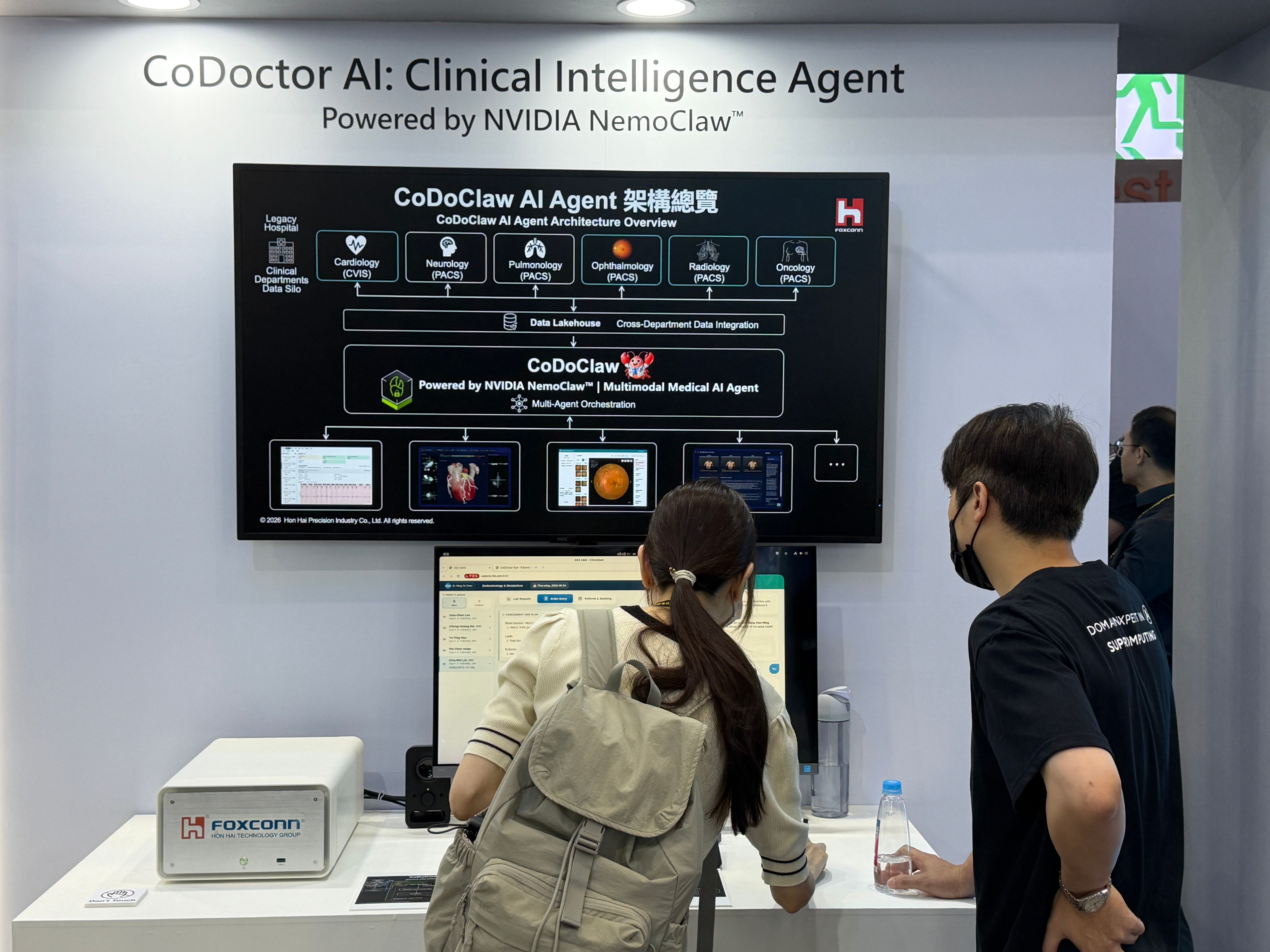
Nvidia is working with Foxconn and Taiwan’s medical centers on AI tools that analyze electrocardiograms, reconstruct coronary arteries in three dimensions, and identify lesions during colonoscopies. The collaboration also includes Foxconn’s Nurabot, a robot built on Nvidia’s computing and robotics technologies that carries medicines and specimens through hospitals.
Smaller companies bring more specialized applications. JelloX lists three-dimensional digital-pathology software, while Aiello will demonstrate a system connecting patient inquiries, hospital knowledge, and staff dispatch. These address distinct problems, from examining tissue images to ensuring a patient’s request reaches the right employee.
Alongside demonstrations, the program includes investment discussions, international business matchmaking, and smart-hospital forums. Taiwan already knows how to manufacture sophisticated equipment. The Expo will show how effectively it can turn that capability into better care.