



How Nvidia and Taiwan are taking AI into the physical world
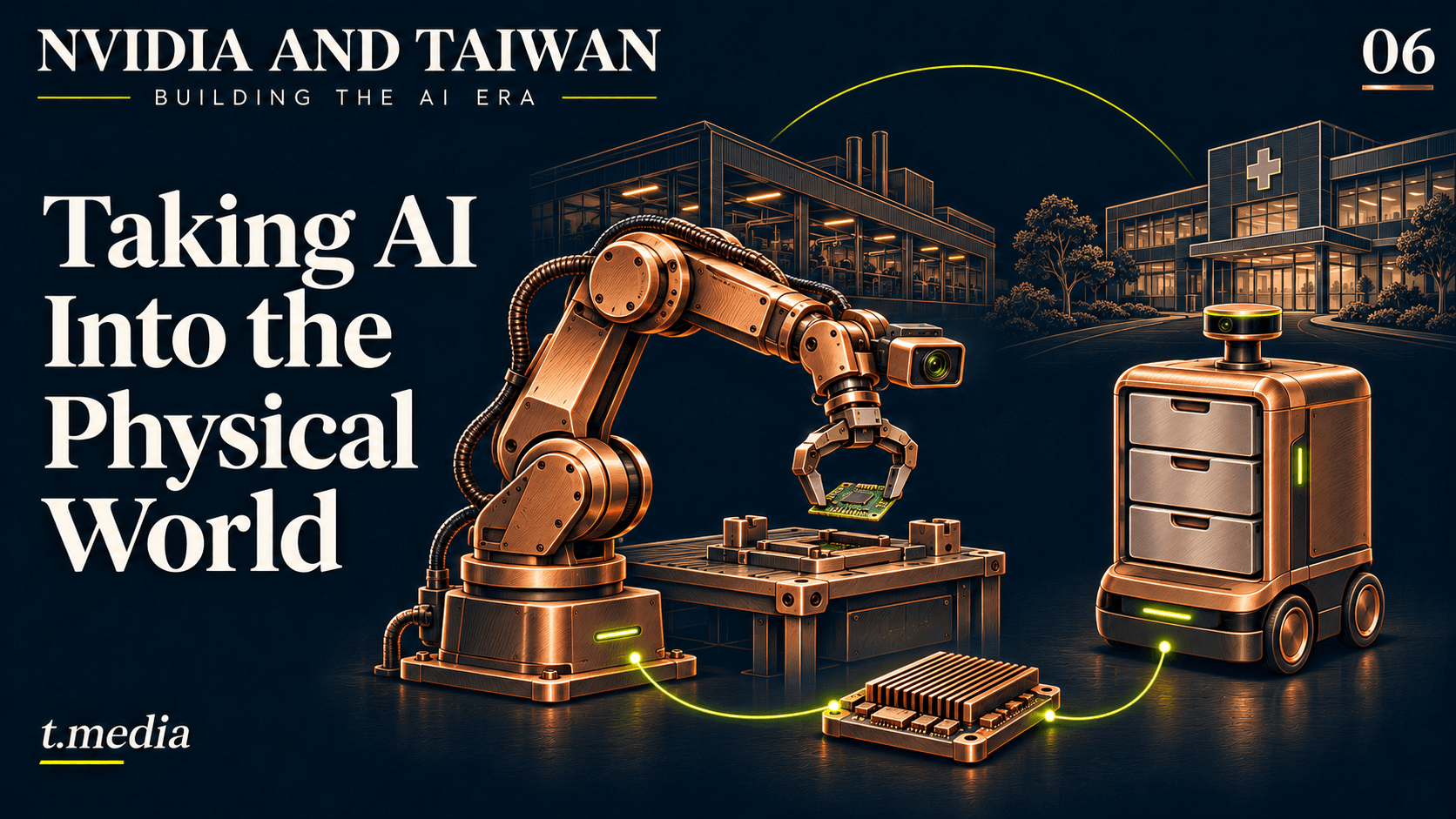
The companies building Nvidia’s AI servers are becoming customers for its next generation of computing. Inside their factories, robots must move components, inspect assemblies, and handle parts that vary in shape and position. In hospitals, machines must navigate busy corridors and deliver supplies without interrupting staff. Nvidia wants its processors and software to help them understand their surroundings and act on what they see.
Nvidia calls this physical AI. Conventional automation follows carefully programmed movements in controlled conditions. Physical AI promises machines that interpret instructions, recognize unfamiliar objects, and adjust when circumstances change. For Nvidia and Taiwan, it opens a market beyond the data centers they have spent the past decade building together.
The partnership has many of the ingredients that made AI servers successful. Nvidia supplies computing platforms and software, while Taiwan contributes electronics, precision components, manufacturing, and system integration. The customers, products, and economics are considerably less settled.
Nvidia has prepared for this market for more than a decade. It introduced Jetson in 2014, putting GPU computing into a small platform for embedded applications such as robotics and machine vision. Jetson computers now process camera and sensor data inside the machine, so it can respond without sending every decision to a remote server. Jetson Thor extends that approach to more demanding AI models and several tasks running at once.
The accompanying Isaac software provides tools for developing, simulating, and deploying robots. Engineers train and test behavior in virtual environments before putting expensive equipment to work. Simulation allows them to repeat difficult situations, vary lighting, and object positions, and investigate failures without stopping a production line. The strategy connects the computers that train AI models with the machines that eventually use them.
Taiwan’s largest manufacturers are practical place to start. Foxconn and Quanta already understand Nvidia’s hardware, employ large engineering teams, and operate factories where successful automation can be deployed repeatedly. They can develop products around problems they encounter themselves.
Foxconn has used Nvidia’s simulation tools to plan manufacturing operations and test robots before deployment. Its work combines factory digital twins, or virtual representations of facilities, with autonomous mobile robots and the computing needed to coordinate them. This makes the company both a supplier of AI infrastructure and a potential customer for the automation it enables.
Quanta pairs QCT’s computing systems with the group’s Techman Robot. Their work spans the infrastructure used to develop robot intelligence and the machines that perform physical tasks. Techman is applying Jetson Thor and Isaac technologies to its TM Xplore I platform, including work on server-fan assembly. Experience making computers defines the tasks that intelligent robots must learn.
Healthcare is the second testing ground. Foxconn is developing hospital systems with medical partners in Taiwan that combine robots, AI software, and digital twins. Its Nurabot platform handles routine logistics such as transporting medicines and specimens, while other projects address surgical assistance and coordinated hospital workflows. The work puts Foxconn in close contact with the people who must use and maintain the machines.
Physical AI also needs computers that survive on the factory floor. Taiwan’s industrial PC suppliers have spent decades building systems for factories, transport, and medical equipment, where temperature, vibration, connectivity and long product lifetimes matter. Advantech’s Jetson Thor-based AIR-075 applies that experience, giving manufacturers need a deployable industrial computer with the interfaces and support a bare processor lacks.
Around Taichung, Taiwan’s precision engineering industry supplies the moving parts. Hiwin makes the mechanisms that turn electrical commands into controlled movement, from ballscrews and motors to reducers and actuators. At Computex 2026, it demonstrated robot-joint modules, intelligent grippers, and a dual-arm logistics robot. Accurate perception is of little use if a machine cannot grip an object reliably or move it without damage.
Humanoid robots attract attention because they could operate in spaces designed for people. They also bring demanding problems of balance, mechanical complexity, power consumption, and cost. Many commercial tasks do not require legs. A wheeled machine carrying supplies through a hospital or an arm handling components at a workstation can address a specific need with fewer moving parts. Such products may reach widespread use sooner than machines designed to imitate the full range of human movement.
The larger obstacle is commercial fragmentation. A handful of cloud companies order vast numbers of servers built around a common architecture. Hospitals and factories differ in layout, equipment, procedures, and purchasing budgets. Each installation can require substantial integration, staff training, and continuing maintenance. Customers must see savings that justify the complete cost of deployment.
Established industrial robot manufacturers hold strong positions, but no company has secured an equivalent to Nvidia’s AI server leadership in this emerging market. Reliability, service, and the ability to repeat a successful installation will matter as much as computing performance.
That gives Taiwan’s manufacturers an opening. They can combine Nvidia’s technology with their own production experience, industrial computers, and precision machinery, and prove the results in the island’s factories and hospitals before selling them more widely. Those early deployments must then become products that need progressively less customization.
Taiwan helped Nvidia turn graphics chips into computers, and computers into entire racks of AI infrastructure. The next stage will be measured differently. A robot earns its place by completing a task safely, repeatedly, and at an acceptable cost. Nvidia and Taiwan have learned how to build the machines that train AI. Now they must show what AI can do outside the data center.
This is the sixth and final article in “Nvidia and Taiwan: Building the AI Era,” a six-part series exploring the partnership behind the AI boom. You can read the first five articles here:
How Taiwan helped Jensen Huang build Nvidia
How gaming paid for Nvidia's long bet on AI computing
How TSMC’s CoWoS packaging became the key to Nvidia’s AI processors
How Nvidia’s move into AI servers transformed Taiwan’s PC manufacturers