



Fulbright forum explores the human edge in AI hiring
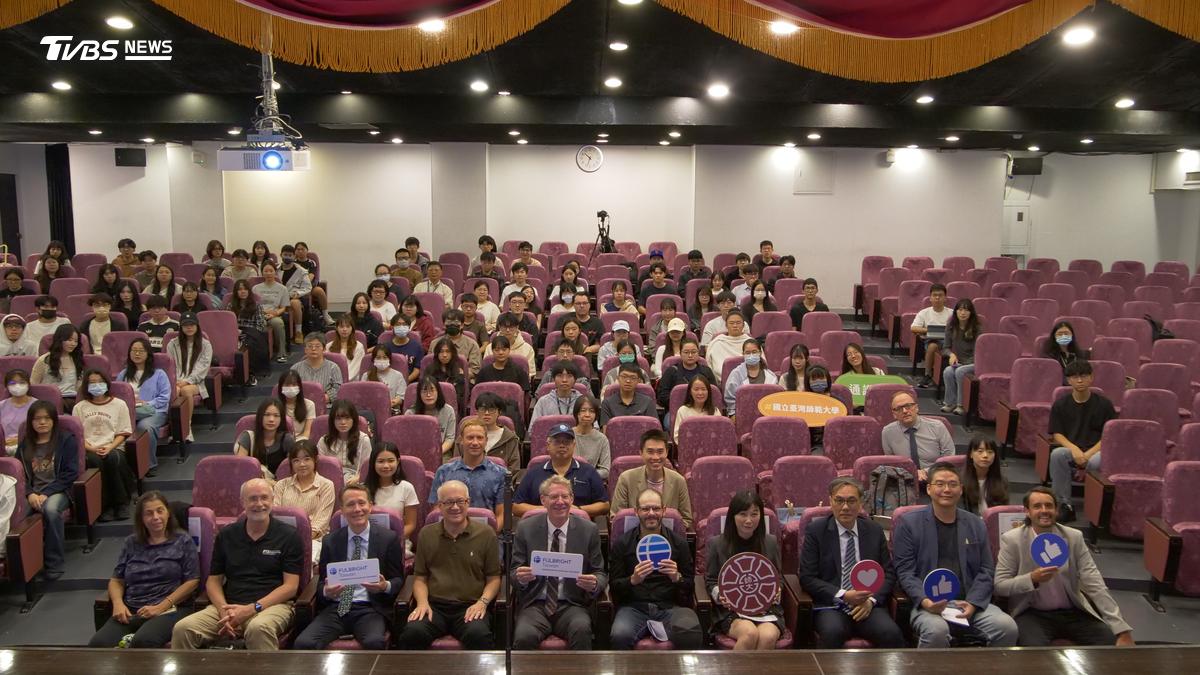
TAIPEI (TVBS News) — In an era when algorithms screen resumes and chatbots conduct first-round interviews, what makes a job candidate irreplaceable? A forum at National Taiwan Normal University offered a surprising consensus: the answer lies not in mastering AI, but in cultivating the human qualities that AI cannot replicate.
The forum, held Wednesday (Nov. 4) at National Taiwan Normal University (國立臺灣師範大學), one of Taiwan's leading teacher-training institutions, brought together experts from academia, industry and international exchange programs. Their task: examine what employers actually value beyond algorithmic scores.
Their consensus: storytelling ability, adaptability, emotional intelligence and sound judgment have become the true differentiators in hiring. Call it the "human moat" — the competitive advantage that no algorithm can cross.
Alan McIvor, a headhunter at Paul Wright Group who specializes in executive search and international talent acquisition, offered a concrete example. His firm recently placed a candidate at a major semiconductor company in Taiwan, an industry where the island produces more than 60 percent of the world's advanced chips. She did not have the strongest technical background. But she had spent two years working in both the United States and Taiwan.
"She understood both markets. She could communicate with engineers and with executives," McIvor said with the confidence of someone who has seen the pattern repeat. "That cross-border experience, that cultural fluency, that's what got her the job."
Dr. Randall Nadeau, executive director of Fulbright Taiwan (學術交流基金會), the Taipei-based office of the U.S. government-funded international exchange program, offered a parallel perspective. The forum marked the 80th anniversary of the Fulbright Program, which has facilitated academic exchanges between Taiwan and the United States since 1947.
"In the age of AI, Fulbright does not overlook the human element," Nadeau said, pointing to "real-life interactions that cannot be replaced by machine learning."
Andy Yang (楊世鐸), manager of TVBS's AI Future Tech Department, urged preparation rather than resistance. "Train yourself to be ready for the next wave," Yang said. "Cultivate your soft skills."
McIvor identified qualities that algorithms struggle to assess: likeability, confidence, and eye contact, qualities that emerge only in person. He also noted a cultural challenge specific to Taiwanese professionals: many undersell themselves in international job markets.
"Taiwanese professionals are often very modest," McIvor observed. "That's a cultural strength in many ways. But in an international job market, especially when competing with American or European candidates, you need to be able to articulate your value clearly."
"Talk about your impact," McIvor said. "What did you achieve? How did you add value?"
Dr. Yu-Ling Chang (張育菱), an assistant professor at NTNU's Graduate Institute of International Human Resource Development and winner of the 2023 AHRD Knowles Dissertation of the Year Award, focuses her research on human-centric AI. She advised students to provide concrete examples and evidence, not just claims.
Rather than relying on self-assessment, Chang recommended building portfolios, case studies or project narratives that document outcomes. Testimonials, peer feedback and demonstrated results carry more weight than assertions, she noted.
The human qualities discussed were not merely personal; they were strategic. Professor Kuo-Hui Chang (張國暉) of National Taiwan University, who spent a year at UC Berkeley on a Fulbright grant studying technology governance, argued the power struggle between major nations and tech companies will shape all career paths.
"American rules on chip exports reach directly into Taiwanese companies and into your careers," Chang said with professorial gravity, urging students to "think like the state" when evaluating new technologies.
The panelists converged on a single takeaway: AI is a tool, not a judge. Algorithms can filter resumes, but they cannot measure passion, empathy, or potential.
But of all the human qualities discussed, one emerged as foundational: storytelling.
Professor Tony Martinez, a film scholar from Texas Tech University and current Fulbright Scholar in Taiwan who studies how nonfiction narratives build empathy across cultures, argued that while AI can generate content, storytelling remains fundamentally human.
"Someone has to decide what story to tell, how to tell it, what emotions to evoke," Martinez said, leaning into the question. "AI can generate options, but it can't make those choices."
Martinez and McIvor both noted that storytelling applies far beyond media careers. An engineer explaining a design decision, a business professional pitching an idea, a job candidate articulating their impact — all rely on narrative structure.
The forum offered no data on how many Taiwanese companies actually use AI screening tools, or how hiring practices differ between multinationals and local firms. But the panelists' message was clear: in a world where algorithms can filter resumes in seconds, the qualities that matter most are those that take years to develop, and that no machine can replicate. As AI screening tools proliferate, the test will be whether employers act on the advice, or let algorithms make the final call. The moat, it turns out, is human. ◼