



From TV coils to AI racks: Delta's power and cooling push
Delta Electronics started in 1971 as a 15-person factory in Xinzhuang, outside Taipei, making coils and transformers for television sets. In the 1980s it moved into switching power supplies for personal computers. When orders grew and outside fan supplies ran short, it began making its own fans to cool them in 1988. Power conversion and heat removal have been at the centre of its business ever since, and AI data centers now need both on a far larger scale.
As customers fit more computing power into each rack, delivering electricity efficiently becomes harder, and conventional air cooling struggles to remove the resulting heat. Power and cooling increasingly have to be designed together. That gives Delta a route from selling individual components to supplying larger systems.
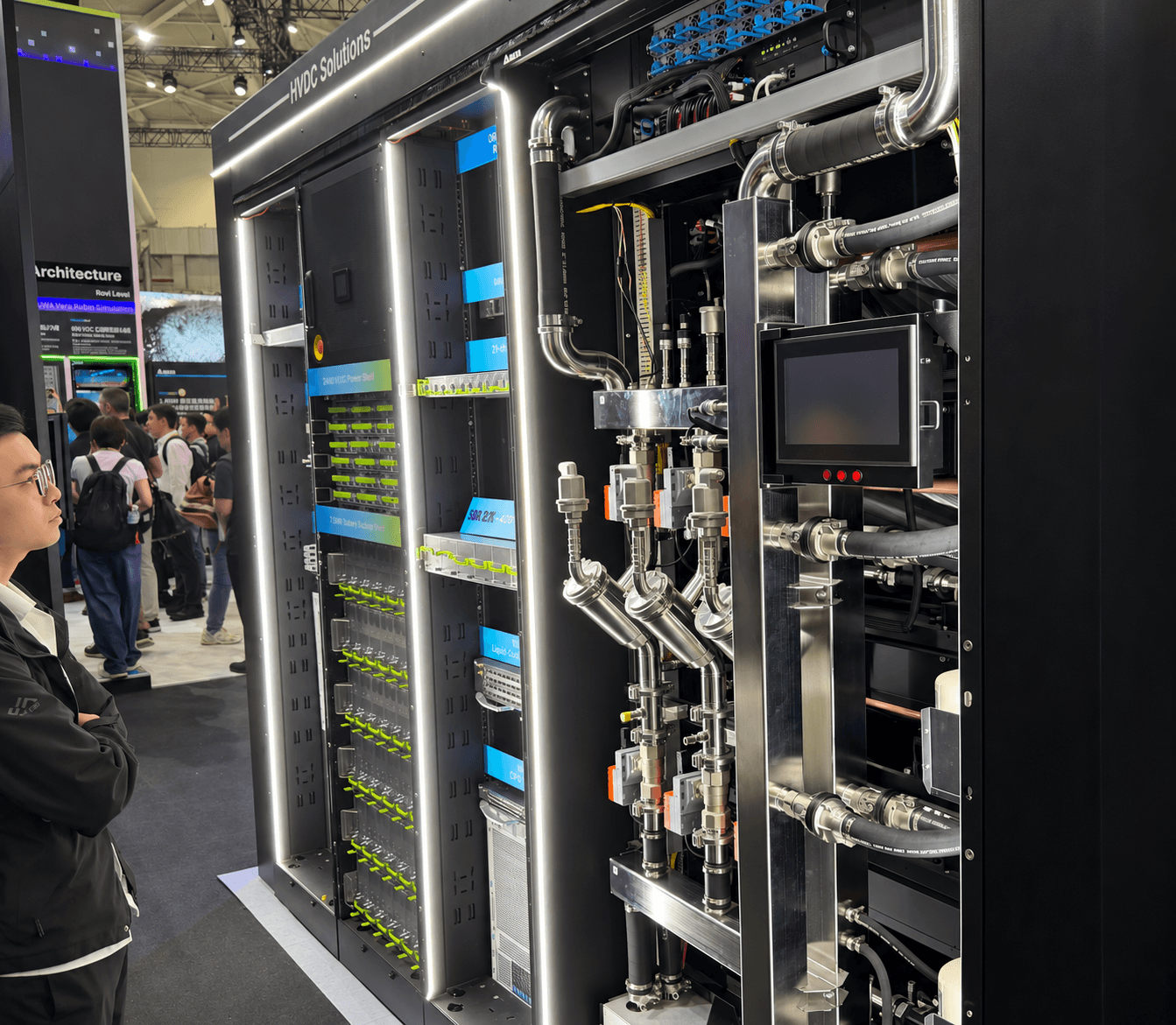
Its work with Nvidia shows the approach. At October's Open Compute Project summit, Delta presented an 800-volt direct-current power rack for Vera Rubin NVL72 and other Nvidia MGX systems that delivers 660 kilowatts, with 480 kilowatts of backup power. Higher-voltage distribution reduces the current needed to deliver a given amount of power, which limits electrical losses and the amount of copper required.
Delta also showed equipment that converts medium-voltage alternating current directly into 800-volt direct current, followed by converters that step the voltage down for server equipment. The aim is to simplify the path from a data center's electricity supply to its computing racks.
On cooling, Delta's exhibits included a coolant distribution unit that can transfer up to 2.5 megawatts of heat and a cold plate designed for Vera Rubin NVL72. Cold plates absorb heat next to the processors, while distribution units manage the coolant circuit and pass the heat to the facility's cooling system. Delta supplies both parts of that loop.
The company is also looking at where the electricity comes from. Chairman Ping Cheng said in October that Delta plans to begin producing solid oxide fuel cells in 2027, starting with customer qualification. These systems generate electricity electrochemically from fuel and could support on-site power generation where grid capacity limits data-center construction.
AI demand lifted third-quarter 2026 revenue to a record NT$197.06 billion (about US$6.03 billion), up 31.1% from a year earlier. Net profit rose about 26% to NT$23.5 billion (US$719 million), with earnings per share of NT$9.04. Gross margin fell to 34.1% from 35.6% in the previous quarter. Delta attributed the inventory provisions behind that drop to order adjustments, changing specifications, delayed components, and mismatched supplies. It expects fourth-quarter revenue to exceed the third quarter's as that inventory moves into shipments. Outside AI, its automation business returned to quarterly profit, while mobility remained loss-making.
Delta has said 2026 capital expenditure could approach NT$70 billion (US$2.14 billion), supporting expansion in Taiwan, Thailand, China, and the United States. It has also approved a new production base in Penang, Malaysia, where it plans to build substantial capacity over several years.