



Pegatron's AI server push lifts sales as new customers fuel expansion
Pegatron's investment in AI servers is beginning to reshape a business long associated with smartphones, PCs, and game consoles. The Taiwan contract manufacturer reported third-quarter revenue growth of 50.9% from a year earlier, supported by rising server shipments and the seasonal increase in smartphone production. Management expects servers to contribute about 10% of annual revenue in 2026 and server sales to rise to several times their current level in 2027.
The company’s server business has already moved past its initial production ramp. Shipments of Nvidia GB300 racks increased from September, alongside general-purpose and storage servers. Co-chief executive Kuang-Chih Cheng said Pegatron is pursuing a balanced portfolio spanning Nvidia systems and servers built around customers' own custom AI processors, known as application-specific integrated circuits (ASICs). The company has four to five ASIC customers and expects substantial shipments in 2027, when it also hopes to secure meaningful revenue from additional major cloud operators.
Building both Nvidia and ASIC systems gives Pegatron several routes into AI infrastructure spending. Its customers include specialist computing providers as well as large cloud companies. A previously announced collaboration with Together AI and AI infrastructure provider 5C covers liquid-cooled Nvidia GB300 and HGX B200 rack deployments in US data centers. Such projects require Pegatron to integrate processors, networking, power, and cooling into systems ready for installation.
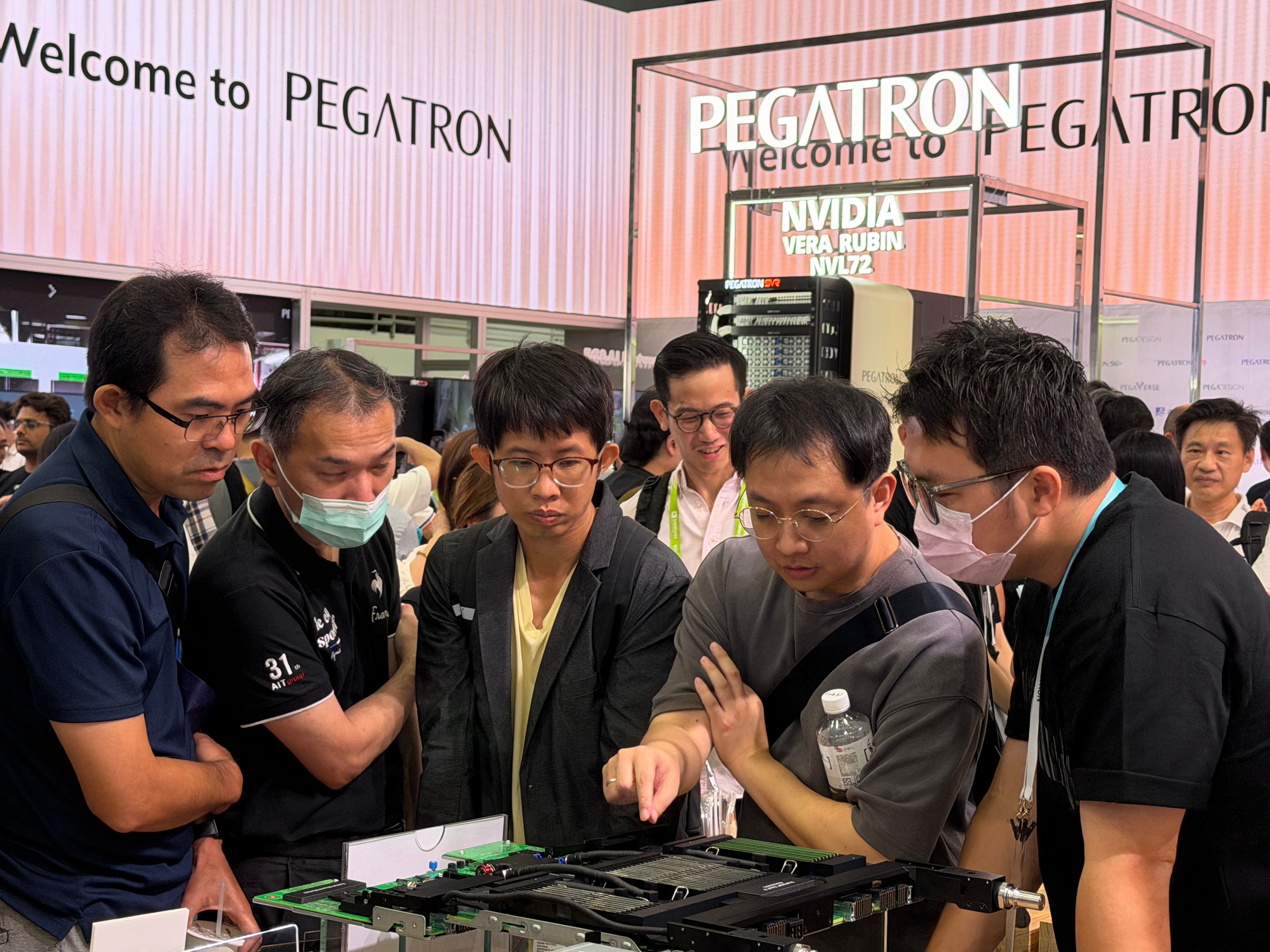
Pegatron is also preparing for subsequent platforms. Its October Open Compute Project summit presentation featured a liquid-cooled Vera Rubin NVL72 rack combining 72 Rubin GPUs and 36 Vera CPUs. Its portfolio extends to smaller accelerated systems and computing and storage equipment, allowing the company to supply different parts of a customer's data center buildout.
Meeting expected demand requires further investment. Pegatron plans to expand facilities, equipment, and research staffing in Taiwan and North America during the fourth quarter and early 2027. Management highlighted the substantial cost of liquid-cooling laboratories and production equipment. Pegatron is also developing automotive electronics and battery-backup products, and is targeting first-half 2027 shipments for new augmented- and virtual-reality products.
The server business is already lifting earnings. Third-quarter revenue reached NT$389.07 billion (approximately US$11.86 billion), up 41.8% from the previous quarter. Operating profit rose 149.7% year on year to NT$8.04 billion (US$245 million), with operating margin increasing to 2.1% from 1.2%. Gross margin improved to 4.5%, though net profit attributable to shareholders fell 12.5% to NT$3.98 billion (US$121 million), reflecting investment valuation losses and higher interest expenses.
Management expects shipments of AI, general-purpose, and storage servers to keep rising through the rest of 2026. Pegatron's larger ambition is for servers to overtake its traditional computing and consumer electronics businesses. Production for Nvidia systems and four to five ASIC customers would give it a broader and more reliable source of earnings than smartphones, PCs, and game consoles.