


The island inside every AI data center
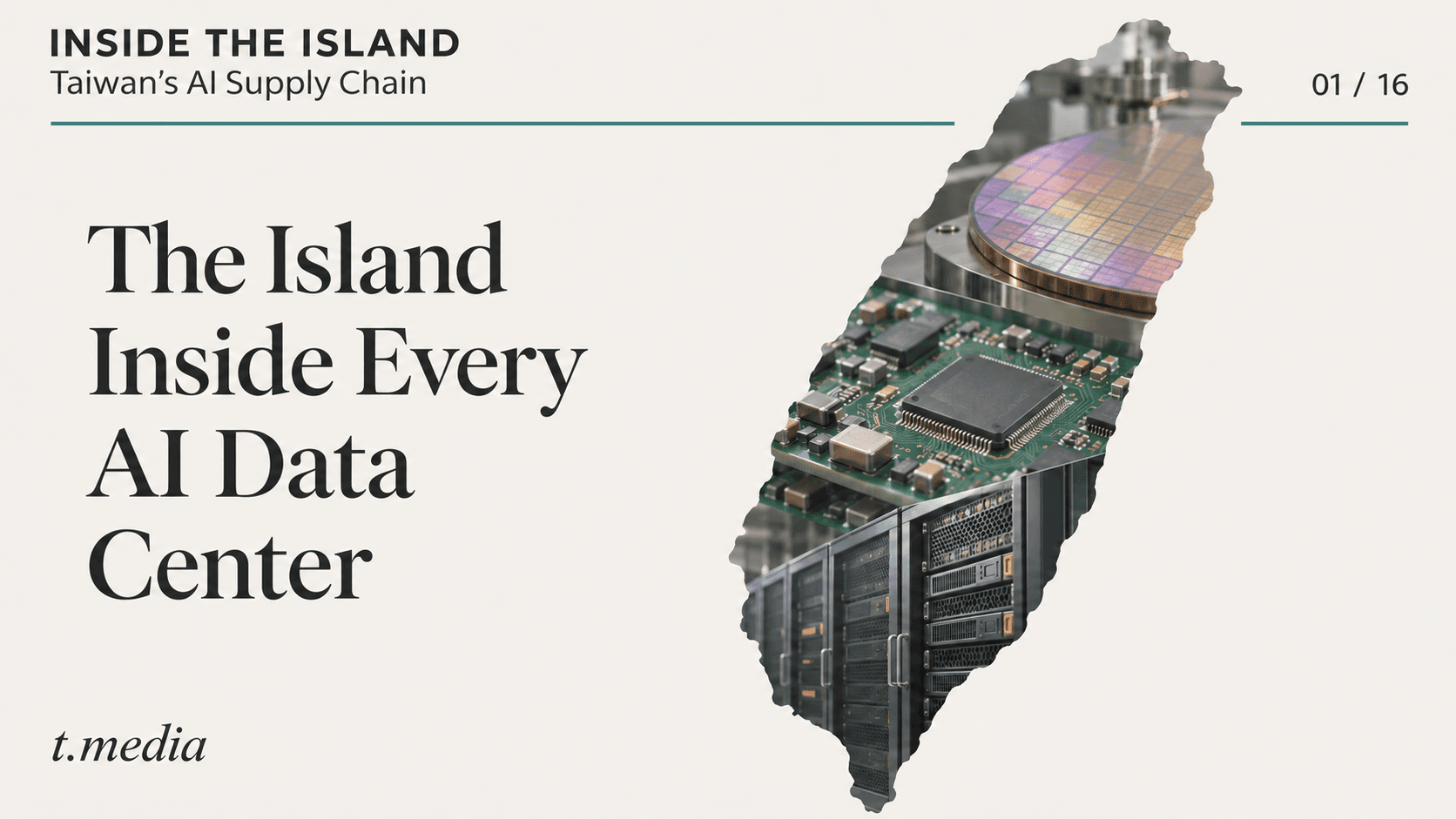
An AI rack can contain the world’s most advanced processors and still be delayed by a connector. The chips need power, cooling, and thousands of dependable connections before they can perform a single useful calculation. Taiwan’s importance to the AI boom lies in its ability to supply and integrate that entire chain.
Nvidia’s Vera Rubin NVL72 illustrates the scale of the task. It connects 72 GPUs and 36 CPUs in a rack containing approximately 1.3 million components by Nvidia’s count. Bringing those parts together requires a manufacturing network that extends from semiconductor factories to companies making circuit boards, cables, and precision metalwork. Taiwan’s manufacturers occupy critical positions throughout it.
Start with the rack itself. Foxconn, Quanta, and Wistron integrate servers, networking, power, and cooling, then test the assembled systems before shipment. King Slide makes the rails that support heavy server trays and allow technicians to withdraw them safely. Delta Electronics and Lite-On build the power equipment, while Asia Vital Components and Auras produce cooling components that carry liquid coolant across each chip.
Beneath those processors lies another chain of specialists. Gold Circuit Electronics makes the multilayer boards used in servers. Elite Material supplies the laminate sheets from which such boards are pressed on, reinforced by specialist glass cloth from companies including Taiwan Glass and Fulltech. Unimicron and Kinsus make substrates, the densely wired bases that connect processors to circuit boards.
TSMC fabricates processors for Nvidia, AMD, and other customers and combines them with high-bandwidth memory through CoWoS packaging. ASE and its subsidiary SPIL provide further packaging and testing, while KYEC tests finished chips before they go into a server.
Nvidia Chief Executive Jensen Huang put numbers on this reach at GTC Taipei on June 1, when he said 150 of Vera Rubin’s supply chain partners are based in Taiwan and operate more than 350 factories in 30 countries. A Taiwan Semiconductor Industry Association forum on October 29 heard that more than 80 percent of an AI rack’s supply chain can be completed on the island. The largest gap is the high-bandwidth memory itself, which no Taiwan company makes.
At that forum Lipen Yuan, TSMC’s vice president of business development, said a single passive component, connector, or thermal module can keep a rack from entering volume production. Suppliers increasingly have to develop and validate their products together, rather than wait for the processor design to be finished.
That coordination took shape in Taiwan’s PC industry. Acer built an international computer brand, while Asus, Gigabyte and MSI grew from motherboards and graphics cards into complete systems. Foxconn, Quanta, and Wistron manufactured PCs for brands around the world. Their engineers had to make processors, memory, boards, and power supplies from different vendors work together. Notebooks forced them to fit those components into thinner enclosures without overheating, and servers added the requirement of reliability under continuous operation.
AI racks bring those disciplines together at a much larger scale. Much of the engineering and supplier development remains concentrated in Taiwan, even as its companies assemble systems in Mexico, the United States, and elsewhere. Nearby suppliers can investigate a fault, revise a component and test the result without coordinating every step across continents. That matters when new platforms arrive annually and production must ramp within months.
The scale shows in Taiwan’s economic statistics. The semiconductor association expects Taiwan’s industry output to reach approximately NT$9.19 trillion (approximately US$277 billion) in 2026, more than 40% above the previous year. That figure covers chip design, manufacturing, packaging, and testing but leaves out servers and components. The Ministry of Economic Affairs counted a record US$123.82 billion of export orders in October, up 78.3 percent, and Huang Wei-chieh, director of its statistics department, said the full-year figure will pass US$1.1 trillion.
Customers are committing money to ensure that capacity arrives in time. Nvidia’s November supplier announcement included more than US$1 billion in funding for Kinsus, whose Nvidia-dedicated substrate capacity is scheduled to exceed 3.5 times its existing level by the third quarter of 2028. A separate multiyear agreement provides multibillion-dollar funding for SPIL’s advanced packaging expansion, with additional contracted capacity due by mid-2029.
These agreements turn product forecasts into factory investment. Substrates and packaging capacity must be secured years before the finished racks reach customers, so Nvidia is helping finance the facilities needed to manufacture its future systems.
The pressure is also spreading to industries outside AI. In November, the Global Electronics Association warned that shortages across the circuit-board supply chain were threatening automotive, medical, defense and aerospace production, and it expects little relief to until at least mid-2028. AI buyers are competing for materials and factory capacity used by many other products.
Wherever an AI data center is built, much of the expertise inside it comes from Taiwan. Its chipmakers, packaging specialists, component suppliers, and server manufacturers must meet the same demanding production schedule, even as each generation becomes harder to build. Cloud companies can commit billions to computing capacity, but that investment produces no computing power until the hardware is assembled, tested, and installed. That is the island inside the data center, a manufacturing network that turns advanced chip designs into working AI systems.