



President Lai chides opposition, seeks defense budget deal
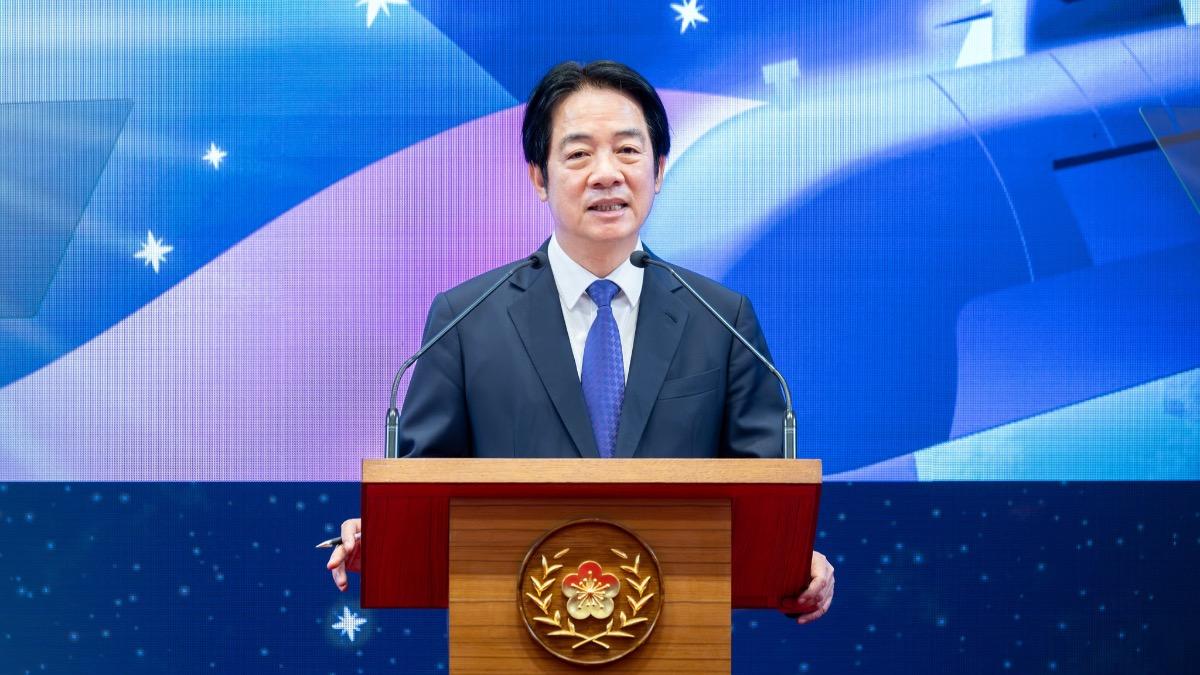
TAIPEI (TVBS News) — Taiwan has "no time for internal strife," President Lai Ching-te (賴清德) warned Thursday (Jan. 1), accusing opposition legislators of blocking a critical US$40 billion (NT$1.25 trillion) defense budget as China's 2027 invasion timeline looms.
"Facing China's alarming military ambitions, Taiwan has no time to wait and certainly no time to consume ourselves with internal strife," Lai said during his New Year's Day address. "We may hold different views on many issues, but without strong and resilient national defense, there will be no country, nor will there be space allowed for us to debate."
Lai delivered his remarks, titled "Resilient Island, Light of Hope" (韌性之島,希望之光), from the Presidential Office (總統府) grand hall following a flag-raising ceremony. Vice President Hsiao Bi-khim (蕭美琴) and Presidential Office Secretary-General Pan Meng-an (潘孟安) attended. The speech came amid an ongoing impeachment effort by opposition parties, which Lai dismissed as a "waste of time."
The president accused the Kuomintang (KMT, 國民黨) and Taiwan People's Party (TPP, 民眾黨) caucuses of neglecting constitutional duties by failing to review the central government budget for over three months. Taiwan's cabinet, the Executive Yuan (行政院), submitted the budget in late August. Legislators have instead prioritized what Lai called "unconstitutional legislation." The delay has stalled funding for government operations and defense programs.
"Over the past year, many bills promoting the well-being of our nation and people have faced serious delays due to political obstruction, while multiple constitutionally questionable bills were forced through the legislature," Lai said. Opposition parties, which control the Legislative Yuan (立法院), Taiwan's parliament, rejected the accusations and defended their budget review process as a constitutional duty.
Lai emphasized the urgency of passing the eight-year special defense budget, citing recent Chinese military exercises targeting Taiwan's newly acquired weapons systems as simulated adversaries. International analysts, including U.S. military officials, have assessed China may be prepared to invade Taiwan by 2027. The U.S. State Department on Dec. 18 approved a massive arms deal that includes HIMARS, howitzer equipment, drones, and software — the largest-ever arms sale to Taiwan.
"We must prepare for the worst while making the best preparations," Lai said, quoting Sun Tzu's "The Art of War" (孫子兵法). He warned continued obstruction may cause international allies to question Taiwan's defense commitment. "This should be a national consensus across party lines," he added. "I hope the ruling and opposition parties can work together to swiftly pass this crucial national defense budget."
The budget standoff unfolds alongside a separate political crisis. The legislature recently passed an impeachment motion against Lai, 60-51. Opposition legislators have scheduled hearings for Jan. 21-22 and set May 19 for the final vote. Lai noted the opposition lacks the two-thirds majority constitutionally required for removal.
Lai denied wrongdoing, stating he has "not taken bribes or engaged in any illegal activities" since taking office. He offered to deliver a state-of-the-nation address if it would resolve partisan gridlock. "As president, I will take action to promote cooperation between the ruling and opposition parties," Lai said. "I am willing to deliver a state of the nation address to the Legislative Yuan in accordance with constitutional methods."
The president also sought to frame the domestic dispute in international terms, criticizing opposition legislators for "making excuses for China" while the international community condemned Beijing's military provocations. The United States, Japan, the United Kingdom and European Union have expressed support for Taiwan and cross-strait stability. "This shows us that Taiwan is not just indispensable, but also a trustworthy, responsible force for good in the international community," Lai said.
Lai pledged to implement his "Four Pillars of Peace Action Plan" (和平四大支柱行動方案) in 2026, strengthening asymmetric warfare capabilities through drones, unmanned vessels and underwater vehicles. Asymmetric strategies aim to deter a larger adversary through unconventional means rather than matching conventional forces. The government launched 17 anti-infiltration national security strategies and is accelerating amendments to 10 national security laws.
"In the face of these threats, the international community is paying attention to whether the Taiwanese people possess the resolve for self-defense," Lai said. "As president, my position has always been clear: to staunchly defend national sovereignty, strengthen national defense, and enhance whole-of-society defense and resilience."
The next test comes in late January, when opposition legislators convene impeachment hearings. In the meantime, the defense budget remains in limbo and the 2027 timeline continues its advance. As Taiwan marks 30 years of direct presidential elections, Lai offered citizens a stark choice: "Democracy gives us the right to debate and the right to disagree. But without a nation, freedoms and rights like these would not exist." The debate continues. The clock does not stop. ◼ (At time of reporting, US$1 equals approximately NT$31.3)