


Taiwan pledges US$9.5B for chip design as SEMICON opens
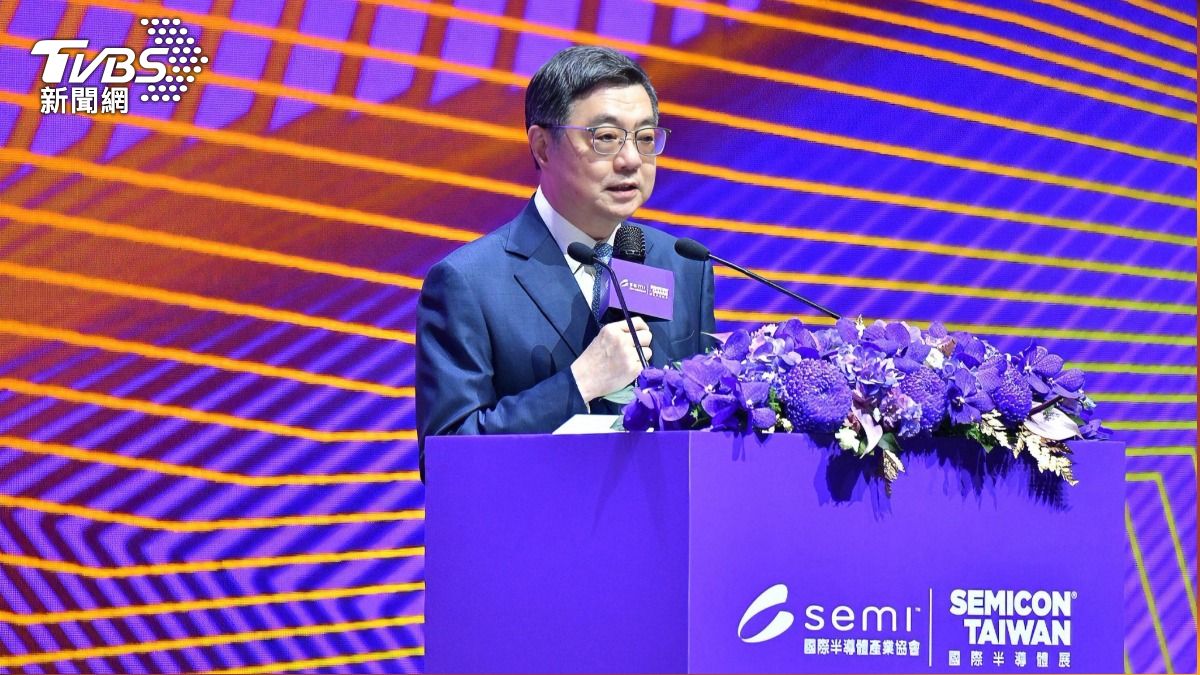
TAIPEI (TVBS News) — Taiwan will invest NT$300 billion (around US$9.5 billion) in chip design through 2033, Premier Cho Jung-tai (卓榮泰) announced Wednesday (Sept. 2) at the opening of SEMICON Taiwan 2026, as industry leaders declared the global semiconductor market has reached US$1.5 trillion and Taiwan's output is surging more than 40% to nearly US$300 billion this year.
SEMICON Taiwan, Asia's largest semiconductor trade show organized by the global industry association SEMI, drew executives and diplomats from 60 countries to the Taipei Nangang Exhibition Center. Speaking with an impassioned tone, Cho compared the gathering to a legendary martial arts contest from Chinese literature. "We are here in Taiwan to discuss the future of human civilization and hope," he said.
The government's "Chip Innovation Taiwan" (晶創台灣) program, administered by the National Science and Technology Council, will support next-generation chip design, silicon photonics, quantum computing and autonomous vehicle technologies. The exhibition drew a record 18 countries to its Global Pavilion — up from 62 booths in 2023 to 220 this year, according to SEMI — with 4,300 booths and more than 1,300 exhibiting companies.
"Surprisingly, we will reach US$1.5 trillion this year — four years ahead of schedule," said Chih-I Wu (吳志毅), president of the Taiwan Semiconductor Industry Association. Taiwan's semiconductor revenue hit US$209 billion last year and is projected to approach US$300 billion in 2026, Wu said.
SEMI President and CEO Ajit Manocha said the industry could reach US$2 trillion by 2030, driven by AI demand. Manocha revealed that President Lai Ching-te (賴清德) personally assured him a day earlier that Taiwan would face no power supply constraints through 2035, as the industry grapples with energy demands from 93 new fabs planned worldwide over the next five years.
Cho pledged that the government would pre-build factory infrastructure so companies could begin operations immediately. "We will prepare the Eastern Wind first, then invite companies to come, so we won't be lacking only the Eastern Wind," he said. The phrase alludes to the Romance of the Three Kingdoms, a classical Chinese novel in which strategist Zhuge Liang (諸葛亮) fire attack strategy required only the "Eastern Wind" to succeed — signaling Taiwan would have land, energy, financing and workforce ready for investors.
"Many domestic companies, supply chain firms and international corporations are coming to Taiwan, hoping we can provide more land, more stable energy, more financial support, and more talent," Cho added.
The premier also announced NT$40.6 billion (around US$1.3 billion) for the "AI New Era Construction" initiative to guide domestic industries in integrating AI technologies, and NT$25 billion (around US$789 million) for small and medium enterprise transformation.
American Institute in Taiwan Director Raymond Greene emphasized shared values underpinning the U.S.-Taiwan chip partnership. "All of us striving to ensure that the technologies that will define the future reflect the values of democracy, freedom, and the rule of law that both the U.S. and Taiwan hold dear," Greene said.
SEMI forecasts global semiconductor manufacturing equipment sales to rise 23.2% to US$165.9 billion in 2026. The exhibition runs through Friday. ◼ (At time of reporting, US$1 equals approximately NT$31.69)