



Taiwan’s substrate suppliers gain a larger role in AI infrastructure
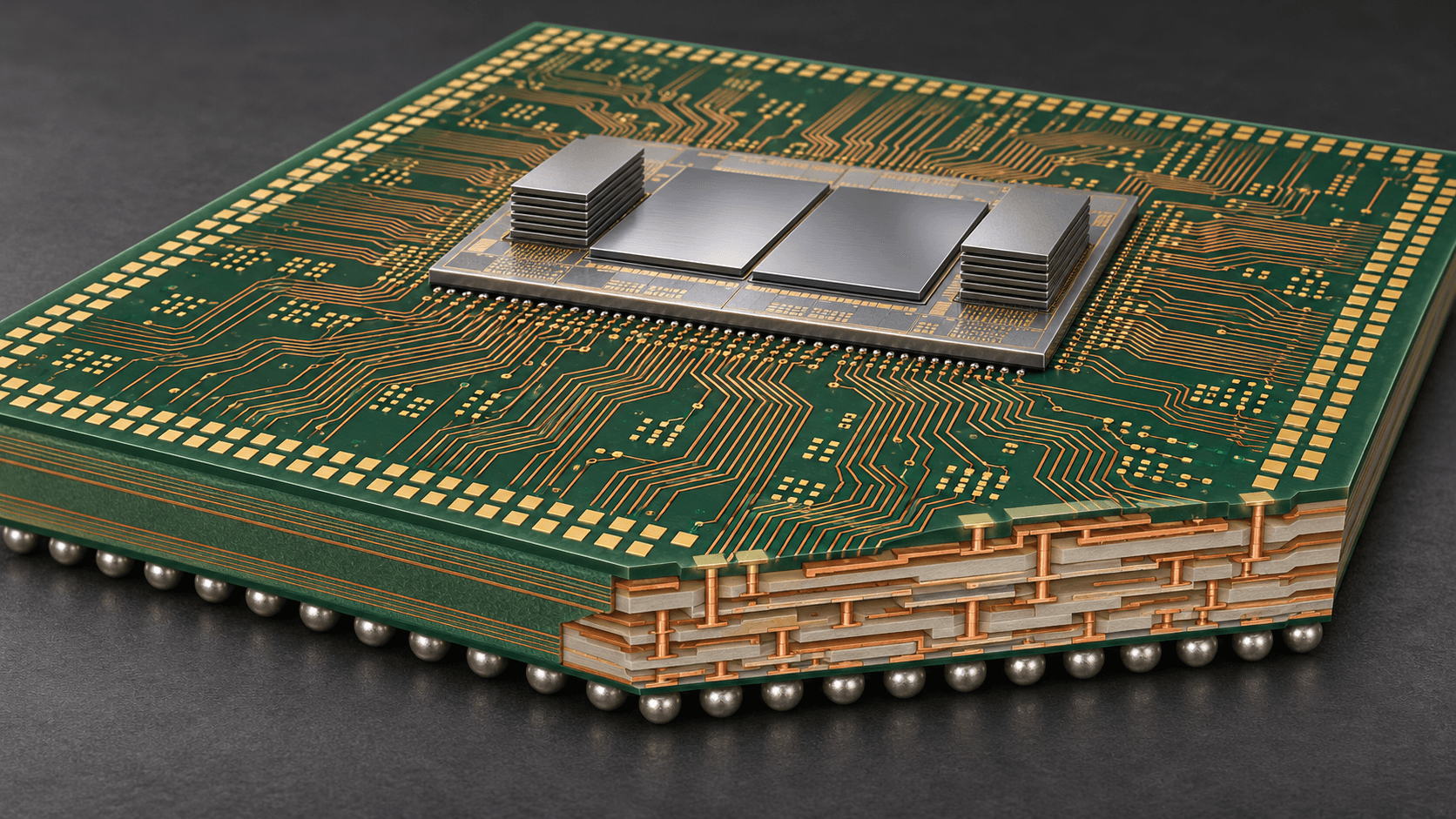
Nvidia is securing substrate capacity years before it needs the finished products. Its agreements with Taiwan’s suppliers reflect a growing constraint in AI manufacturing. Every additional processor needs one of the finely wired bases that connect its package to server circuit boards. Unimicron, Kinsus, and Nan Ya PCB are investing to meet that demand as more complex products lift their sales and margins.
A substrate provides mechanical support, distributes power, and carries signals between a chip package and the circuit board beneath it. In advanced AI packages, processors and high-bandwidth memory are connected through an interposer or other dense wiring structures. The substrate sits below and connects that assembly to the rest of the system.
Taiwan’s three main suppliers manufacture ABF substrates, named after the Ajinomoto Build-up Film used to insulate successive wiring layers. Building those layers requires repeatedly depositing insulation, forming tiny holes, and creating copper connections. Each layer must align precisely with the others.
AI makes the process harder. Packages containing multiple processing chips and memory stacks need larger substrates with more connections and wiring layers. Larger products take up more manufacturing space, and the additional processing steps lengthen production time and raise the risk of defects. The finished substrate must also stay flat, because warping can break the connections assembled above and below it.
Unimicron's third-quarter results show how much AI demand is lifting its business. Third-quarter 2026 revenue reached NT$52.65 billion (approximately US$1.61 billion), up 54.9 percent from a year earlier. Net profit rose to NT$10.05 billion (US$306 million), and gross margin reached 28.85 percent. Its business includes both substrates and conventional printed circuit boards, though advanced substrates are central to its AI expansion.
Kinsus has secured a large customer commitment. Under its November agreement with Nvidia, it plans to raise Nvidia-dedicated advanced substrate capacity at its Youth campus in Taoyuan to more than 3.5 times current levels. Production is expected to begin in the second half of 2027, with additional capacity targeted for the third quarter of 2028. Kinsus reported third-quarter net profit of NT$2.39 billion (US$73 million), with gross margin of 33.9 percent. Nvidia also named Unimicron among the partners supporting its manufacturing expansion. The improvement extends to the third producer. Nan Ya PCB’s quarterly revenue rose 49.3 percent to NT$16.38 billion (US$499 million).
Growth prospects reach beyond Nvidia. Cloud companies’ custom AI processors and faster networking chips require advanced substrates as well. Each new design is an opening for suppliers able to meet its electrical, thermal, and dimensional requirements.
Customer commitments help justify expensive factories and equipment, but turning investment into usable capacity takes time. Materials must be secured, processes qualified, and yields raised to commercial levels.
That timetable is why Nvidia is reserving output years ahead. Taiwan’s suppliers gain twice, from rising chip volumes and from the additional manufacturing work required for each package. The next generation of AI processors will reach the market no faster than qualified substrates are ready to carry them.
US$ conversions use an illustrative exchange rate of NT$32.8 per US$1.